
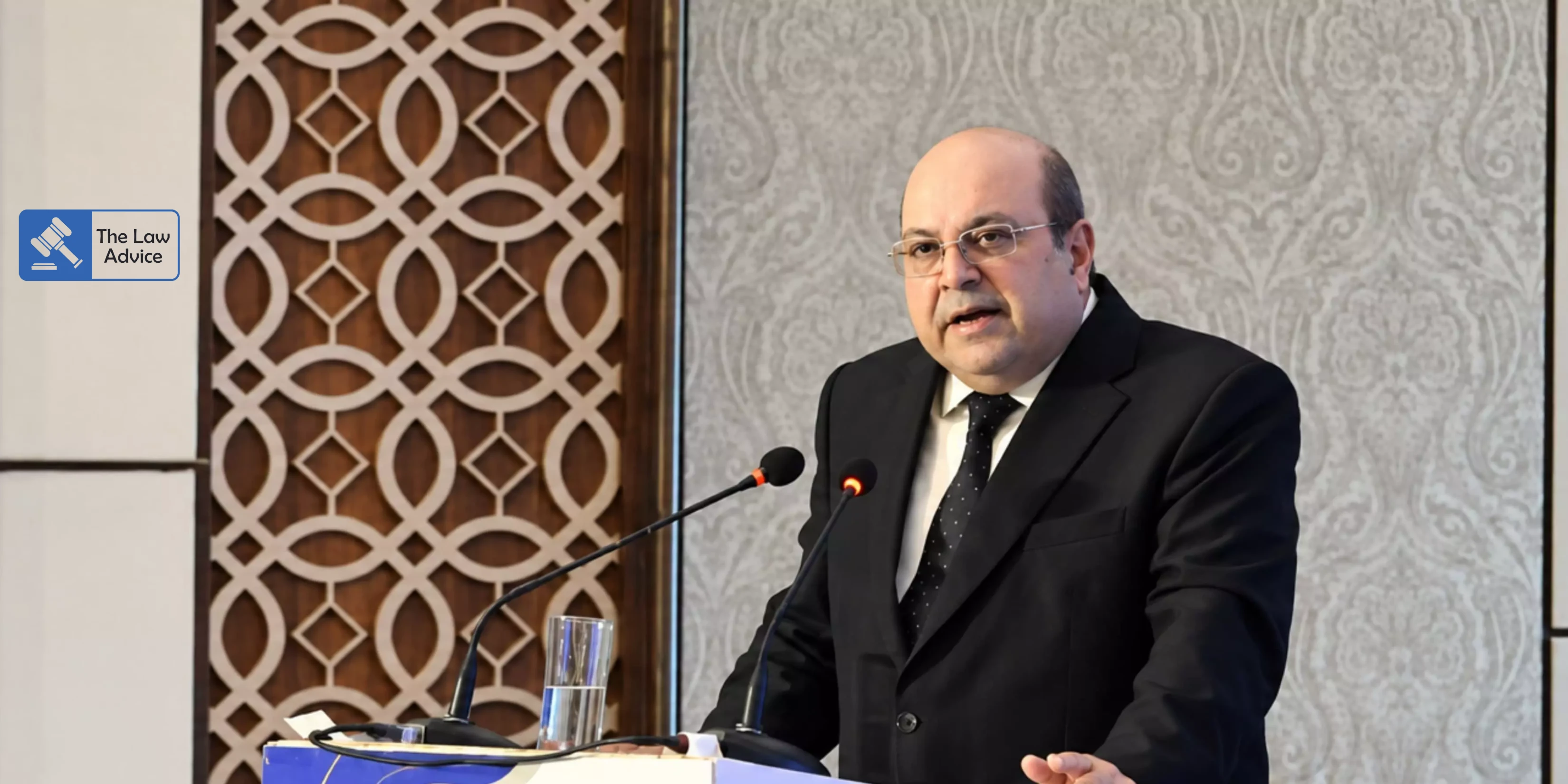
Former Supreme Court Judge Justice Rohinton F. Nariman has strongly criticised several recent Constitution Bench rulings on arbitration, stating that some judgments have reopened settled questions and created “grave uncertainty” in Indian arbitration law.
Justice Nariman was delivering the keynote address at the Gujarat High Court Arbitration Centre’s Arbitration Week 2026, where he examined five recent Constitution Bench decisions dealing with the appointment of arbitrators, unstamped arbitration agreements, interference with arbitral awards and modification of awards.
Justice Nariman observed that the Arbitration and Conciliation Act, 1996 had not fared particularly well in light of recent judicial developments.
“Here we have five recent judgments of the Supreme Court. How has the Act fared? According to me, not particularly well, because, firstly, the judgments don’t conduce to certainty.”
He added that repeatedly reopening questions that had already been settled was resulting in “grave uncertainty”, and submitted that some of the judgments were “on the face of them not correct.”
Justice Nariman first discussed the five-judge Constitution Bench decision in Cox and Kings, which dealt with the application of the “group of companies” doctrine and the circumstances in which a non-signatory could be bound by an arbitration agreement.
He contrasted the reasoning in Cox and Kings with the subsequent seven-judge ruling concerning unstamped arbitration agreements, which described the Arbitration Act as a self-contained code and a special enactment.
According to Justice Nariman, this approach was difficult to reconcile with Cox and Kings, where the Contract Act had been considered fundamental to determining the existence of an arbitration agreement.
He also questioned the reopening of the earlier five-judge decision in NN Global by a seven-judge Bench.
“Unfortunately, what was made certain by 5 judges was made uncertain,” he observed, adding that it remained uncertain whether the issue could eventually be reconsidered by an even larger Bench.
Justice Nariman also criticised the Supreme Court’s curative decision concerning the Delhi Metro Rail Corporation–Delhi Airport Metro Express Private Limited (DAMEPL) dispute.
The Supreme Court had interfered with the arbitral award after finding that the earlier judgment upholding the award had resulted in a miscarriage of justice.
Justice Nariman questioned the extent of judicial interference, particularly where the issue involved appreciation of facts that had already been considered by the arbitral tribunal.
He pointed out that the tribunal had examined whether Delhi Metro Rail Corporation had cured the defects and whether effective steps had been taken.
Referring to the reliance placed on a safety certificate, Justice Nariman said:
“Now, that’s another big leap, because a certificate by itself can show nothing; that again is something for the appreciation of the arbitrator.”
He expressed concern that the judgment could open the door to challenges to arbitral awards on factual grounds even at the curative stage.
“We have a major problem now with this case, because all arbitral awards now have this chance of hopefully being interfered with on fact at the fag end in a curative petition if, finally, the court’s conscience, so to speak, is shocked.”
Justice Nariman next addressed the Constitution Bench judgment in Gayatri Balasamy v. ISG Novasoft Technologies Limited, in which the majority recognised a limited power of courts to modify arbitral awards under Section 34 of the Arbitration and Conciliation Act.
He observed that the judgment did not expressly overrule NHAI v. M. Hakeem, which had held that courts exercising jurisdiction under Section 34 could set aside an award but could not modify it.
Instead, according to Justice Nariman, the ruling effectively “tweaked” the earlier precedent.
He argued that Section 33 of the Arbitration Act gives the arbitrator the power to correct an award, whereas Section 34 permits the court to set aside an award wholly or partly.
“The whole thing is one big jamboree. I don’t understand how the law gets furthered by having this kind of a judgment which, again, doesn’t conduce to either clarity or to any real forward advance in the law.”
Justice Nariman also said that Justice K.V. Viswanathan's dissent in Gayatri Balasamy was “clearly right”.
Justice Nariman also discussed the Constitution Bench ruling in Central Organisation for Railway Electrification, concerning arbitration clauses that allowed one party, particularly the government, to have control over the appointment of arbitrators.
While agreeing with the conclusion that such clauses violate the principle of equal treatment of parties, he questioned the majority's reliance on Section 18 of the Arbitration Act.
He pointed out that Section 18 concerns equal treatment during the arbitral process and does not specifically govern the appointment stage.
“Strictly speaking, 18 won’t apply, because 18 is equal treatment to be given to parties after the arbitral process begins, not before. This is the appointment stage.”
Against the backdrop of these judgments, Justice Nariman proposed a significant restructuring of the mechanism for judicial review of domestic arbitral awards.
He suggested that there should be a full-fledged appeal on both facts and law at one stage after 30 years of operation of the Arbitration Act.
“My suggestion now is that the time has come, after 30 years of working of this Act, to have a full-blown appeal on both facts and law at one stage.”
According to the proposal, such an appeal should lie directly before a Division Bench of a High Court, eliminating the existing single-judge stage. The Division Bench should, he suggested, dispose of the appeal within one year.
Justice Nariman argued that the present system could allow arbitral awards containing errors of fact or law to survive judicial scrutiny.
“You can’t have a system in which a wrong award, let’s put it that way, wrong on facts, wrong in law, still passes muster.”
He said arbitral awards should be “as accurate as a trial court judgment” if confidence in the arbitration system is to be restored.
Justice Nariman also proposed reforms concerning arbitrators' fees.
He suggested that arbitrators' fees should be fixed as a lump sum at the beginning of the proceedings, with the amount deposited into an escrow account.
The fees, according to his proposal, should be released only after the arbitral award is pronounced.
The former Supreme Court judge's remarks come amid continuing judicial debate over the balance between finality of arbitral awards, limited judicial intervention and the need to correct erroneous awards, highlighting concerns over certainty and predictability in India's arbitration regime.
Website designed, developed and maintained by webexy