
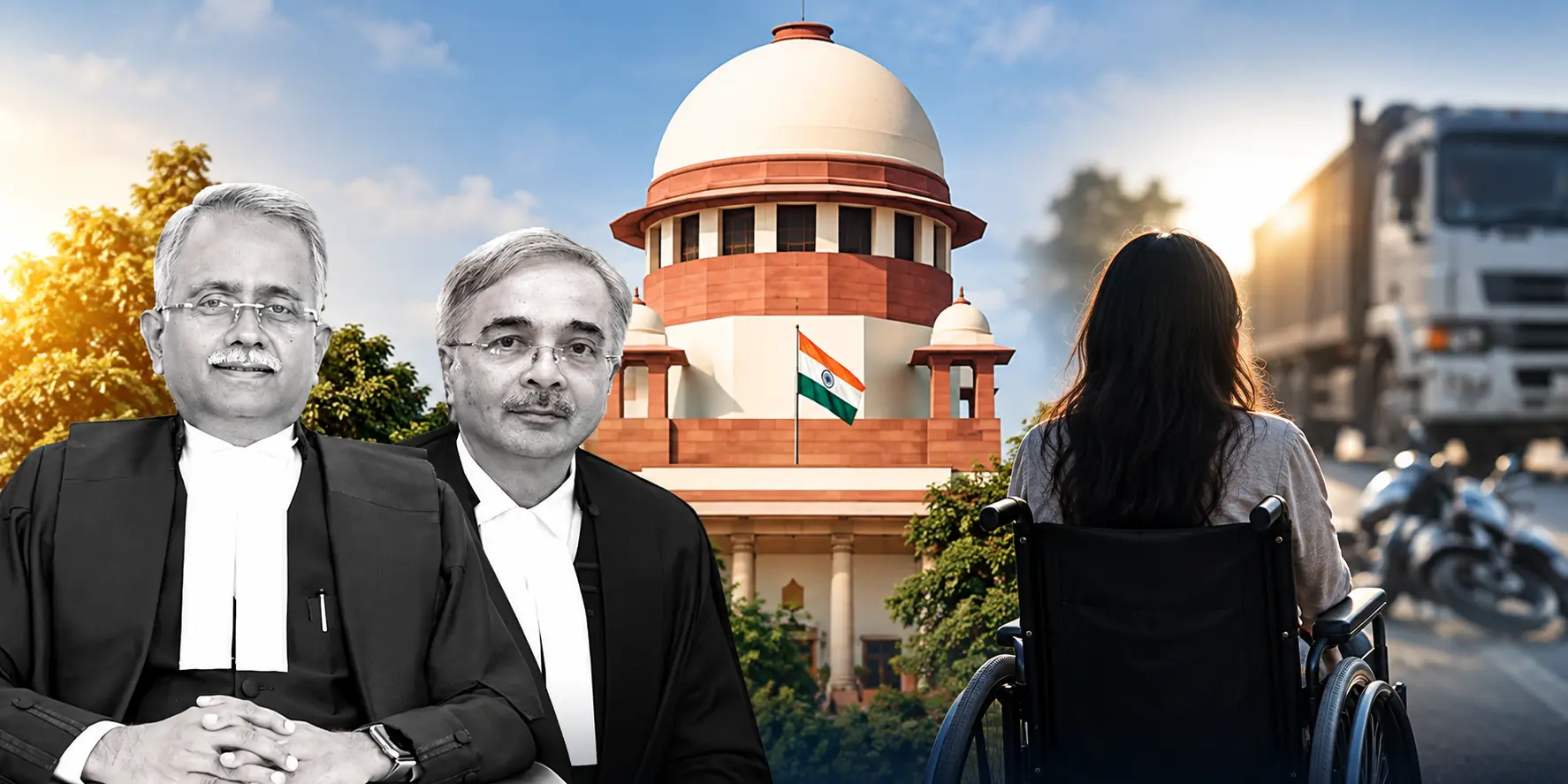
The Supreme Court has enhanced compensation payable to an accident victim from ₹2.94 crore to ₹3,77,84,297, holding that her continued employment could not negate the severe impact of her disabilities on her earning capacity and career prospects.
A Bench of Justice S.V.N. Bhatti and Justice N.V. Anjaria passed the judgment on September 3, 2026, in a batch of appeals arising from a 2011 motor accident involving Priyanka Das.
The accident occurred on April 10, 2011, when a truck hit the motorcycle on which Priyanka Das was travelling as a pillion rider. The motorcycle rider, Sushant Prabhakaran, died on the spot, while Das suffered grievous injuries.
She was initially treated at Anand Hospital, Meerut, and subsequently underwent extensive treatment at Fortis Hospital and Kailash Hospital in Noida, including pelvic reconstruction and rectal/colostomy surgeries.
An AIIMS assessment had certified 100% visual disability, while medical evidence established that attempts to restore the continuity of her large intestine had failed, leaving her dependent on a permanent stoma for life.
At the time of the accident, Das was working as a Deputy Group Manager with IBM Daksh in Gurugram.
The Motor Accident Claims Tribunal had assessed her functional disability at 60%, primarily because she continued to remain employed and her CTC increased from ₹16 lakh to ₹19 lakh per annum after the accident.
It awarded ₹1,35,53,298 as compensation.
The Punjab and Haryana High Court subsequently increased the functional disability assessment to 80%, awarded 50% towards future prospects and enhanced the total compensation to ₹2,94,82,617.
During the Supreme Court proceedings, a Medical Board constituted at Vardhman Mahavir Medical College & Safdarjung Hospital re-examined Das pursuant to the Court's direction.
The Board concluded that she suffered 100% permanent physical impairment of the whole body. The Court also considered the evidence establishing complete visual disability and the permanent stoma.
The Court rejected the insurer's argument that continued employment meant that Das had not suffered corresponding loss of earning capacity.
It observed that functional disability has to be assessed by considering a person's earning capacity in the open and competitive market, rather than merely looking at whether the person continues in a particular accommodated job.
The Court noted that Das could continue working only because of specially created software, flexible working hours and extensive accommodations provided by her employer. The evidence also showed that she had lost normal career progression and opportunities for advancement following the accident.
The Supreme Court therefore revised the assessment from 80% to 100% functional disability, holding that her capacity to independently secure, sustain or advance employment in the open labour market had been entirely extinguished.
Based on a monthly income of ₹84,057, 50% future prospects and a multiplier of 16, the Court calculated the loss of future earning capacity at ₹2,42,08,416.
The Court awarded:
₹2,42,08,416 – Loss of future earning capacity
₹35,48,798 – Medical expenses
₹28,80,000 – Attendant charges for three attendants and 24×7 care
₹15,97,083 – Loss of income during treatment
₹15,00,000 – Future medical expenses
₹15,00,000 – Pain, suffering and mental agony
₹20,00,000 – Loss of marriage prospects
₹2,00,000 – Special diet
₹2,00,000 – Loss of amenities and disfiguration
₹1,50,000 – Transportation charges
The total compensation was thus fixed at ₹3,77,84,297, with interest at 7.5% per annum from the date of filing of the claim petition until realization.
The Supreme Court specifically clarified that the award of ₹20 lakh for loss of marriage prospects was based on the peculiar facts and circumstances of the case and “shall not be treated as a precedent.”
The appeals filed by Reliance General Insurance Company were dismissed, while the claimant's appeal seeking enhancement was partly allowed.
Case: Reliance General Insurance Company Limited v. Priyanka Das & Ors.
Citation: 2026 INSC 950
Bench: Justice S.V.N. Bhatti and Justice N.V. Anjaria
Date: September 3, 2026.
Website designed, developed and maintained by webexy