
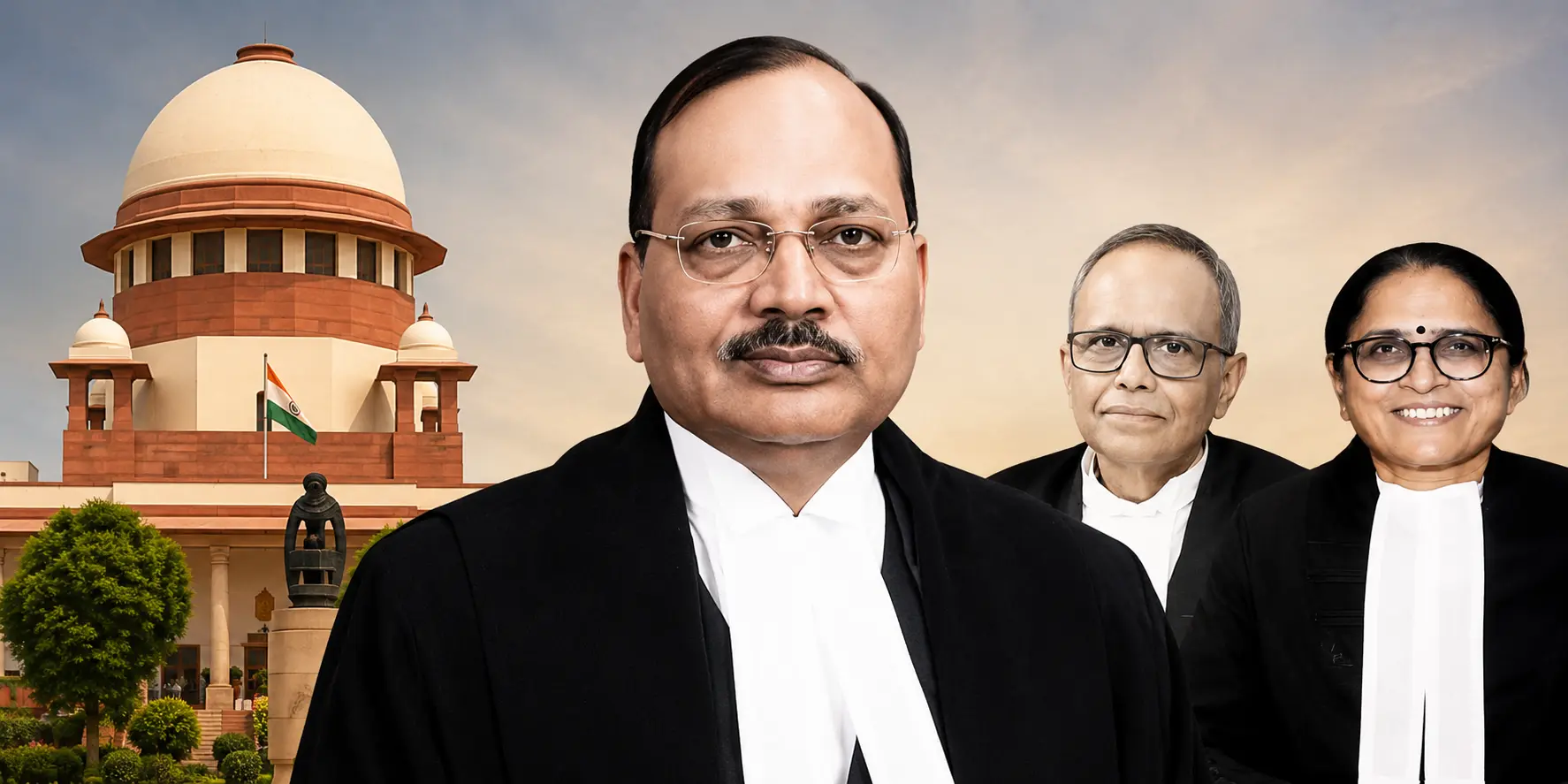
The Supreme Court has directed seven States—Chhattisgarh, Karnataka, Madhya Pradesh, Maharashtra, Sikkim, Tamil Nadu and West Bengal—to enhance the retirement age of judicial officers from 60 to 62 years, after the respective State governments consented to the proposal in All India Judges Association v. Union of India.
A Bench comprising Chief Justice of India Surya Kant and Justices Joymalya Bagchi and V. Mohana directed the States to amend their service rules at the earliest, preferably within two months.
The enhancement, however, will be subject to a suitability and performance assessment by the concerned High Court when a judicial officer reaches the age of 60.
The Supreme Court directed that, until the necessary amendments are made, judicial officers in these seven States who have already attained 60 years shall not superannuate before attaining 62 years, subject to assessment of their suitability and performance by the concerned High Court.
The Court stated:
“The States which have consented to the enhancement of age of the Judicial Officers, namely, Chhattisgarh, Karnataka, Madhya Pradesh, Maharashtra, Sikkim, Tamil Nadu, West Bengal, are directed to amend the service rules and enhance the age of superannuation in the judicial service to 62 years…”
The amendments have been directed to be carried out as early as possible, preferably within two months.
The Court has also provided relief to judicial officers from these seven States who retired on or after March 31, 2026.
Such officers may exercise an option to rejoin judicial service, provided they have not subsequently taken up employment or been appointed to any other office of profit under the Union or State government.
Those opting to return will be entitled to consequential benefits relating to pay, seniority and continuity of service, subject to suitability and performance assessment by the High Court.
However, they will have to surrender any post-retirement benefits already granted to them.
The Supreme Court also dealt with States and Union Territories that have either refused to enhance the retirement age or are still considering the proposal.
The Court directed such States and UTs to reconsider their position or take an appropriate decision on raising the retirement age from 60 to 62 years within two weeks and file compliance reports.
The Court emphasised the need to retain experienced judicial officers and address the persistent gap between the sanctioned strength and working strength of the district judiciary.
“The crying need of the hour is to ensure that the attrition of the experienced judicial talent be arrested so that the gap between the sanctioned and the working strength in the judicial service is reduced, and access to justice does not remain a mere chimera due to unfilled posts.”
The Court rejected the argument that raising the retirement age of judicial officers could trigger similar demands from other government employees.
It held that the judicial service is distinct from other State services, and therefore enhancement of the retirement age of judicial officers cannot automatically create a claim of parity for other employees.
“The enhancement of the age of superannuation of judicial officers cannot be permitted to have a cascading effect on the principle of parity claimed by other employees.”
The Bench also rejected concerns regarding the additional financial burden on State governments.
It noted that extending the service period could actually defer post-retirement liabilities and reduce expenditure associated with recruiting and training new judicial officers to replace those retiring at 60.
The Bench highlighted the continuing shortage of judicial officers across the country and observed that recruitment of competent and independent members of the judiciary remains an arduous exercise.
Several recruitment exercises, the Court noted, have failed to fill sanctioned posts optimally.
The Court therefore considered retention of experienced judicial officers an important means of reducing the gap between sanctioned and working strength and strengthening the administration of justice.
At the same time, the Bench welcomed the proposal for suitability and performance assessment at the age of 60, observing that such a mechanism would allow experienced officers to be retained while preventing unsuitable officers from continuing in service.
The Supreme Court noted that the retirement age of judicial officers was last enhanced in 1992, and more than three decades have passed since then.
During this period, the sanctioned strength of judicial services in most States has increased, while a substantial number of posts have remained vacant due to the non-availability of eligible candidates.
The Court emphasised that competent judicial officers are essential for preserving an independent judiciary, which forms part of the basic structure of the Constitution.
The directions were issued after the Court had, on August 5, sought responses from High Courts, State governments and Union Territory administrations on the proposal to increase the retirement age of district judges from 60 to 62.
After examining the responses, the Court found that while most High Courts supported the proposal, State governments had taken differing positions, citing financial implications and concerns regarding the aspirations of younger entrants into the judicial service.
The matter has now been listed for October 1, 2026 for further consideration.

Website designed, developed and maintained by webexy