
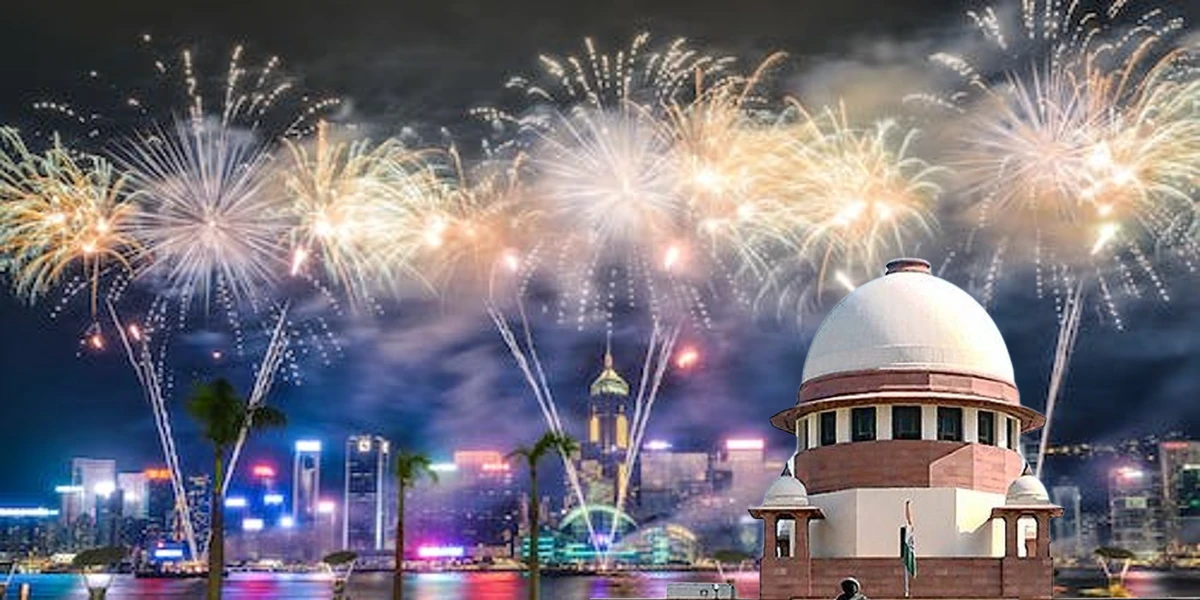
Today, the Supreme Court held that it would adopt a balanced approach to the use of firecrackers during the upcoming Diwali season, saying it would neither impose a total ban nor permit firecrackers to be burst throughout the day.
A Bench of Justices M.M. Sundresh and Prasanna B. Varale said the Court would consider allowing permissible firecrackers during specified hours, keeping in mind both the sentiments associated with Diwali and the impact of firecracker use on air quality and vulnerable groups.
“We will make it very clear. Neither we are going to agree with you for total ban. Nor are we going to allow them to do it for 24 hours,” the Court said.
The Bench observed that a complete ban could affect the sentiments of people celebrating Diwali, while unrestricted use could have a significant impact on “every other living being”, including the elderly, sick persons and children.
The Court said it would determine specified timings for bursting firecrackers after receiving a report from the Central Pollution Control Board (CPCB) on the types of firecrackers that could be permitted.
The proceedings arise from a 2015 case in which the Supreme Court has passed several orders restricting the use of firecrackers in Delhi and other northern states during periods when air pollution levels remain a concern.
During earlier hearings in July and August, the Court had asked the CPCB to examine whether restrictions could be relaxed for certain categories of firecrackers.
Additional Solicitor General Aishwarya Bhati sought time until October 15 to place the CPCB's response on the use of barium-based firecrackers before the Court. She said outdoor testing of such firecrackers was yet to be conducted.
The ASG also suggested that joint firecrackers, commonly known as “larri”, could be permitted subject to certain conditions. These consist of individual firecrackers connected by a single fuse and designed to burst consecutively.
The Court indicated that it was inclined to accept the suggestion concerning joint firecrackers and recorded that it was “inclined to accept” the submissions made during the hearing.
The Bench also considered concerns regarding the combined impact of Diwali celebrations and crop burning on Delhi's air quality during the coming months.
The Court made it clear that it would not permit unrestricted use of firecrackers but would examine whether their use could be allowed during specified time slots during the festival season.
Senior Advocate K. Parameshwar, appearing for certain firecracker manufacturers, urged the Court to adopt a uniform approach rather than treating Delhi separately. He submitted that climatic conditions could be considered while modifying the restrictions but referred to the need to reconcile the proceedings in the present case with the pending M.C. Mehta and Arjun Gopal matters.
The Court granted the CPCB time to submit its report on the impact of barium-based firecrackers.
It also noted that some issues in the present proceedings overlap with those pending in another matter. The Bench observed that it would be appropriate for both matters to be heard together by a common Bench and permitted the parties to mention the issue before the appropriate Bench.
The Court directed that other applications, including those seeking a ban on firecrackers, may also be taken up for hearing.
Website designed, developed and maintained by webexy