
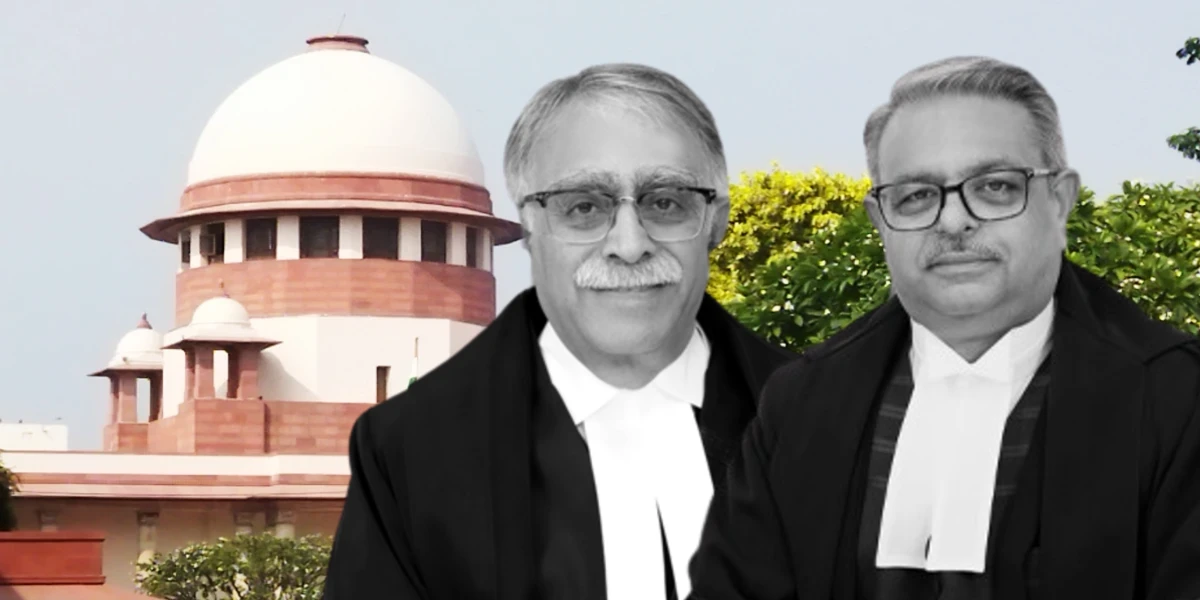
The Supreme Court has acquitted a man who was convicted of murdering his wife and young son, holding that the prosecution failed to establish a complete and reliable chain of circumstances proving his guilt beyond reasonable doubt.
A Bench comprising Justice Sanjay Karol and Justice Augustine George Masih allowed the appeal filed by Ravi Kumar Singh Malhotra and set aside the Madhya Pradesh High Court judgment that had convicted him under Sections 302 and 201 of the IPC and sentenced him to life imprisonment and two years of rigorous imprisonment, respectively.
The case arose from the deaths of Sushma and her young son in September 1989. The prosecution alleged that Malhotra, who had been living separately from Sushma and their two sons, took them on a trip from Kanpur to Khajuraho and subsequently murdered the woman and one of the children. Another young son, aged around four-and-a-half years, survived and became the prosecution's principal eyewitness.
The trial court had originally acquitted Malhotra, finding the child's testimony unreliable and noting contradictions as well as the absence of sufficient corroborative evidence. The High Court, however, reversed the acquittal and convicted him, principally relying on the child's testimony, his alleged abscondence and the explanation offered by him under Section 313 CrPC.
Supreme Court Questions Reliability of Child Witness
The Supreme Court stressed that although a child is a competent witness, his evidence must be evaluated with particular caution because of the possibility of tutoring. The Court noted that there is no absolute rule that a child witness's testimony must always be corroborated, but corroboration ordinarily operates as a rule of prudence.
The Court found significant reasons for doubting the testimony of PW-28. He was only about four-and-a-half years old when the incident occurred, his evidence was recorded nearly four years later, and he had lived with a police constable. Importantly, the child himself stated that the police had made him read a statement before appearing in court and instructed him to give the same statement before the Magistrate.
The Court also noted that portions of the child's account regarding an alleged attempt to strangle him and throw acid on him were contradicted by medical evidence.
'Suspicion Cannot Be a Substitute for Proof'
The Bench emphasized the settled principle applicable to cases based on circumstantial evidence: every incriminating circumstance must be established through reliable evidence and the circumstances must form a complete chain pointing only towards the guilt of the accused.
Relying on established precedent, the Court reiterated that "suspicion, however grave it may be, cannot be a substitute for a proof." Where a missing link exists in the chain of circumstances, a finding of guilt cannot be sustained.
No Forensic Link Between Accused and Crime
The Supreme Court found that there was no medical or scientific evidence connecting Malhotra to the crime. The bodies were in an advanced stage of decomposition, preventing the doctors from giving a definite opinion regarding the cause of death. The chemical examination of the bloodstained soil was also inconclusive.
The Court further found that the clothes and bottle allegedly recovered at the appellant's instance were not scientifically linked either to the deceased or to the accused. The recovery was also made around six months after the bodies had been discovered. The absence of expected mud, water or earth residue on articles allegedly buried deep underground further raised doubts about the recovery, and the possibility of planting could not be ruled out.
Last Seen Theory and Motive Also Not Established
The Court held that the prosecution failed to establish the last seen theory. Witnesses did not identify Malhotra as the person who left with Sushma and the children. One witness specifically stated that the person sitting in the car with Sushma was not the appellant and that Malhotra had not visited the area for several months.
The prosecution also failed to establish a motive. Evidence indicated that the relationship between Malhotra and Sushma was amicable and that they had resolved their differences while living separately.
The Court also noted that the investigating agency failed to trace or examine the driver who, according to the child's version, could have been a material witness to the incident. The failure to trace the car and its driver created another significant gap in the prosecution case.
Unexplained FIR Delay Weighed Against Prosecution
Another significant factor was the delay in registration of the FIR. The surviving child had been brought to the police station on September 26, 1989, and the prosecution claimed that the accused's identity was disclosed to the investigating officer by September 29. Yet the FIR was registered only on October 1.
The Supreme Court held that the unexplained delay, despite the alleged identification of the accused before registration of the FIR, seriously undermined the credibility of the prosecution case and raised the possibility of embellishment during investigation.
High Court Judgment Set Aside; Accused Acquitted
Concluding that the prosecution had failed to produce cogent evidence leading to the sole conclusion that the appellant was guilty, the Supreme Court held that the conviction could not be sustained.
The Court accordingly allowed the appeal, set aside the Madhya Pradesh High Court's judgment dated October 9, 2012, and acquitted Ravi Kumar Singh Malhotra of the charges. His bail bonds were also discharged.
Case Title: Ravi Kumar Singh Malhotra v. State of Madhya Pradesh
Case No.: Criminal Appeal No. 937 of 2014
Citation: 2026 INSC 899

Representation:-
For Appellant(s) : Ms. Vibha Datta Makhija, Sr. Adv. Mr. Raj Kishor Choudhary, AOR Mr. Harsh Sethi, Adv. Mr. Aditya Wadhwa, Adv. Mr. Arunav Sharma, Adv. Ms. Priyanka Kashayap, Adv. Mr. Girish Tripathi, Adv. Ms. Rohini Narayanan, Adv. Mr. Vineet Jindal, Adv. Ms. Gulfeshan Javed, Adv. Mr. Vikram Patralekh, Adv. Mr. Sukhpreet Maan, Adv.
For Respondent(s) : Mr. D. S. Parmar, A.A.G. Ms. Mrinal Gopal Elker, AOR Mr. Abhimanyu Singh, Adv. Mr. Saurbah Singh, Adv.
Website designed, developed and maintained by webexy