
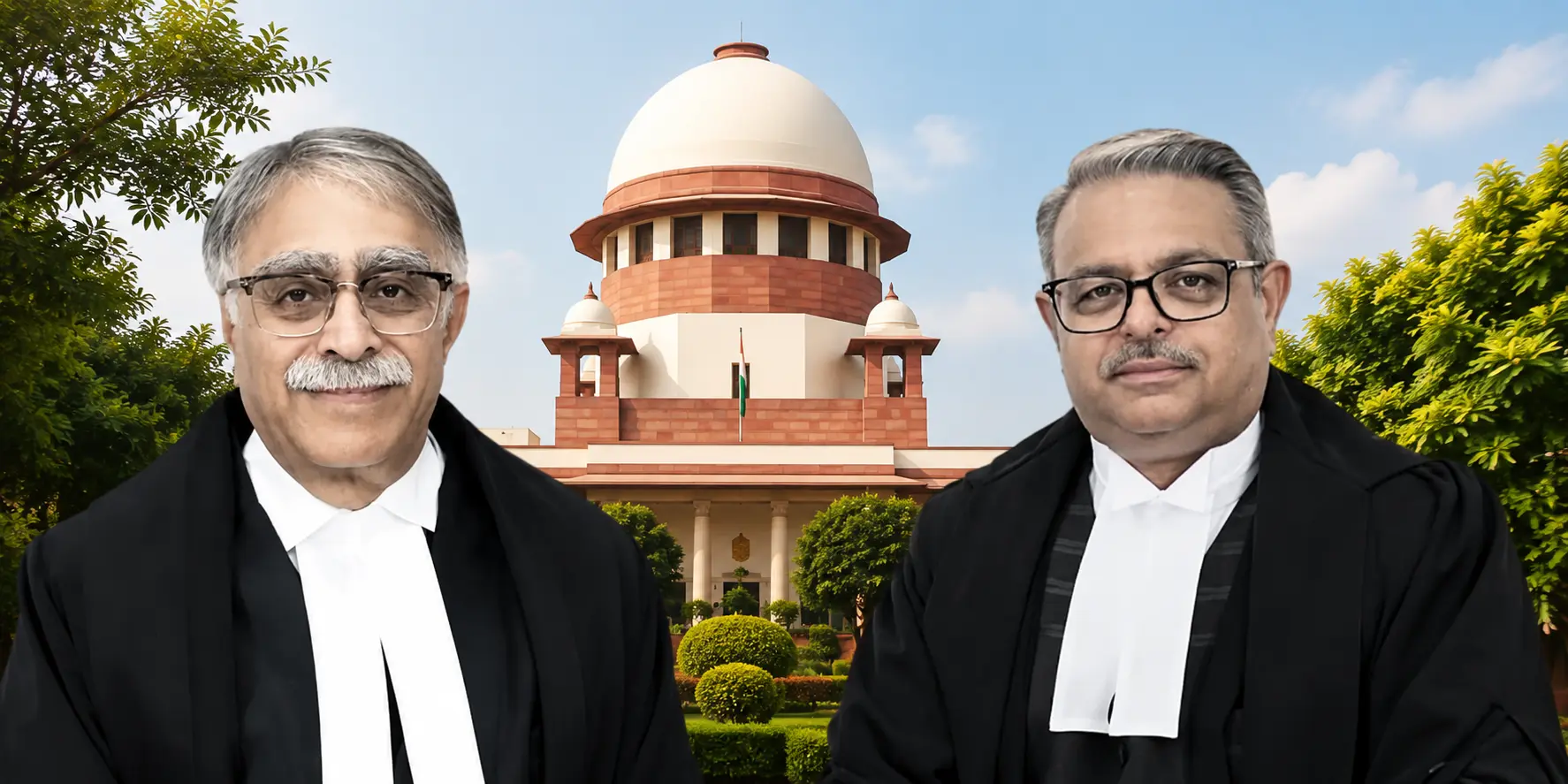
The Supreme Court has set aside a Madhya Pradesh High Court judgment concerning a dispute over 12.41 acres of agricultural land in Indore, holding that a revenue mutation entry by itself cannot extinguish a person's proprietary rights in immovable property.
A Bench comprising Justice Sanjay Karol and Justice Augustine George Masih allowed the appeal filed by Jamnabai and others in Jamnabai & Ors. v. Vasudev & Ors., reported as 2026 INSC 900, and restored the concurrent findings of the trial court and first appellate court in favour of the appellants.
The dispute concerned agricultural land bearing Survey No. 307, measuring approximately 12.41 acres, situated at Village Kanadia, Tehsil and District Indore, along with a house standing on the property.
The property originally belonged to Bhagwansingh, who had two sons, Ramprasad and Vasudev. After Bhagwansingh's death, the property devolved upon both brothers and revenue mutation was effected in their joint names.
The appellants claimed that Ramprasad continued to hold an equal proprietary interest in the property. They alleged that their requests for partition were repeatedly deferred by Vasudev.
The dispute came to light after a public notice dated January 26, 2008, published in Dainik Bhaskar, indicated that Vasudev had entered into an agreement to sell part of the property. On January 30, 2008, the appellants obtained certified revenue records and discovered that Ramprasad's name had been removed from the records. They instituted a suit on February 13, 2008, seeking declaration of co-ownership, partition, separate possession and permanent injunction.
The respondents claimed that Ramprasad had voluntarily relinquished his interest in the property in 1990.
They relied upon an affidavit and statement allegedly given before the Naib Tehsildar, which resulted in a mutation order dated April 24, 1990, as well as a written consent letter dated June 17, 1990. According to the respondents, these documents established that Ramprasad had knowingly given up his share.
The trial court, however, found the alleged relinquishment unsupported and held that Ramprasad's proprietary interest had not been legally extinguished. It also found the alleged consent document vague and held that the appellants were entitled to a one-tenth share each, subject to lawful partition by the competent Revenue Court.
The first appellate court affirmed the trial court's findings after examining additional revenue records and witnesses.
The Madhya Pradesh High Court, exercising jurisdiction under Section 100 CPC, reversed the concurrent findings of the two courts below and dismissed the suit.
The High Court held that the consent reflected in the alleged relinquishment document had been established and that the mutation had remained unchallenged for around 18 years. It therefore concluded that the suit was barred by limitation and by the proviso to Section 34 of the Specific Relief Act, 1963.
The Supreme Court emphasized that the jurisdiction of a High Court under Section 100 CPC is restricted to substantial questions of law.
It held that concurrent findings of fact ordinarily cannot be disturbed in a second appeal unless they are perverse or affected by an error of law. A High Court cannot reappreciate the evidence merely because it prefers another possible inference.
The Bench concluded that the High Court had exceeded the permissible limits of its jurisdiction by reassessing the same evidence and reaching a different factual conclusion.
One of the key findings of the judgment concerned the legal effect of mutation entries.
The Supreme Court reiterated that an entry in revenue records neither creates nor extinguishes title. Revenue entries are essentially maintained for fiscal purposes. A mutation order cannot, merely by replacing one person's name with another's, operate as a conveyance or relinquishment of proprietary rights.
The Court further held that the burden of proving an alleged relinquishment of an interest in immovable property rests on the party asserting it. A person cannot be treated as having voluntarily abandoned property rights merely because a subsequent revenue entry appears in somebody else's favour. The underlying transaction surrendering the title must independently be established.
The Court found several deficiencies in the respondents' evidence.
The alleged consent document, Ex.D5, was found to be vague, did not clearly identify the property and was not a registered instrument. No independent witness had been produced to prove its execution, while the evidence regarding the document was inconsistent.
The Court also noted that the signatures attributed to Ramprasad on several revenue documents had been disputed and no independent witness was produced to establish their execution.
The Supreme Court rejected the High Court's conclusion that the suit was barred by limitation merely because the mutation took place in 1990.
The Court held that the starting point of limitation cannot be determined simply by identifying the date of a revenue entry. What matters is when the right to sue actually accrued. In a co-ownership situation, possession by one co-owner is ordinarily treated as possession on behalf of all, and mere exclusive possession does not establish ouster.
The Court accepted that the appellants' case was that they discovered the alleged mutation only after the January 26, 2008 public notice and obtained certified copies on January 30, 2008.
The Supreme Court also rejected the High Court's view that the suit was barred under Section 34 of the Specific Relief Act because the appellants had not specifically sought cancellation of the mutation order.
The Court pointed out that the appellants had not sought a bare declaration. They had sought co-ownership, partition, possession and permanent injunction. A declaration of title is distinct from cancellation of a revenue mutation entry.
The Supreme Court ultimately held that the High Court's judgment could not be sustained.
It set aside the Madhya Pradesh High Court judgment dated May 9, 2025 and restored the first appellate court's judgment dated May 2, 2019, which had affirmed the trial court decree dated May 4, 2016.
The appellants and other legal heirs of late Ramprasad were held entitled to the shares declared in their favour, subject to lawful partition under the applicable provisions of the Madhya Pradesh Land Revenue Code. The respondents were also restrained from alienating the disputed property or creating third-party rights contrary to the decree until lawful partition takes place.
Case Title: Jamnabai & Ors. v. Vasudev & Ors.
Citation: 2026 INSC 900
Case Number: Civil Appeal No. 11173 of 2026

Representation:-
For Petitioner(s) :Mr. Padmesh Mishra, Adv. Mr. Vinod Sharma, Adv. Mr. Yashwardhan Rai, Adv. Mr. Vijant, Adv. Mr. Aayushmaan Vatsyayana, AOR
For Respondent(s) :Ms. Deeplaxmi Subhash Matwankar, AOR Mr. Vinay Navare, Sr. Adv. Ms. Deeplaxmi S Matwankar, Adv. Ms. Manreet Kaur, Adv. Mr. Amit Gurnani, Adv. Ms. Manshi Jain, Adv. Mr. Yatharth Kansal, AOR Mr. Rudraditya Khare, D.A.G. Mr. Harmeet Singh Ruprah, AOR Mr. Surjeet Singh GA, Adv. Mr. Sai Shashank, Adv.
Website designed, developed and maintained by webexy