
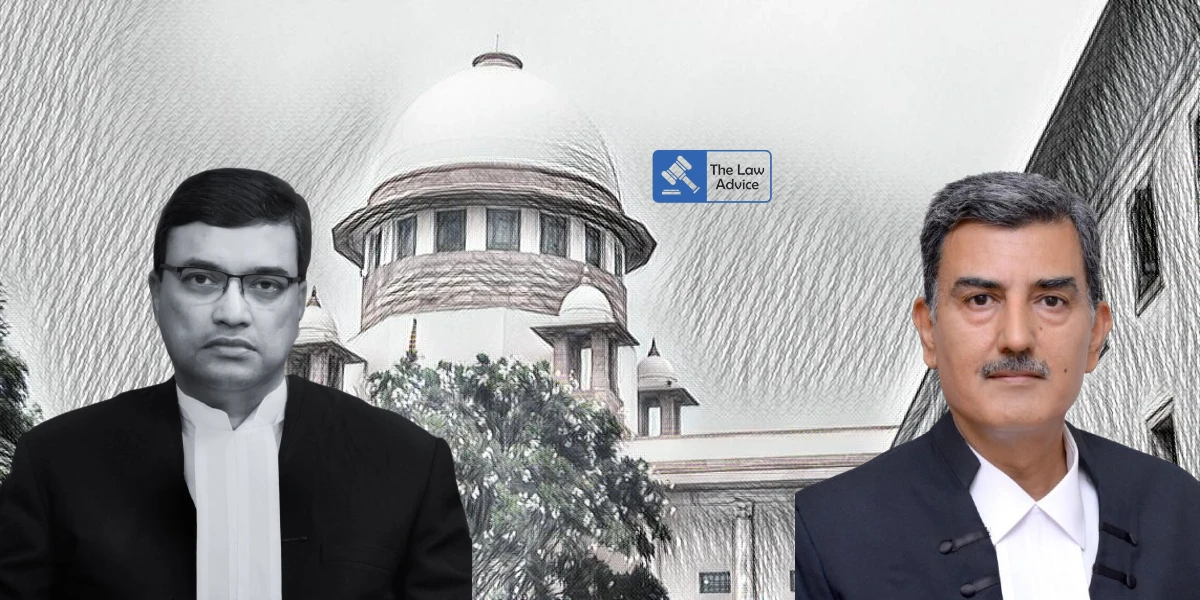
The Supreme Court has held that a public employee cannot be discharged from service merely because a criminal case is pending against him, in the absence of legal authority permitting such termination. Invoking its powers under Article 142 of the Constitution, the Court directed the State authorities to pay ₹5 lakh compensation to a former Punjab Police employee who was discharged solely on the ground that a criminal case was pending against him.
A Bench comprising Justice Dipankar Datta and Justice Sheel Nagu delivered the judgment in SPO/Constable IRB Satpal Singh v. State of Punjab & Ors., Civil Appeal No. 9749 of 2016, reported as 2026 INSC 798.
Appellant Discharged While Criminal Case Was Pending
Satpal Singh had been appointed as a Special Police Officer in Police District Batala in 1991. In 2002, he was selected for appointment as a Constable in the First Indian Reserve Battalion (IRB), Patiala. Although he reported for joining, he was not permitted to join because a criminal case was pending against him.
The criminal case arose from FIR No. 159 of 2001 registered under Sections 324, 326 and 34 IPC. The appellant was subsequently convicted under Section 324 IPC, while his conviction under Section 326 IPC was set aside in appeal. He was released on probation of good conduct, with the sentencing court observing that the conviction should not affect his service career.
However, even before the conviction, the appellant had been discharged from service on January 14, 2003, with reference to the pending criminal proceedings.
Supreme Court Examines Section 12 of Probation of Offenders Act
The appellant argued that his release on probation under the Probation of Offenders Act, 1958, particularly Section 12, meant that his conviction should not operate as a disqualification affecting his service.
The Supreme Court rejected this interpretation. It held that release on probation does not obliterate a conviction. Section 12 removes statutory disqualifications attached to a conviction but cannot be stretched to create an absolute bar against termination of a public employee where constitutional provisions governing public service apply.
The Court relied on a series of earlier decisions and held that the principle stated in Jaswant Singh v. State of Punjab was not correct law to the extent that it suggested that probation necessarily protected an employee's service career from the consequences of conviction.
But Discharge Merely Due to Pendency of Case Was Illegal
Despite rejecting the appellant's argument regarding the effect of probation, the Supreme Court found a crucial distinction in the case.
The appellant had not been discharged because of a conviction. At the time of his discharge, the criminal case was merely pending. The Court noted that he was not given an opportunity to defend himself and that the respondents could not point to any law authorising the discharge of a police employee solely because a criminal case was pending against him.
The Bench observed that the appellant had been given a "raw deal" because he was discharged merely on the ground of pendency of the criminal case. The subsequent conviction under Section 324 IPC could not retrospectively cure the illegality in the original discharge order.
Reinstatement Not Granted; ₹5 Lakh Compensation Ordered
The Court also noted several procedural deficiencies in the appellant's civil suit. The original discharge order had not been specifically challenged, the reliefs claimed were defective, and reinstatement could not have been granted by a civil court in view of Section 14 of the Specific Relief Act, 1963. The Court therefore did not order reinstatement.
However, holding that the respondents could not be completely absolved of the consequences of their illegal and arbitrary action, the Supreme Court invoked Article 142 and directed the respondents to pay ₹5,00,000 compensation to Satpal Singh within three months.
Case Title: SPO/Constable IRB Satpal Singh v. State of Punjab & Ors.
Citation: 2026 INSC 798
Case Number: Civil Appeal No. 9749 of 2016

Representation:-
For Appellant(s) : Mr. Pardeep Gupta Adv., Mr. Parinav Gupta, Adv., Mrs. Mansi Gupta Adv., Mr. Rakshit Rathi Adv., Ms. Nandani Gupta Adv., Dr. Mrs. Vipin Gupta AOR, Mr. Krishna Kumar Adv.
For Respondent(s) :Mr. Karan Sharma AOR, Mr. Mohit Siwach Adv.
Website designed, developed and maintained by webexy