
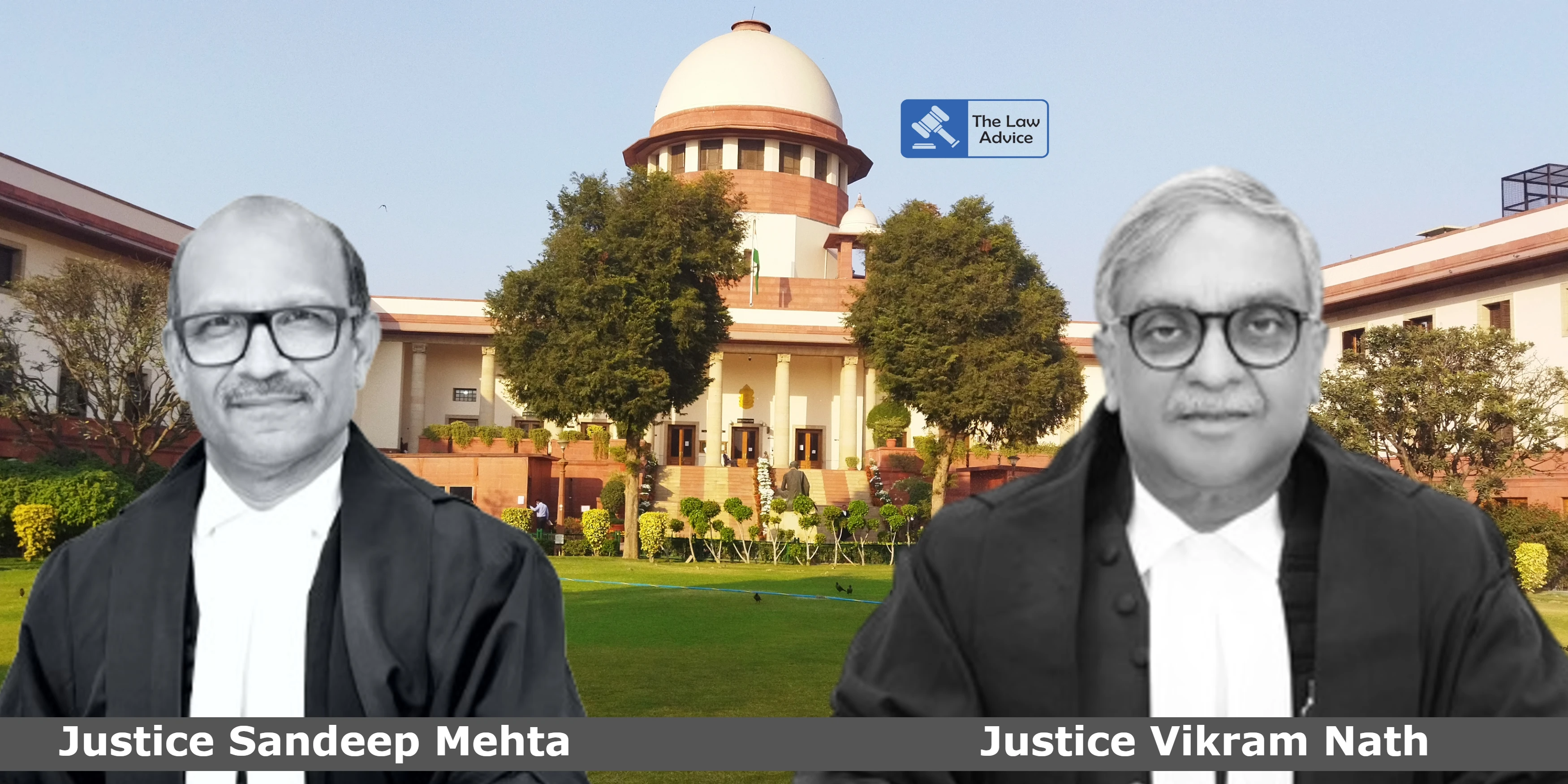
The Supreme Court has held that a compromise decree obtained without impleading a necessary legal heir can be treated as a nullity, and such a legal heir cannot be prevented from challenging the decree merely by invoking the bar under Order XXIII Rule 3A of the Code of Civil Procedure (CPC).
A Bench comprising Justice Vikram Nath and Justice Sandeep Mehta made the observation while allowing appeals filed by Geeta Bai and others in Geeta Bai & Ors. v. K. Arjun Singh & Ors. on September 28, 2026.
The dispute arose from a partition suit concerning property belonging to the family of Late Shri Tikaram Singh.
The appellants were the legal heirs of Late Smt. Ballo Bai, who was the daughter and legal heir of Tikaram Singh.
According to the appellants, Ballo Bai was entitled to an undivided 1/4th share in the suit property by virtue of Section 6 of the Hindu Succession Act, 1956, as amended by Act 39 of 2005.
However, Ballo Bai was not impleaded as a defendant in the original partition suit.
The suit, O.S. No. 473 of 2000, was filed by her brother Late Dhan Singh against other members of the family.
The trial court dismissed the partition suit on June 30, 2009.
Dhan Singh's legal heirs subsequently filed Appeal Suit No. 552 of 2009 before the Telangana High Court.
Even in the appeal, the legal heirs of Ballo Bai were not impleaded as respondents.
The parties who were before the High Court subsequently entered into a memorandum of compromise, under which the suit property was partitioned proportionately among them.
The High Court accepted the compromise and passed a judgment and decree on September 23, 2020.
Ballo Bai's legal heirs later came to know about the compromise decree and approached the High Court.
They filed three interlocutory applications seeking:
Recall of the compromise decree;
Their impleadment as necessary and proper parties in the original suit; and
Restraining the parties from alienating or creating third-party rights over the disputed property.
The Telangana High Court rejected the applications on the ground of maintainability.
The High Court had observed that the appellants could not seek recall of the post-decretal arrangement between the parties and that their remedy would be to file a separate suit or approach the higher court after obtaining leave.
The appellants challenged this decision before the Supreme Court.
The Supreme Court disagreed with the High Court's approach.
The Bench held that, by virtue of Section 6 of the Hindu Succession Act, 1956, as amended in 2005, Ballo Bai was entitled to claim a 1/4th share in the suit property and was therefore undoubtedly a necessary party to the proceedings.
The Court observed that the compromise decree had been obtained by the brothers/legal heirs without impleading Ballo Bai or her legal heirs despite her being a necessary party.
The Supreme Court held:
“The compromise decree obtained by the brothers/legal heirs being the plaintiffs and the defendants without impleading Late Smt. Ballo Bai or her legal heirs, despite her being a necessary party to the suit, was a nullity in the eyes of law.”
The Court further held that Ballo Bai and her legal heirs could not be treated as strangers to the litigation.
Consequently, they could not be prevented from challenging the compromise or seeking recall of a decree obtained behind their back by relying on the bar contained in Order XXIII Rule 3A CPC.
The Supreme Court therefore held that the High Court's order rejecting the three interlocutory applications was unsustainable in law.
The Supreme Court set aside the High Court's order and remitted the matter to the High Court for fresh consideration of the three applications in light of the observations made by the Supreme Court.
The Court also directed that the interim order granted by it on May 27, 2026 would remain in force for two weeks from the date of the order.
The Supreme Court clarified that continuation of the interim protection should not influence the High Court while independently deciding the request for stay after hearing the parties.
The parties have been directed to appear before the High Court on October 5, 2026.
Third parties who had filed impleadment or intervention applications before the Supreme Court were also given liberty to approach the High Court and appear on the same date.
The appeals were accordingly allowed.
Case: Geeta Bai & Ors. v. K. Arjun Singh & Ors.
Civil Appeals: Arising out of SLP (Civil) Nos. 20008-20010 of 2026
Date: September 28, 2026
Bench: Justice Vikram Nath and Justice Sandeep Mehta

Representation:-
For Petitioner(s) : Mr. K. Parameshwar, Adv. Mr. P. Vamshi Rao, Adv. Ms. Rao Vishwaja- 4027, AOR
For Respondent(s) : Ms. A. Chaya Devi, Sr. Adv. Mr. R. Santhana Krishnan, Adv. Mr. Udhayan Krishna G., Adv. Mr. Tarurag Gaur, Adv. Mr. A. Padmachary, Adv. Mr. Krishna Kumar Singh- 2265, AOR Ms. Bina Madhavan, Adv. Mr. S. Udaya Kumar Sagar, Adv. Ms. Shubhangi Arora, Adv. Mr. Tridev Sagar, Adv. M/S. Lawyer S Knit & Co- 1336, AOR Mr. M. Gireesh Kumar, Adv. Mr. Ankur S. Kulkarni- 1685, AOR Mr. Sanjay Sigh, Adv. Ms. Sneha Mathew, Adv. Ms. Ankita Gupta- 3391, AOR Mr. Navin Pahwa, Sr. Adv. Mr. Sridhar Potaraju, Sr. Adv. Mr. Avishkar Singvi, Adv. Mr. B. Shravanth Shanker- 2815, AOR Mr. Shivam Kunal, Adv. Ms. Prerna Robin, Adv. Mr. Ayush Yashaswi, Adv. Ms. Jaslene Ahluwalia, Adv. Ms. Sakshi Raman, Adv. Mr. Shreyas Jayasimha, Adv. Ms. Grahita Agarwal, Adv. Mr. I.v.sai Nikhil, Adv. Mr. Dandu Laxman, Adv. Mr. Tushar Gadia, Adv. Mr. Suryansh Jamwal, Adv. Mr. B.yeshwanth Raj, Adv.
Website designed, developed and maintained by webexy