
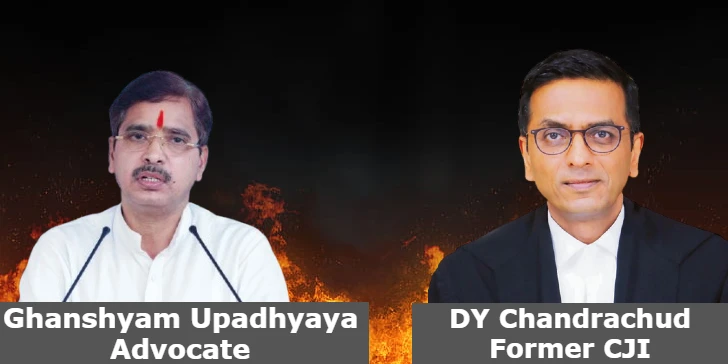
A Mumbai-based advocate has issued a legal notice to former Chief Justice of India, Dhananjaya Y. Chandrachud, over remarks he made during Menstrual Hygiene Week on May 28 regarding the participation of menstruating women in religious rituals.
During a public interaction, Justice Chandrachud recounted a personal family experience from his son's marriage and the family's first Ganesh Utsav celebration. According to his remarks, his daughter-in-law had asked whether she could participate in the puja while menstruating. Chandrachud stated that he told her there was “no impurity in any human being” and that impurity was “a state of mind, not of the body,” following which she participated in the worship ceremony.
The remarks have now triggered a legal controversy. Advocate Ghanshyam Upadhyaya has sent a legal notice demanding an unconditional apology and a public clarification from the former Chief Justice.
According to the notice, Chandrachud should clarify that his comments were confined to his personal family beliefs and should not be construed as an authoritative interpretation of Sanatan Dharma. The notice contends that, as a former constitutional functionary, he does not possess religious authority to reinterpret established Hindu scriptures, customs, or traditions.
The notice further seeks a clarification that the former Chief Justice's statements were not intended to influence ongoing proceedings before the Supreme Court concerning the Sabarimala temple entry dispute and related questions of religious practice.
Additionally, the advocate has urged Chandrachud to refrain from making similar public comments in the future through speeches, media appearances, or social media platforms that may generate controversy regarding Hindu religious beliefs and customs. The notice states that the prestige attached to the office of the Chief Justice of India should not be used to advocate changes in religious practices, particularly when issues involving religious freedom, temple rights, and matters of faith remain pending before courts.
The legal notice alleges that Chandrachud's remarks went beyond narrating a personal family experience and effectively presented his personal views as a model for reforming religious traditions. It argues that such statements undermine and ridicule long-standing religious beliefs associated with Sanatan Dharma.
Upadhyaya has further contended that certain traditional practices observed by some Hindu women during menstruation are rooted in religious and customary norms rather than notions of inferiority or social exclusion. The notice also disputes Chandrachud's assertion regarding the absence of “physical impurity,” claiming that such a view is inconsistent with interpretations found in certain Vedic, Smriti, and Agamic texts.
As of now, there has been no public response from former CJI D.Y. Chandrachud to the legal notice. The development has reignited debate on the intersection of constitutional values, gender equality, religious practices, and personal faith within contemporary Indian society.
Website designed, developed and maintained by webexy