
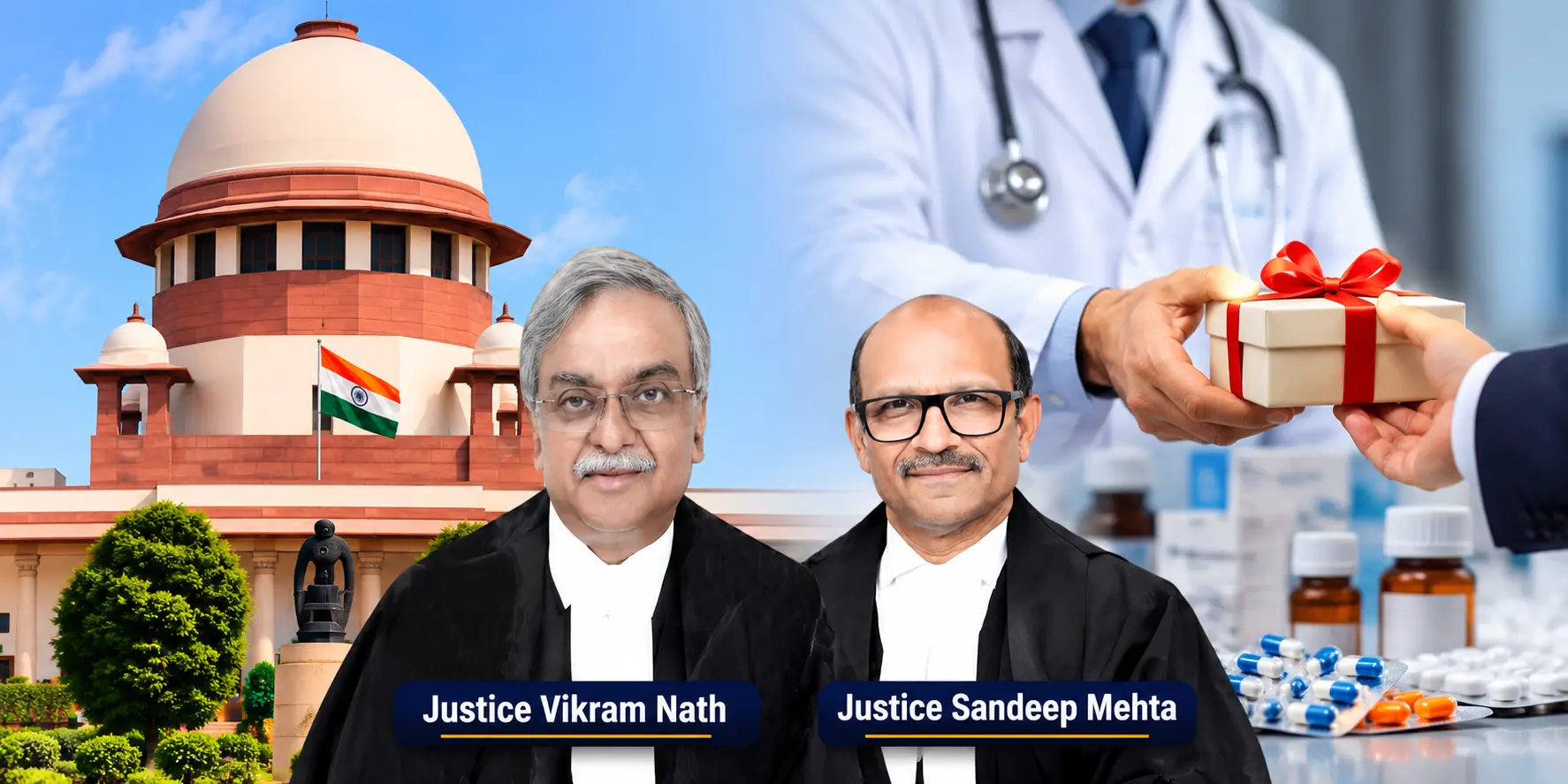
The Supreme Court has directed the Union Government to constitute a committee to examine and recommend a statutory regulatory framework to curb unethical marketing practices adopted by pharmaceutical companies, particularly those involving interactions and inducements to doctors.
A Bench comprising Justice Vikram Nath and Justice Sandeep Mehta passed the direction while hearing a petition seeking statutory regulation of pharmaceutical marketing practices.
The Court directed the committee to consider the suggestions and representations received in the matter and submit its recommendations to the Union Government. The matter has been listed for January 29, 2027, for consideration of the compliance affidavit to be filed by the Centre.
The proceedings concern the Uniform Code for Pharmaceutical Marketing Practices (UCPMP), 2024, which seeks to regulate promotional and marketing practices of pharmaceutical companies.
During the earlier hearings, the Supreme Court had questioned whether the UCPMP contained adequate enforcement mechanisms and whether the Union Government intended to provide statutory backing to the Code.
The Court had observed that in the absence of an effective statutory mechanism and governmental control, a framework described as mandatory could effectively operate as a voluntary regime.
During the proceedings, Solicitor General Tushar Mehta, relying upon the Centre's affidavit dated August 17, 2026, informed the Court that deliberations had taken place between the Department of Pharmaceuticals, Department of Health and Family Welfare and Department of Legal Affairs.
The Centre stated that while an existing regulatory framework provides for disciplinary action against doctors who accept gifts, travel facilities, hospitality or monetary grants from pharmaceutical companies, the question of regulating the pharmaceutical companies themselves required further examination.
The Union therefore proposed constituting a three-member committee to examine whether statutory regulation of pharmaceutical marketing practices was necessary and, if so, what form such regulation should take.
The committee is expected to submit its report within two months, following which the Government would take an appropriate decision. In the meantime, the UCPMP, 2024 would continue to govern pharmaceutical marketing practices.
The petitioners opposed the constitution of another committee, pointing out that the Centre had previously informed the Supreme Court in an affidavit filed in 2022 that a high-level committee had already been constituted to examine the need for a legally enforceable regulatory mechanism.
Senior Advocate Sanjay Parikh, appearing for the petitioners, argued that the existing regulatory framework creates an imbalance by prescribing consequences for doctors who accept gifts and other benefits while not providing a corresponding statutory mechanism to penalise pharmaceutical companies that offer such inducements.
According to the petitioners, this regulatory gap could enable pharmaceutical companies to influence medical prescriptions.
The petitioners therefore urged the Court either to direct the Union Government to formulate a statutory framework or to prescribe appropriate guidelines until such a framework is introduced.
The petitioners also relied upon the Supreme Court's judgment in Apex Laboratories Pvt. Ltd. v. Deputy Commissioner of Income Tax, decided in 2022.
In that case, the Supreme Court had emphasised the special relationship between medical practitioners and patients and observed that benefits provided by pharmaceutical companies could potentially influence prescriptions.
The Court had referred to practices involving gifts, electronic goods and funding of foreign trips and medical conferences for doctors and described such practices as creating a “publicly injurious cycle.”
With the latest order, the Supreme Court has effectively required the Union Government to undertake a structured examination of whether the pharmaceutical industry's marketing practices require a statutory regulatory framework beyond the existing UCPMP mechanism.
The committee will consider the representations and suggestions placed before it and make recommendations to the Union Government.
The Supreme Court will next consider the Centre's compliance affidavit on January 29, 2027.
Case: W.P.(C) No. 323/2021- FEDERATION OF MEDICAL AND SALES REPRESENTATIVES ASSOCIATIONS OF INDIA AND ORS. Vs. UNION OF INDIA AND ORS.
Bench: Justice Vikram Nath and Justice Sandeep Mehta
Order: October 8, 2026
Website designed, developed and maintained by webexy