
The Supreme Court has held that merely because injuries are sustained on non-vital parts of the body, the applicability of Section 307 IPC (attempt to murder) cannot be ruled out. The Court stressed that the crucial consideration is the intention or knowledge of the accused, which must be assessed from the overall circumstances of the incident and not merely from the location or severity of the injuries.
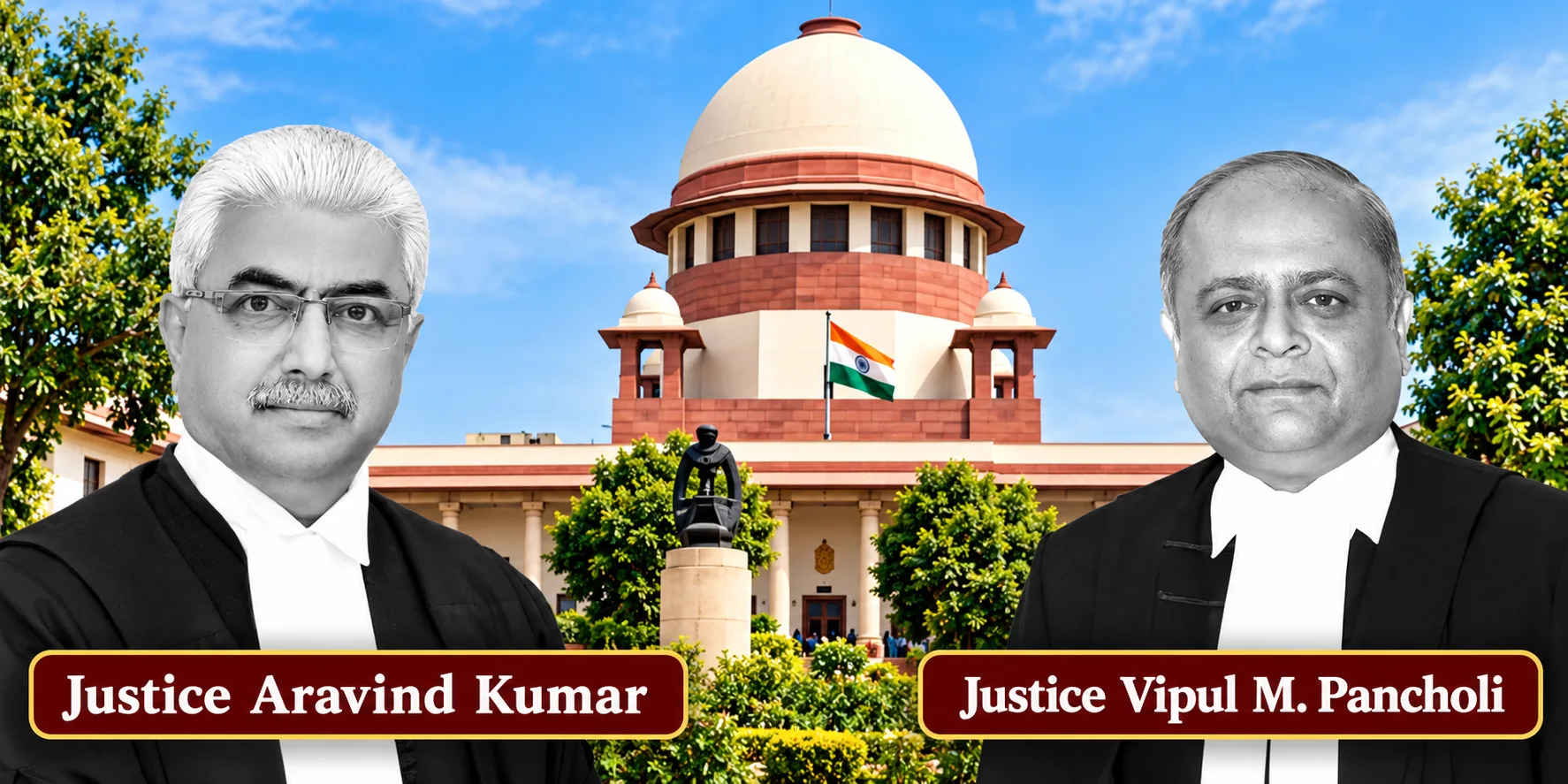
A Bench of Justice Aravind Kumar and Justice Vipul M. Pancholi made the observations while allowing an appeal in Abhishek v. State of Rajasthan & Ors., Criminal Appeal No. 4767 of 2026.
The case arose from an incident dated November 26, 2020, in an agricultural field at Village Polas, Tehsil Degana, District Nagaur, Rajasthan.
According to the prosecution case, the accused allegedly entered the field in a tractor, repeatedly drove it towards the appellant and his family members and struck the appellant's mother. Thereafter, the accused allegedly assaulted the family using sharp-edged agricultural weapons, including axes/kashi.
The appellant and his father sustained deep incised injuries, including bone-deep wounds.
The Additional Sessions Judge, Merta had framed, among other charges, a charge under Section 307 IPC against Respondent No. 2.
However, the Rajasthan High Court, by its order dated April 1, 2025, set aside the Section 307 charge and directed the Trial Court to frame a charge under Section 308 IPC, primarily observing that the injuries were suffered on non-vital parts such as the wrist and arm.
Setting aside the High Court's order, the Supreme Court reiterated that for attracting Section 307 IPC, it is not essential that a fatal or life-threatening bodily injury must actually have been caused.
The Court explained that the decisive question is whether the act was committed with such intention or knowledge and in such circumstances that, had death resulted, the accused would have been guilty of murder.
The nature and site of the injury may assist in determining intention, but they are not conclusive by themselves. The Court said intention or knowledge has to be gathered from the totality of circumstances, including the weapon used, persistence of the assault, prior animosity and manner in which the attack was carried out.
The Supreme Court further reiterated that while framing charges under Sections 227 and 228 CrPC, courts are not supposed to conduct a mini-trial or weigh the evidence as though finally deciding the guilt of the accused.
At this stage, the Court only has to examine whether the investigation material, witness statements and other records disclose a prima facie case and raise suspicion against the accused.
Importantly, the prosecution material indicated that the accused allegedly attacked the heads of the appellant and his father with axes. According to the appellant's statement recorded in the charge-sheet, they raised their arms to protect their heads, resulting in the blows landing on their shoulders and causing deep incised wounds.
The Supreme Court therefore found fault with the High Court for adopting what it described as a “summary and technical assessment” of the injuries merely because the wounds were located on limbs regarded as non-vital parts.
The Court also pointed to Section 216 CrPC, observing that if evidence during trial ultimately shows that the ingredients of Section 307 IPC are not established, the Trial Court has the power to alter the charge to Section 308 IPC or another appropriate lesser offence.
Accordingly, the Supreme Court held that the High Court's interference at the threshold stage was unwarranted.
The Supreme Court allowed the appeal, set aside the Rajasthan High Court's April 1, 2025 order and restored the Trial Court's order framing a charge under Section 307 IPC against Respondent No. 2.
The Bench clarified that its observations were confined to deciding the appeal and would not influence the merits of the criminal trial. The Trial Court was directed to proceed in accordance with law.
Case: Abhishek v. State of Rajasthan & Ors.
Citation: 2026 INSC 1093
Criminal Appeal: No. 4767 of 2026
Bench: Justice Aravind Kumar and Justice Vipul M. Pancholi
Date: October 7, 2026

Representation:-
For Petitioner(s) : Mr. Nishant Bishnoi, AOR
For Respondent(s) : Mr. S. Udaya Kumar Sagar, AOR
Website designed, developed and maintained by webexy