
The Supreme Court has held that an insurer cannot assume or extend insurance risk beyond the insured amount without receiving the requisite premium in advance, reiterating the mandatory nature of Section 64VB of the Insurance Act, 1938.
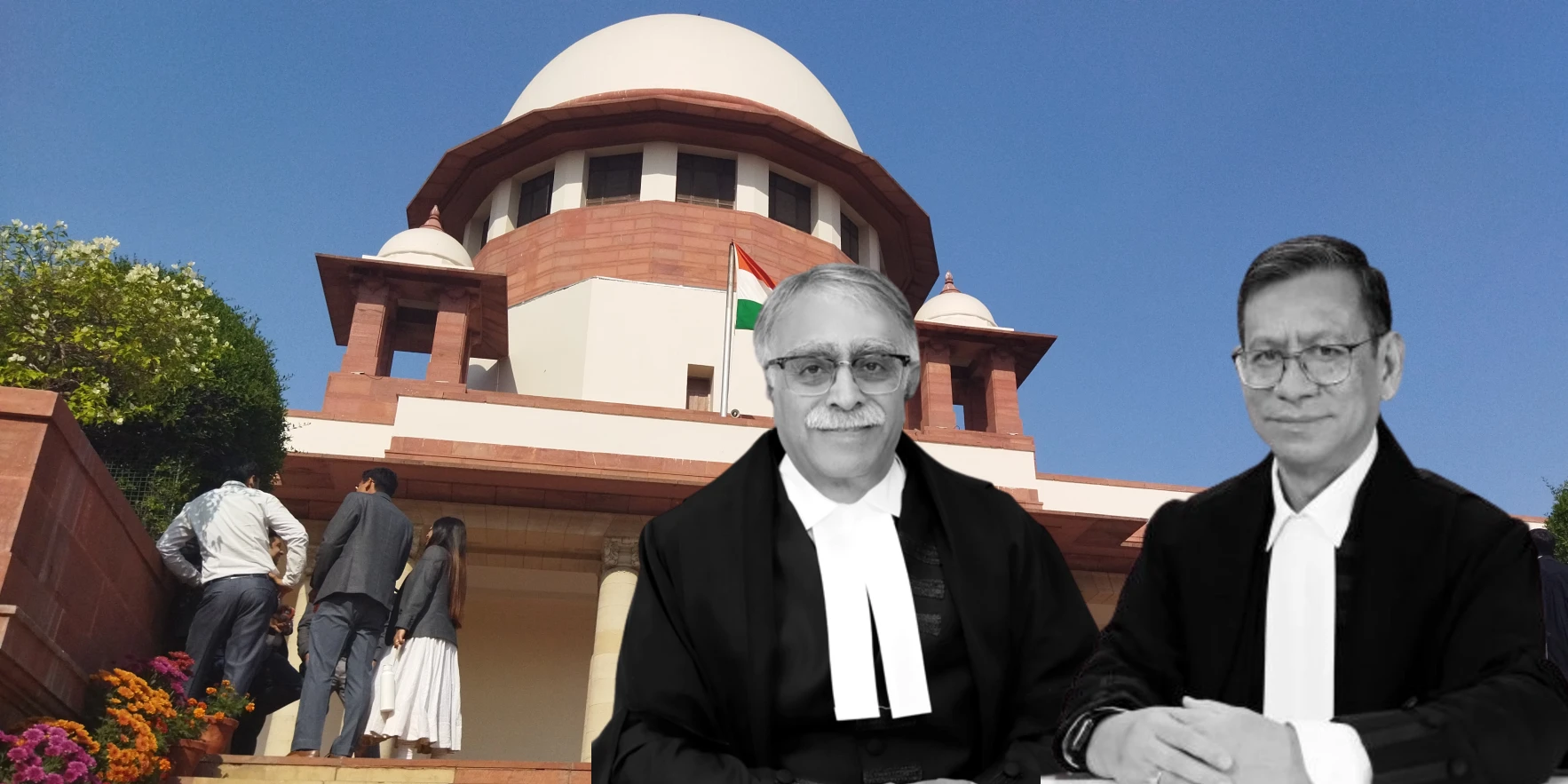
A Bench comprising Justice Sanjay Karol and Justice Nongmeikapam Kotiswar Singh allowed two appeals filed by The New India Assurance Company Ltd. against the National Consumer Disputes Redressal Commission (NCDRC) order directing the insurer to honour a claim made by M/s Louis Dreyfus Commodities India Pvt. Ltd.
The judgment was delivered on August 18, 2026, in The New India Assurance Company Ltd. & Ors. v. M/s Louis Dreyfus Commodities India Pvt. Ltd., Civil Appeal Nos. 7687-7688 of 2025, reported as 2026 INSC 876.
Louis Dreyfus had obtained a Marine Cargo Annual Turnover Policy from New India Assurance for the period January 1 to December 31, 2010, with an annual turnover coverage of ₹1,200 crore, payable through two equal instalments.
On November 7, 2010, a fire broke out at a Container Freight Station where the company had stored 41,481 cotton bales. The insurer's surveyor assessed the loss at approximately ₹22.01 crore.
The insurer subsequently repudiated the claim, contending that the insured's turnover had already exceeded the policy limit and that no additional premium had been paid to extend the coverage before the incident.
The insured relied upon an email dated May 17, 2010, issued by the insurer's Divisional Manager, which stated that after payment of the second instalment, transits would remain covered until the expiry of the policy even if the turnover exceeded ₹1,200 crore.
The NCDRC accepted the insured's contention and directed the insurer to pay the amount assessed by its surveyor.
Setting aside the NCDRC's decision, the Supreme Court held that Section 64VB creates a statutory embargo on an insurer assuming risk before the requisite premium is received or guaranteed in the prescribed manner.
The Court noted that the turnover was a central component of the policy and that the insured's turnover had exceeded the ₹1,200 crore coverage limit on July 10, 2010, well before the fire incident.
The Court therefore held that the insured was required to extend the coverage by paying the additional premium or otherwise complying with the statutory requirements.
The respondent ultimately paid an additional premium of ₹86,86,125 on December 17, 2010, several weeks after the November 7 fire.
The Supreme Court held that this payment could not retrospectively validate the insurance coverage for the earlier loss.
The endorsement issued by the insurer specifically stated that the enhanced coverage would take effect from December 17, 2010.
The Bench observed that Section 64VB leaves no scope for post facto regularisation of insurance risk where the statutory requirement for assumption of risk had not been fulfilled.
The Court further rejected the argument that acceptance of the additional premium prevented the insurer from repudiating the earlier claim.
Justice Sanjay Karol's judgment also dealt with the respondent's reliance on the Divisional Manager's May 17 email.
The Court observed that while a principal can ordinarily be bound by acts of its agent performed within the agent's actual or apparent authority, an agent cannot confer upon the principal a liability which the law itself prevents the principal from undertaking.
The Court referred to Section 182 and Sections 186, 187 and 188 of the Indian Contract Act, 1872, concerning the relationship between principal and agent and the extent of an agent's authority.
It held that the Divisional Manager could correspond with the insured and explain the existing policy, but this did not establish authority to create a new risk, enlarge the sum insured or dispense with a statutory precondition for attachment of risk.
In his concurring judgment, Justice Nongmeikapam Kotiswar Singh elaborated on the distinction between actual authority and ostensible or apparent authority under the Contract Act.
The Court held that merely because an officer is an employee or agent of an insurer, it does not follow that the officer has authority to enlarge the insurer's liability.
Justice Kotiswar Singh noted that Section 237 of the Contract Act may bind a principal where the principal's own words or conduct have induced a third party to believe that an agent possesses certain authority. However, such apparent authority cannot be used to confer upon the insurer a capacity that a statute itself withholds.
The Court also relied on its earlier decisions including Harshad J. Shah v. Life Insurance Corporation of India, Delhi Electric Supply Undertaking v. Basanti Devi and Dilawari Exporters v. Alitalia Cargo.
The Court also rejected the argument that the insurer's subsequent acceptance of the additional premium amounted to ratification of the earlier assurance.
Justice Kotiswar Singh observed that the December 17 endorsement expressly enhanced the sum insured prospectively from December 17, 2010. This was inconsistent with any intention to retrospectively ratify an assurance concerning additional coverage for the November 7 loss.
The Court further clarified that while ratification may cure a lack of authority in appropriate circumstances, it cannot be used to defeat a mandatory statutory requirement governing assumption of insurance risk.
Concluding that the insurance coverage had not extended to the November 7, 2010 incident, the Supreme Court allowed both appeals filed by New India Assurance and disposed of the pending applications, if any.
The judgment reiterates that contractual arrangements, assurances by employees or subsequent acceptance of premium cannot override the statutory mandate under Section 64VB of the Insurance Act, 1938, particularly where additional insurance risk had not lawfully attached before the occurrence of the insured event.

Representation:-
For Appellant(s) : Mr. Salil Paul Adv., Ms. Manjeet Chawla AOR, Mr. Sahil Paul Adv., Mr. Sandeep Dayal Adv., Ms. Kanupriya Mehta Adv., Mr. Harmeet Singh Phillip Adv., Ms. Jyoti Adv.
For Respondent(s) :Mr. Joy Basu Sr. Adv., Mr. Vinay Kumar Misra AOR, Ms. Akshita Adv.
Website designed, developed and maintained by webexy