
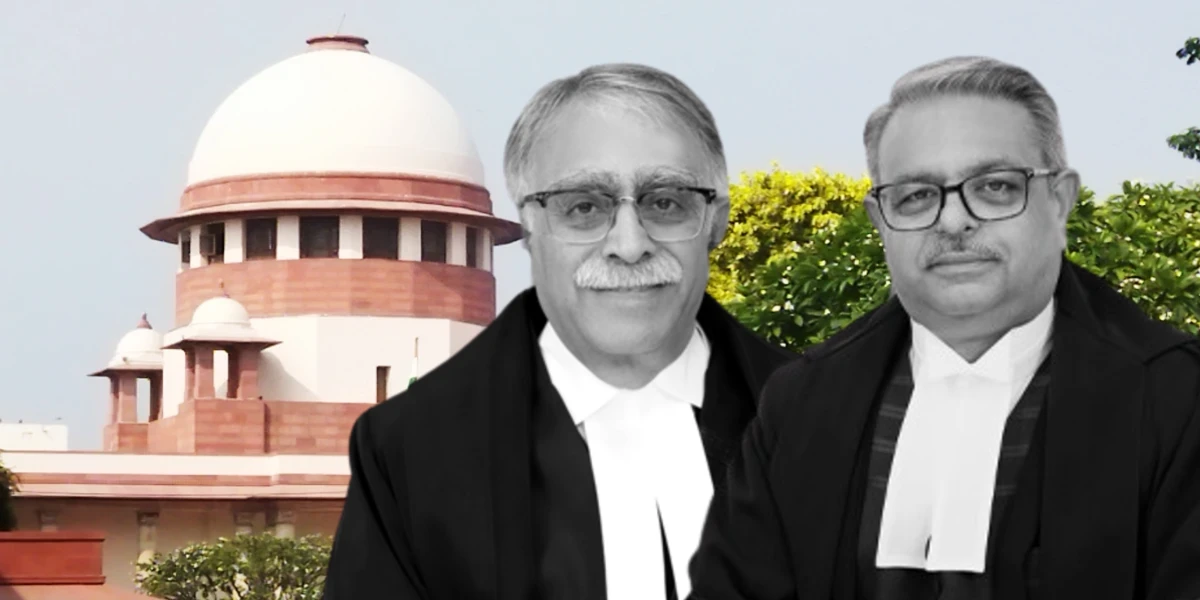
In a significant ruling on the principles of res judicata and daughters’ inheritance rights under the Hindu Succession Act, 1956, the Supreme Court of India has held that the doctrine of “interlocutory res judicata” applies even between different stages of the same litigation, and parties cannot repeatedly seek rejection of a plaint on identical grounds once the issue has attained finality.
The judgment was delivered in B.S. Lalitha & Ors. v. Bhuvanesh & Ors., 2026 INSC 499, where the Court restored a partition suit filed by daughters claiming a share in their deceased father’s property.
A bench of Justice Sanjay Karol and Justice Augustine George Masih ruled that a second application under Order VII Rule 11 CPC seeking rejection of the plaint was barred by res judicata, since the same issue had already been decided earlier by the Karnataka High Court and had attained finality.
The Court observed:
“The principle of res judicata applies also between two stages in the same litigation.”
The dispute arose from a partition suit filed by three daughters after the death of their father in 1985. The defendants relied on a registered partition deed of 2000 and argued that Section 6(5) of the Hindu Succession Act barred reopening of the partition. However, the Supreme Court clarified that Section 6(5) is merely a “saving clause” protecting certain past partitions from the effect of the 2005 amendment and does not create a jurisdictional bar against filing a partition suit.
The Court further held that daughters possess an independent right under Section 8 of the Hindu Succession Act as Class I heirs where the father dies intestate, and such rights are unaffected by Section 6(5).
Setting aside the Karnataka High Court’s 2024 order rejecting the plaint, the Supreme Court restored the partition suit and directed continuation of status quo over the disputed properties until further orders of the trial court.
"70. We may draw our conclusions as under:
(i) The second application under Order VII Rule 11 of the CPC (I.A. No. IV, filed 16.12.2021 by the legal representatives of Defendant No. 4) is barred by the principle of res judicata, inasmuch as the identical issue was directly and substantially in issue in the first Order VII Rule 11 proceedings, was heard and decided by the High Court in R.F.A. No. 168 of 2009 by its order dated 31.01.2013, and that order attained finality. The legal representatives of Defendant No. 4 litigate under the same title as Defendant Nos. 1 to 3 within the meaning of Explanation VI to Section 11 of the CPC, and the decision of this Court in Vineeta Sharma (supra) does not constitute ‘change in law’ relevant to the basis of the 2013 order.
(ii) Section 6(5) of the H.S. Act is a saving clause of narrow and strict application. It does not create a jurisdictional bar to the institution of a suit for partition. Whether a valid partition within the meaning of Section 6(5) has been effected, and whether such partition is binding on persons who were not parties to it, are contested questions of fact and law that must be adjudicated at trial. The High Court erred in rejecting the plaint at the threshold on the basis of Section 6(5).
(iii) The appellants have an independent right under Section 8 of the H.S. Act, 1956 as Class I heirs of the propositus who died intestate on 06.03.1985. This right accrued in 1985 by operation of the proviso to the erstwhile Section 6 read with Section 8, is independent of the 2005 Amendment, and is unaffected by Section 6(5). The suit is maintainable, at minimum, to the extent of the appellants’ claim in the share of the propositus."
The Court also cautioned that disputed questions relating to oral partition, family settlements, validity of partition deeds, and inheritance rights cannot ordinarily be decided at the threshold stage under Order VII Rule 11 CPC without trial and evidence.

Website designed, developed and maintained by webexy