
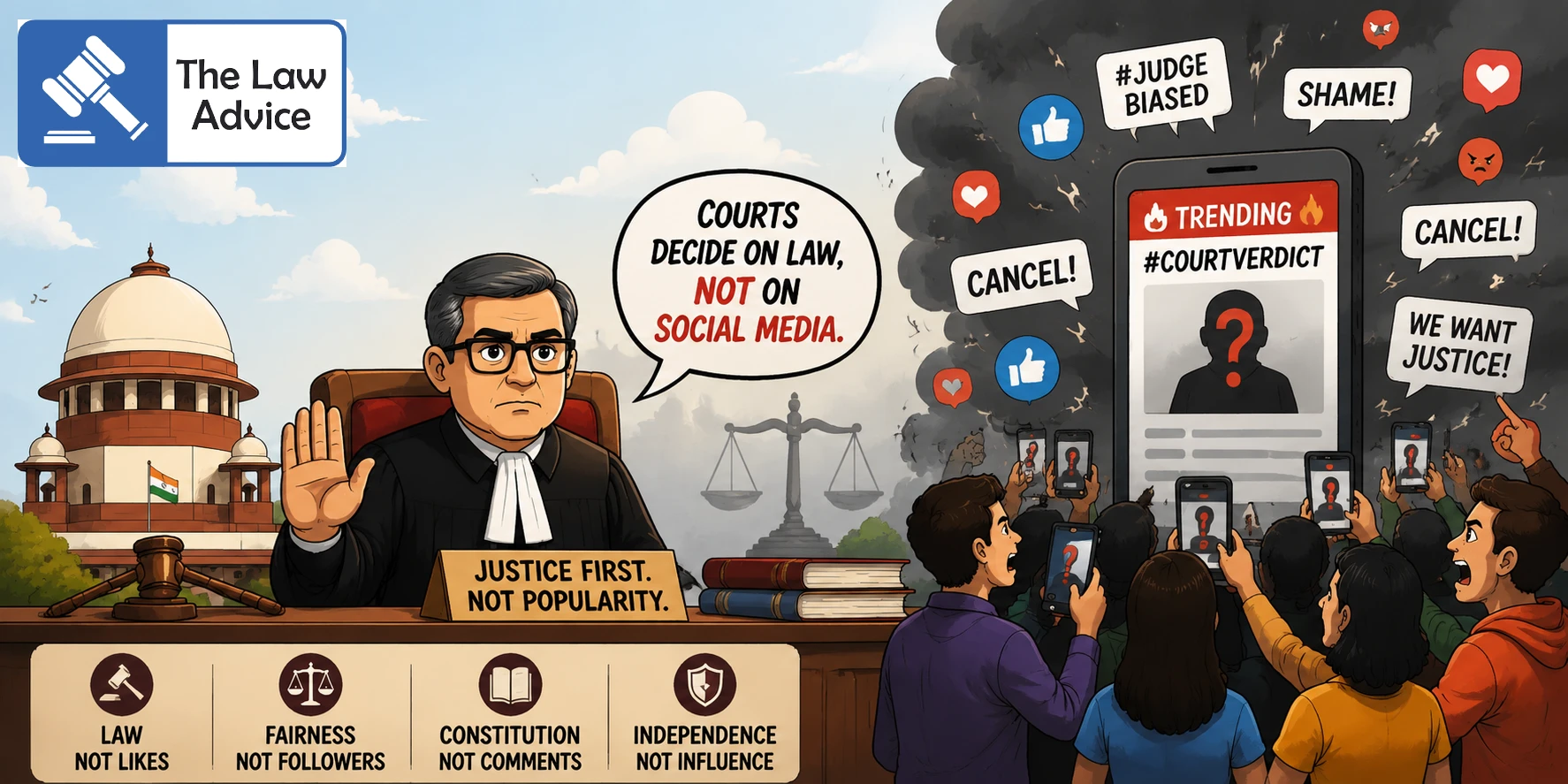
Recently, the Supreme Court judge Justice Joymalya Bagchi said that the rapid spread of misinformation on social media, media trials and algorithm-driven public opinion have emerged as some of the biggest threats to judicial independence.
Speaking at the fifth Justice HR Khanna Memorial National Symposium, Justice Bagchi described social media as a "hydra-headed" phenomenon, warning that false narratives now travel much faster than the truth.
"A clip uploaded on one platform regrows on many. Misinformation outruns the correction," he said, adding that judges today are increasingly being subjected to relentless scrutiny in the digital space.
Justice Bagchi said digital intermediaries must shoulder the primary responsibility for tackling misinformation. "Such entities, which are significant reservoirs of power, cannot plead that they are only a medium," he remarked.
He cautioned that online outrage and media trials are creating unprecedented pressure on judges, often influencing public perception long before a court delivers its verdict.
"Dispassionate adjudication is being auctioned on the altar of 'likes'. Guilt manufactured online brands the acquitting judge as having erred for being fair," Justice Bagchi said.
The judge also raised concerns over the unintended consequences of live-streaming court proceedings. While it has improved transparency and public access, short video clips are often shared out of context, and oral observations made during hearings are frequently mistaken for final judgments.
Rejecting the idea of judges responding to criticism on social media, Justice Bagchi said judicial restraint and impartiality must remain non-negotiable. He also warned that excessive public attention could encourage performative behaviour in courtrooms.
According to him, judges must neither fear the "digital mob" nor seek validation through online applause.
He further stressed that although freedom of the press is essential in a democracy, media trials cannot replace the judicial process by declaring someone guilty before a court has ruled.
Justice Bagchi also highlighted the role of Big Tech algorithms, saying they often amplify sensational content, shape public opinion and can undermine confidence in the justice delivery system.
On live-streaming of proceedings, he suggested that it should not be mandatory in every case. Instead, courts should decide whether to allow it based on the nature of the matter and the need to protect the right to a fair trial.
He also proposed that the Supreme Court and High Courts maintain secure digital archives of live-streamed proceedings, which can be accessed whenever required under the law.
Website designed, developed and maintained by webexy