
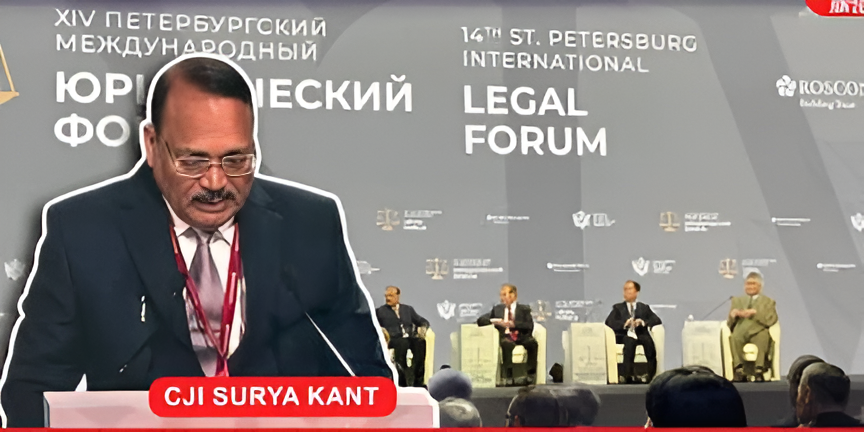
Chief Justice of India (CJI) Surya Kant has emphasized that equality is the foundation of any legal system, observing that law without equality becomes nothing more than the organized will of the stronger party. Speaking at the 14th St. Petersburg International Legal Forum in Russia, the CJI delivered a keynote address on the theme, “Equal Justice, Equal Law: Access as the Measure of International Law's Humanity.”
Drawing inspiration from the iconic Bronze Horseman monument in St. Petersburg, CJI Kant compared its massive foundation stone, known as the Thunder Stone, to the principle of equality that underpins international law. According to him, just as the monument stands firmly because of its foundation, the legitimacy of any legal order depends upon equality.
Tracing the historical roots of equality, the CJI stated that the concept did not originate with the Magna Carta of 1215. Instead, he pointed to Kautilya's Arthashastra, written in the 4th century BCE, which held that a ruler who does not subject himself to dharma and law ceases to be a legitimate king.
He observed that different civilizations developed the idea of equality in their own ways, but the principle was never a privilege granted by the powerful. Rather, equality has always been the essential grammar of legality.
“Without equality, law would merely be the organized will of the stronger party,” he remarked.
Reflecting on contemporary challenges, CJI Kant expressed concern that the international community still needs to debate whether international law truly operates among equals.
He described the very need to ask such a question as an indictment of the current global legal order and suggested that the true test of international law is whether every sovereign state—and every individual within it—can access legal remedies on an equal footing.
Speaking about India's experience, the CJI highlighted the judiciary's efforts to remove barriers to justice arising from geographical, social, and economic inequalities.
He noted that Indian courts have expanded access to justice through legal aid programs, public interest litigation (PILs), and by treating procedural rules as instruments of justice rather than obstacles.
According to the CJI, constitutional courts in India have adopted an expansive interpretation of constitutional guarantees to ensure that access to justice remains a non-discriminatory principle of governance.
Turning to the international sphere, CJI Kant observed that noble intentions behind global human rights instruments do not automatically translate into equitable outcomes.
Referring to international conventions such as the Convention on the Rights of the Child, the Convention on the Elimination of All Forms of Discrimination Against Women (CEDAW), and the International Covenant on Economic, Social and Cultural Rights, he noted that compliance and monitoring mechanisms are often applied unevenly.
The CJI pointed out that countries in the Global South and Global East, many of which continue to grapple with the legacy of colonialism and widespread poverty, are frequently subjected to scrutiny and pressure that are not applied equally to wealthier and more influential nations.
He remarked that while developing nations are still building institutions and addressing historical disadvantages, their compliance records are often judged more harshly than those of powerful states.
Concluding his address, CJI Kant returned to the analogy of the Thunder Stone supporting the Bronze Horseman, reiterating that equal justice and equal law are not aspirational ideals but foundational requirements for any credible legal order.
He stressed that it is the responsibility of judges, lawyers, and legal institutions worldwide to preserve and strengthen this foundation.
“Equal justice and equal law are the conditions under which the legal order may credibly call itself law at all,” the Chief Justice said.
Website designed, developed and maintained by webexy