
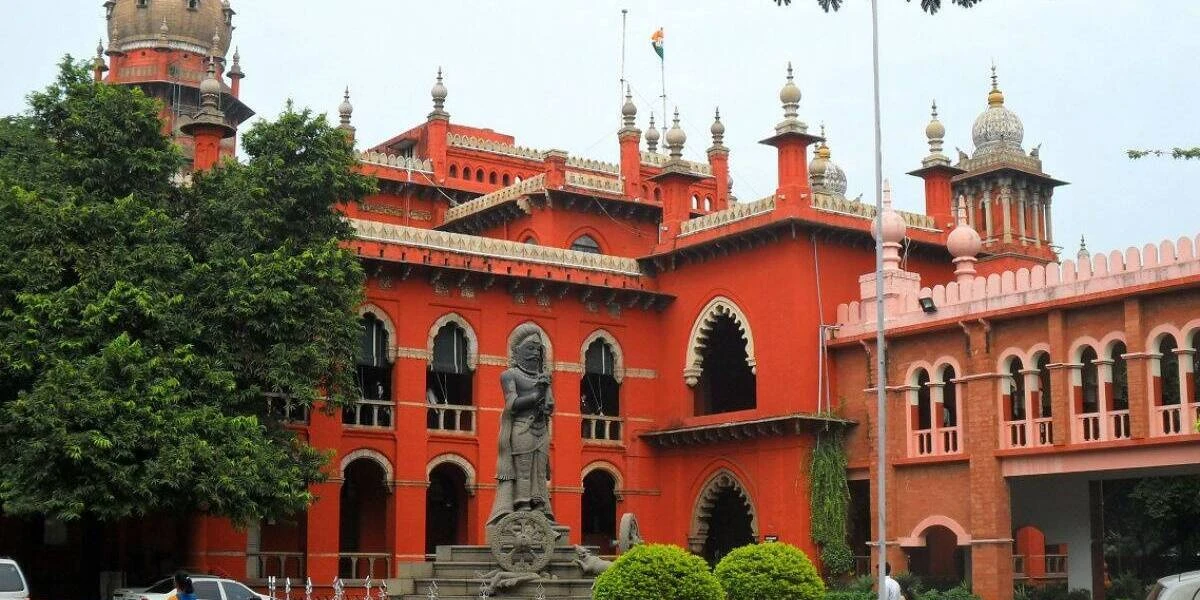
The Madras High Court on Wednesday struck down a Tamil Nadu government order (GO) that allowed persons belonging to Backward Classes (BC), Most Backward Classes (MBC), Denotified Communities (DNC) and Scheduled Castes (SC) to claim the status of Backward Class Muslims after converting to Islam for reservation purposes.
A Division Bench of Justices GR Swaminathan and PB Balaji declared the government order dated March 9, 2024, unconstitutional and held that conversion to Islam does not entitle a person to claim membership of a Backward Class Muslim community.
“As a corollary, we hold that a convert to Islam cannot claim the status of Backward Class Muslim. He is only a Muslim and that’s all there is to it,” the Bench observed.
The Court decided the case while hearing a petition filed by Sameer Ahamed, formerly known as Paramasivam, who was born into a Hindu family in Thoothukudi district. After converting to Islam in 2015, changing his name and marrying according to Islamic rites, Ahamed applied for a community certificate identifying him as "Muslim Lebbai," one of the seven communities recognised as Backward Class Muslims under the State's reservation policy.
The Tahsildar rejected his application, prompting Ahamed to approach the High Court.
Ahamed relied on the 2024 government order, which permitted converts from reserved communities to obtain community certificates identifying them as one of the seven notified Backward Class Muslim groups. The State defended the order, arguing that it implemented the recommendation of the Tamil Nadu Backward Classes Commission and merely allowed those who had already enjoyed reservation benefits before conversion to continue receiving them.
The High Court rejected the State's defence.
The Bench noted that the Madras High Court had already ruled in G. Michael v. S. Venkateswaran (1951) that a Hindu who converts to Islam becomes "just a Mussalman" and that the Muslim community does not determine a person's social position based on their former caste. The Bench added that the Supreme Court had subsequently approved this legal position.
“When the proposition laid down by the Hon’ble Division Bench is holding the field, it cannot be undone by issuing a mere Government Order,” the Court said.
The Bench emphasised that the executive cannot override binding judicial precedents through a government order and warned that allowing such action would undermine the rule of law.
The Court also found the government order arbitrary because it grouped converts from BC, MBC, DNC and SC communities into a single Backward Class Muslim category solely to preserve reservation benefits.
“Just for the sake of ensuring that the converts to Islam continue to enjoy some form of reservation benefit, such a bunching has been done by the State Government,” the Bench observed.
The judges acknowledged that different Muslim communities exist but held that birth alone determines membership in those communities.
“One can even boldly remark that they are akin to caste in Hinduism. Just as caste is determined by birth, one is a Rowther or Marakkayar or Deccani Muslim by birth alone. It is ridiculous to suggest that one can be converted into a Rowther Muslim,” the Court observed.
The Bench concluded that while a person may convert to Islam, they cannot convert into a particular Muslim community for the purpose of claiming reservation benefits.
The Court also described the government order as “not only unconstitutional but also un-Islamic,” observing that Islam's foundational principles reject social hierarchy and promote equality.
“The Christian missionaries as well as Islamic preachers harangued through decades and centuries that their religions offer social equality unlike Hinduism which has caste as its inherent feature. Having taken such a stand for effecting conversions, it is disingenuous to claim that there is hierarchy in Islam also. In our respectful view, categorising certain sects as Backward and the remaining as Forward is antithetical to Quranic injunctions. Islam seeks to establish an egalitarian society. Everyone is equal in the eye of God. There is no social hierarchy,” the Court observed.
The Court ultimately upheld the Tahsildar's decision rejecting Ahamed's request for a Muslim Lebbai community certificate and disposed of the writ petition.
Advocate R. Maheswaran appeared for the petitioner, while Government Advocate L. Siva represented the State authorities.
Website designed, developed and maintained by webexy