
In a significant judgment on matrimonial law, the Supreme Court has held that persistent refusal to engage in sexual relations without reasonable cause amounts to mental cruelty and can constitute a valid ground for divorce under Section 13(1)(ia) of the Hindu Marriage Act, 1955.
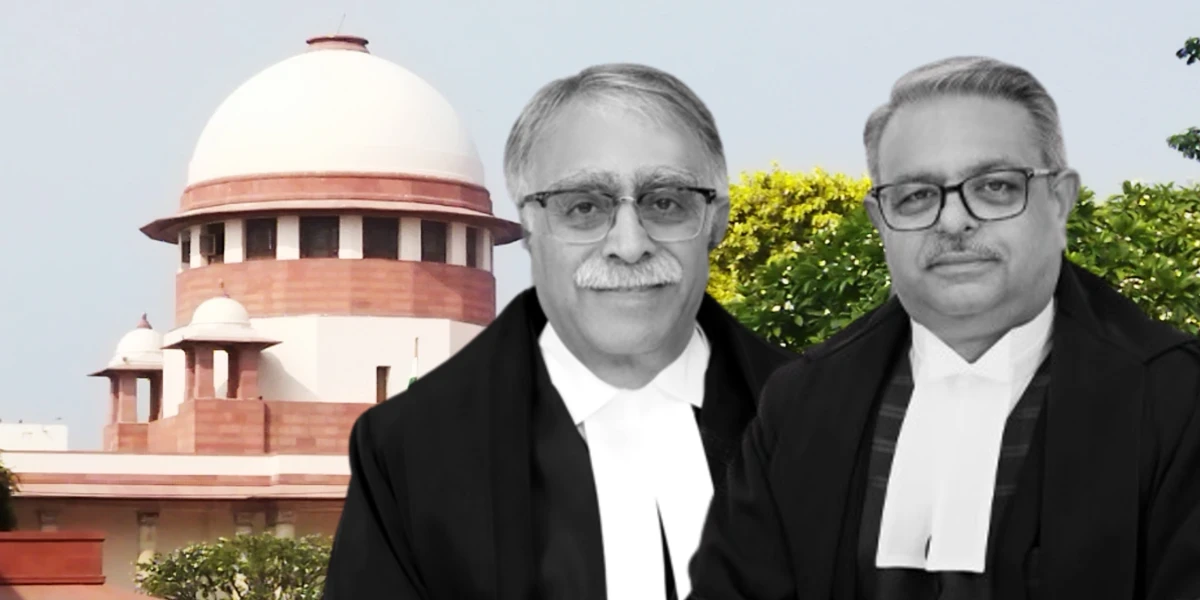
A Bench of Justice Sanjay Karol and Justice Augustine George Masih dismissed an appeal filed by a wife challenging a Rajasthan High Court judgment that had dissolved her marriage with her husband, both of whom are government doctors.
The parties married in December 2007. While the wife was serving as a gynecologist in Gujarat, the husband was working as a doctor in Rajasthan. No child was born from the marriage.
According to the husband, the wife stayed at the matrimonial home in Bharatpur for only two to three months during their approximately two-year marital relationship. He alleged that she refused to perform marital obligations and denied him sexual relations on multiple occasions.
In 2009, the husband filed a divorce petition under Section 13(1)(ia) of the Hindu Marriage Act on the ground of cruelty.
The Family Court dismissed the petition, holding that cruelty had not been proved. However, the Rajasthan High Court reversed that decision and granted a decree of divorce, prompting the wife to approach the Supreme Court.
While examining the evidence, the Supreme Court noted that the husband had testified that the wife used to sleep separately, lock her room from inside, and not respond even when he knocked on the door. Importantly, the wife did not dispute that the parties slept in separate rooms.
Relying on the principles laid down in Samar Ghosh v. Jaya Ghosh, the Court reiterated that persistent refusal of sexual intercourse without a valid reason amounts to mental cruelty.
The Bench observed:
"Denial of conjugal rights including persistent refusal of sexual intercourse without a reasonable cause constitutes mental cruelty and is a valid ground for divorce."
According to the Court, withholding sexual intimacy causes severe emotional distress and strikes at the very foundation of marriage.
The judgment contains important observations on the nature of marriage and matrimonial obligations.
The Court emphasized that marriage cannot be viewed merely as a collection of legal rights. It is a relationship built on mutual respect, companionship, emotional support, fidelity, responsibility and care.
The Bench observed that conjugal rights and conjugal duties are interconnected and that a spouse cannot insist upon the benefits of marriage while simultaneously withdrawing from its foundational obligations.
According to the Court, persistent withdrawal from the essential aspects of married life can have legal consequences when determining allegations of mental cruelty.
The Court noted that the parties had been living separately for more than 15 years and had cohabited for only a brief period after marriage.
Repeated attempts at reconciliation, including mediation ordered by the Supreme Court in 2025, had failed.
The Bench observed that both parties had pursued independent professional lives in different States and had made no meaningful effort to revive the marital relationship.
The Court held that where spouses remain separated for several years without any genuine attempt at reconciliation, the continuation of the marriage may itself amount to cruelty.
It further clarified that appellate courts are entitled to consider subsequent events, including prolonged separation during litigation, while assessing whether cruelty exists.
Apart from upholding the finding of cruelty, the Supreme Court also held that the marriage had irretrievably broken down.
The Court noted that:
Invoking its powers under Article 142 of the Constitution, the Court held that continuing the marriage would serve no useful purpose and would merely perpetuate a relationship that existed only on paper.
The Bench observed that prolonged matrimonial litigation often leads to the perpetuation of a dead marriage and that courts must provide an effective exit where a relationship has become emotionally dead and beyond repair.
Dismissing the wife's appeal, the Supreme Court upheld the divorce granted by the Rajasthan High Court and formally dissolved the marriage.
The judgment reaffirms that persistent denial of sexual relations, prolonged separation, and complete emotional breakdown of the marital relationship can together constitute mental cruelty and justify dissolution of marriage.
Case: Sonal Talpada v. Veerbhan Singh (2026 INSC 620)
Bench: Justice Sanjay Karol and Justice Augustine George Masih
Date of Judgment: June 2, 2026.

Representation:-
For Petitioner(s) : Mr. Neeraj Shekhar, AOR, Mrs. Kshama Sharma, Adv., Mr. Ram Bacchan Choudhary, Adv.
For Respondent(s) : Mr. Mithilesh Jha, AOR, Ms. Rishika Chahar, Adv., Mr. Tarun Chauhan, Adv.
Website designed, developed and maintained by webexy