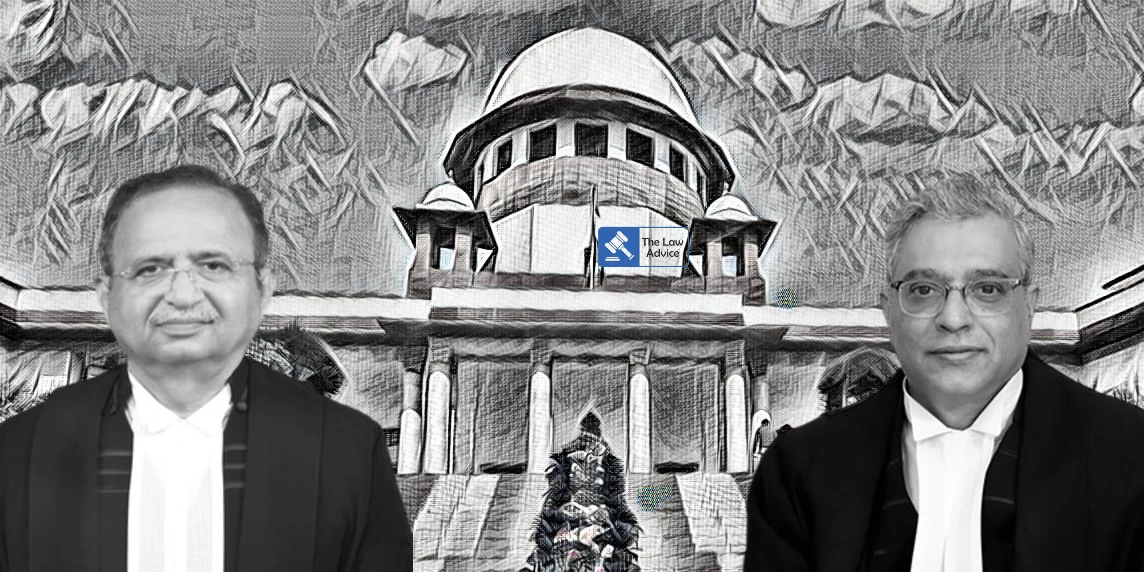
The Supreme Court on Wednesday (August 12) deprecated the practice of holding a mini-trial at the stage of a grant of an interlocutory order under the Code of Civil Procedure, holding that the courts, while hearing the application for temporary injunction, must confine their findings to the existence of a prima facie case, balance of convenience and irreparable injury.
"We accordingly do not approve the practice of writing lengthy, merits-laden orders, whether at the interlocutory stage or in appeal from it, on applications for temporary injunction, and emphasise that courts confine such orders to recording, with reasons, their findings on the three settled conditions of prima facie case, balance of convenience and irreparable injury, without embarking upon an examination of the final merits or the probable outcome of the issues that properly arise for trial", observed a bench of Justice Pamidighantam Sri Narasimha and Justice Alok Aradhe. The Court set aside the Delhi High Court's Division Bench order, which had interfered with the interlocutory order passed by the Single Judge, in ignorance of the law laid down in Wander Ltd. & Anr. vs. Antox India P. Ltd., 1990 Supp. SCC 727, that "interference is warranted only where the discretion below has been exercised arbitrarily, capriciously, perversely, or contrary to settled principles of law regulating the grant or refusal of temporary injunctions". In this case, the Division Bench of the High Court conducted a mini-trial and interfered with an order of the Single Judge, who had similarly conducted a mini-trial, while granting an interim injunction in favour of the appellant-plaintiff, restraining the respondent-defendant from alienating the subject property during the pendency of the lis.
The dispute arose after the death of one Devinder Singh Chaudhary on December 5, 2009. The original plaintiff alleged that her granddaughter and her husband had taken advantage of her old age and procured transfer of shares and LLP interests worth approximately Rs. 1,000 crores through fraudulent means.
The Single Judge granted an interim injunction on July 29, 2022, making seven detailed findings on issues including interpretation of the Will, Section 14 of the Hindu Succession Act, and undue influence.
The Division Bench reversed the order on March 20, 2026, after conducting its own mini-trial with twelve detailed findings.
Aggrieved, the plaintiff approached the Supreme Court.
Setting aside the Division Bench's judgment, the judgment authored by Justice Aradhe, while restoring the Single Judge's decision, criticized the holding of a mini-trial at the stage of grant of an interlocutory order, and an appeal heard from that order(s). "Orders become lengthy for a single reason: the court passing them has, whether consciously or not, entered upon the final merits of the controversy and conducted what is, in substance, a mini-trial upon affidavits and documents that properly await the leading of evidence... This is not what Order XXXIX requires, nor what the law permits - whether of the court of first instance or of an appellate court reviewing it," the Court said.
"This Court emphasised the court's reluctance to decide difficult questions of law or fact at the interlocutory stage. The scope of examination on an application under Order XXXIX—and, equally, of an appeal against an order made on such an application—is confined to the limited and threshold question whether the plaintiff has shown a serious dispute meriting investigation at trial; it does not extend to an examination of the final effect, probative value or ultimate merits of the documents annexed to the pleadings, which is the trial court's task, to be undertaken after evidence and not before," the Court observed, referencing Colgate Palmolive (India) Ltd. v. Hindustan Lever Ltd., (1999) 7 SCC 1.
Applying the law, the Court observed:
"The Division Bench proceeded, over twelve detailed findings, to construe individual clauses of the Will dated 26.03.2004, to weigh the effect of delay and of admissions said to have been made in a separate suit, to apply Section 89 of the Companies Act, 2013 to the facts, and to assess whether a 'clear prima facie nexus' had been demonstrated between specific acquisitions and specific proceeds. Each of these is a matter of substance properly reserved for trial; none of them is a matter upon which an appellate court, confined to asking whether the Single Judge's discretion was perversely or arbitrarily exercised, may substitute its own appreciation of the evidence," the Court observed.
Case Details:-
SLP (C) NOS. 12592–12597 OF 2026
SHRUTI MANAV SHARMA & ANR. … APPELLANTS
VERSUS
SUNANINA SINGH & ORS. … RESPONDENTS
Representation:-
For Petitioner(s) :Mr. Kapil Sibal, Sr. Adv., Mr. S. Niranjan Reddy Sr. Adv,. Mr. Mohit Paul AOR, Mr. Anunaya Mehta Adv., Ms. Rangoli Seth Adv., Ms. Anandita Tayal Adv., Mr. Vidhan Malik Adv., Mr. Ashutosh Chugh Adv., Mr. Rohit Adv.
For Respondent(s) :Mr. Mukul Rohatgi Sr. Adv., Mr. Abhimanyu Bhandari Sr. Adv., Mr. Ritin Rai Sr. Adv., Mr. Nakul Dewan Sr. Adv., Mr. Nikhil Singhvi Adv., Ms. Shraddha Deshmukh AOR, Mr. Soham Krishan Luthra Adv., Ms. Mansi Gupta Adv., Mr. Yogit Kamat Adv., Mr. Naman Joshi Adv., Mr. Guneet Singh Sidhu Adv., Ms. Ritika Vohra AOR, Mr. Hardik Singh Adv., Mr. Rahul Adv., Mr. Yogit Kamat Adv., Mr. Dheeraj P Deo AOR, Mr. B.S. Jakhar Adv., Mr. Vikram Singh Jakhar Adv., Ms. Rusheet Saluja Adv., M/s Sarc Legal AOR, Mr. Satvik Verma Sr. Adv., Mr. Rishabh Kapur AOR, Mr. Shantanu Parmar Adv., Mr. Balram Adv