
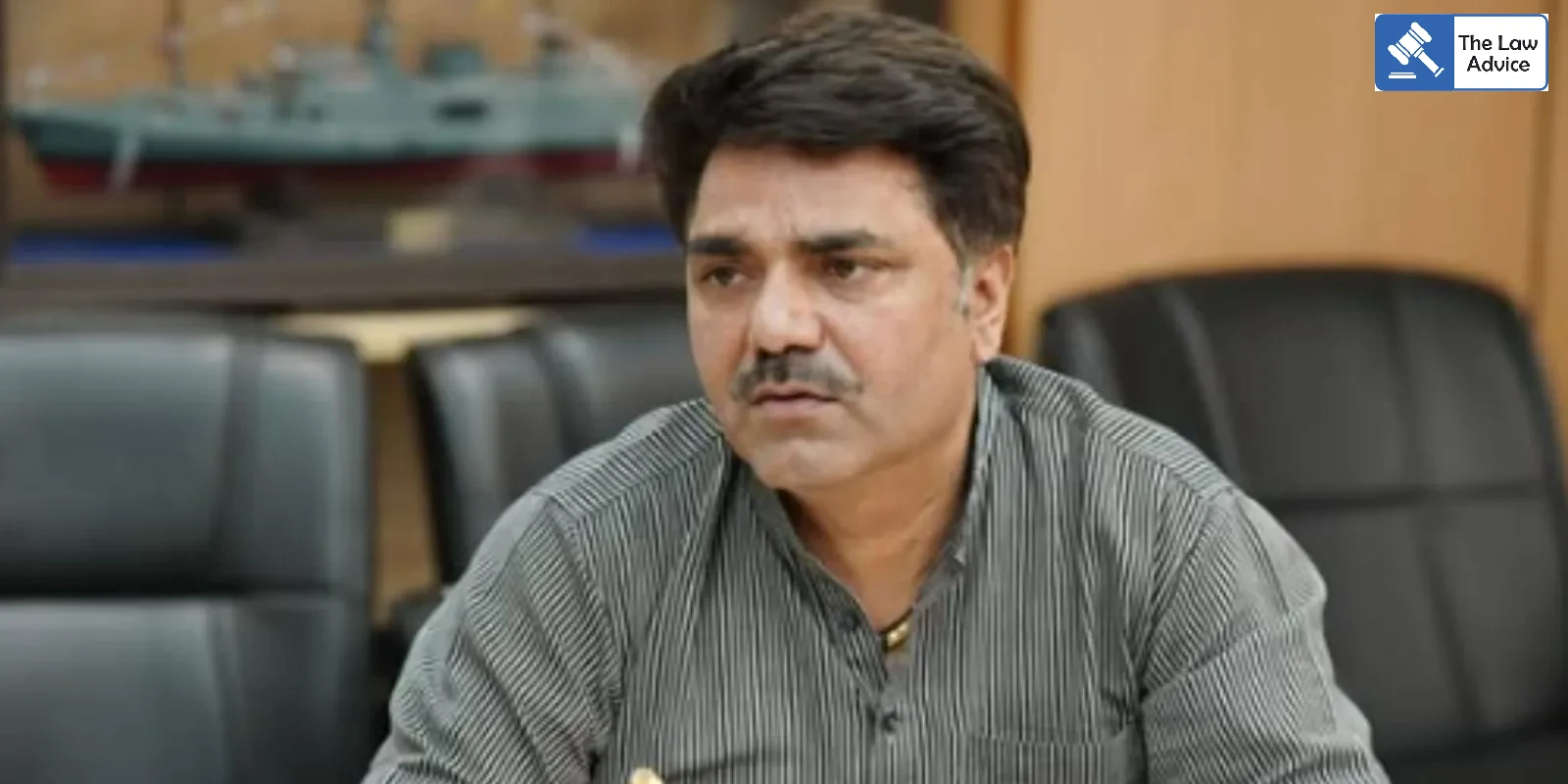
The Supreme Court on Monday issued notice on the bail plea of former Aam Aadmi Party MLA Naresh Balyan in a case registered under the Maharashtra Control of Organised Crime Act (MCOCA).
A Bench of Justices Vikram Nath and Sandeep Mehta granted four weeks to the Delhi Government to file its response to Balyan’s plea.
Balyan has approached the Supreme Court challenging the Delhi High Court’s August 3 order, which refused to interfere with the trial court’s rejection of his bail application.
The case relates to an FIR registered by the Delhi Police Crime Branch on August 28, 2024, under Sections 3 and 4 of the MCOCA. Balyan was arrested on December 4, 2024. His first bail plea was rejected by the trial court in January 2025, followed by a second rejection in May 2025.
According to the prosecution, the case concerns an organised crime syndicate allegedly headed by gangster Kapil Sangwan. The syndicate is accused of involvement in extortion, threats, shootings and illegal property dealings. Investigators have alleged that businessmen and property dealers were threatened for money, while property owners were allegedly pressured into selling plots at below-market prices.
The Delhi High Court, while rejecting Balyan’s appeal, had held that sufficient material existed at the bail stage to indicate his alleged connection with the syndicate. Around 17 FIRs were reportedly linked to the syndicate’s activities.
The prosecution relied on alleged conversations between Balyan and Sangwan, statements of protected witnesses, confessional statements of co-accused and other investigation material. It alleged that Balyan helped identify potential extortion targets and facilitated property-related disputes allegedly used by the syndicate to threaten owners.
The High Court had also considered an audio-video recording purportedly featuring a conversation between Balyan and Sangwan. Balyan’s specimen voice was obtained with the permission of the designated court and was found to match the voice in the recording, according to the forensic report. However, the Court noted that the identity of the person on the other end of the conversation was not completely clear.
The prosecution further relied on confessional statements of co-accused Rohit Sharma and Sachin Chhikara. The High Court held that questions regarding the alleged retraction of those statements would have to be examined during the trial and could not be conclusively determined at the bail stage.
Balyan had argued that the invocation of MCOCA against him was legally unsustainable, contending that there was no fresh continuing unlawful activity attributable to him and no material establishing his membership of the alleged syndicate.
The High Court rejected these submissions, holding that the requirement of multiple chargesheets under the MCOCA was syndicate-centric and did not necessarily have to be satisfied against Balyan individually. It also rejected his contention that registration of a separate MCOCA FIR amounted to double jeopardy.
On bail, the High Court noted the stringent conditions under Section 21(4) of MCOCA, which require the Court to have reasonable grounds to believe that the accused is not guilty and is unlikely to commit an offence while on bail.
The High Court ultimately concluded that the investigation material disclosed a discernible nexus between Balyan and the alleged syndicate and that the requirement of continuing unlawful activity was satisfied.
With arguments on framing of charges already underway before the trial court, the High Court also observed that prolonged custody alone could not justify bail in a case involving stringent MCOCA provisions.
The Supreme Court will now consider Balyan’s challenge to the denial of bail after receiving the Delhi Government’s response.
Case: SLP (Crl) No. 14919/2026
Website designed, developed and maintained by webexy