
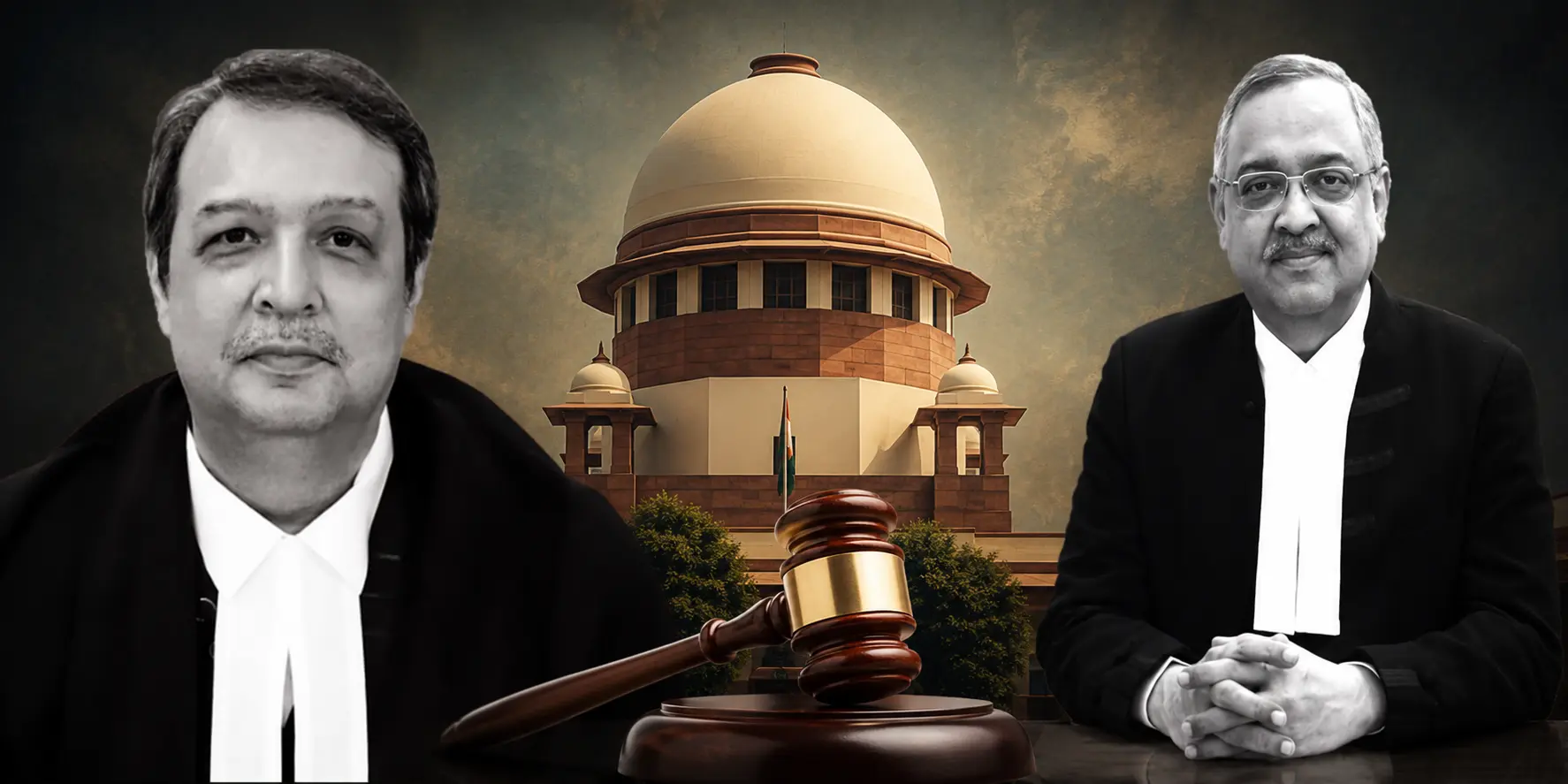
Supreme Court Acquits Murder Accused, Rules Prior Trial Evidence Cannot Be Used Without Compliance with Section 299 CrPC
In a significant ruling on the rights of absconding accused persons and the admissibility of evidence recorded in their absence, the Supreme Court of India has held that testimony recorded during the trial of a co-accused cannot be relied upon against an absconding accused in a subsequent trial unless the mandatory requirements of Section 299 of the Code of Criminal Procedure, 1973, were complied with when the evidence was originally recorded.
A Bench of Justice J. B. Pardiwala and Justice K. Vinod Chandran delivered the judgment in Mahendra Singh v. State of Chhattisgarh (2026 INSC 775), acquitting the appellant of murder after finding that the prosecution had failed to satisfy the statutory prerequisites under Section 299 CrPC.
Background
The case arose from a murder that took place on 1 April 1999 in Chhattisgarh. Two persons were accused of committing the offence. According to the prosecution, Mahendra Singh, the appellant, allegedly strangulated the deceased while sitting on his chest, whereas the co-accused allegedly exhorted the assault and threatened eyewitnesses.
Following the incident, Mahendra Singh absconded. His case was split up, while the co-accused was tried separately and eventually acquitted.
The appellant was arrested nearly 18 years later, in September 2017, and put on trial.
During the fresh trial, the prosecution relied heavily on the testimony of a crucial eyewitness who had deposed in the earlier trial but had died before Mahendra Singh's trial commenced.
The Trial Court convicted the appellant, and the conviction was upheld by the High Court.
Core Issue Before the Supreme Court
The principal legal question before the Court was:
Can evidence recorded during the earlier trial of a co-accused be used against an absconding accused in a subsequent trial merely because the witness later becomes unavailable?
The answer, according to the Supreme Court, is No, unless the mandatory procedure prescribed under Section 299 CrPC had been followed.
Interpretation of Section 299 CrPC
The Court undertook a detailed analysis of Section 299 CrPC and reiterated the settled legal position laid down in earlier decisions, including Nirmal Singh v. State of Haryana, Jayendra Vishnu Thakur v. State of Maharashtra, and Sukhpal Singh v. NCT of Delhi.
The Bench explained that Section 299 is an exception to the general rule requiring an accused to have the opportunity to cross-examine prosecution witnesses.
Before evidence can be recorded in the absence of an accused and later used against him, the Court must first record findings on two essential jurisdictional facts:
Both conditions must be established conjunctively, not alternatively.
Mandatory Judicial Satisfaction
The Supreme Court emphasized that merely declaring an accused absconding or issuing proclamation proceedings is insufficient.
The court recording the evidence must pass a specific judicial order under Section 299 after examining material demonstrating both:
Only thereafter can witness testimony be preserved for possible use in a later trial if the witness subsequently dies, becomes incapable of giving evidence, cannot be located, or cannot reasonably be produced before the court.
Why the Conviction Failed
Applying these principles, the Bench found that no order under Section 299 CrPC had ever been passed when the appellant absconded in 1999.
Although evidence was recorded during the trial of the co-accused, the prosecution had never obtained the mandatory judicial finding that the appellant was absconding and unlikely to be arrested in the near future.
Consequently, the deposition of the deceased eyewitness could not legally be read against Mahendra Singh during his subsequent trial.
The Court also noted that:
Without the inadmissible prior testimony, the prosecution case collapsed.
Important Legal Principle
The Court observed that Section 299 seeks to balance two competing interests:
While an accused who deliberately evades the legal process cannot later insist upon every procedural protection, the prosecution must nevertheless strictly comply with the statutory safeguards before depriving him of that right.
The Bench reiterated that Section 299 constitutes a narrow exception to the ordinary rule under the law of evidence and therefore must be applied strictly.
Verdict
Allowing the appeal, the Supreme Court set aside the conviction and acquitted Mahendra Singh of all charges.
The Court directed that:
Case Details:-
Special Leave Petition (Crl.) No.6741 of 2026)
Mahendra Singh ….Appellant
Versus
The State of Chhattisgarh ….Respondent

Representation:-
For Petitioner(s) :Mr. Jayesh K. Unnikrishnan, AOR Mrs. Sasmita Tripathy, Adv. Ms. Smriti Parija, Adv. Mrs. Gitanjali Tripathy, Adv. Ms. Gautami Budhapriya, Adv. Mr. Niranjan Bishi, Adv. Mr. Abhilash Joseph, Adv. Mr. Ashish Kumar Rai, Adv. Mr. Ayush Baliarsingh, Adv. Mr. Somesh Sankhala, Adv.
For Respondent(s) :Mr. Siddhartha Sinha , AOR Mr. Praneet Pranav, D.A.G. Mr. Abhishek Pandey, Adv.
Website designed, developed and maintained by webexy