
Adultery Plea Under Section 125(4) CrPC Must Be Decided Before Final Maintenance; Calls for Regulation of Private Detectives
In a significant judgment clarifying the law on maintenance under Section 125 of the Code of Criminal Procedure, the Supreme Court of India has held that where a husband raises a plea under Section 125(4) CrPC alleging that the wife is living in adultery, the court cannot postpone consideration of that plea until the final disposal of the maintenance case. Instead, the application under Section 125(4) must be adjudicated on its own merits during the pendency of the proceedings, as its outcome directly affects the wife's entitlement to both interim and final maintenance.
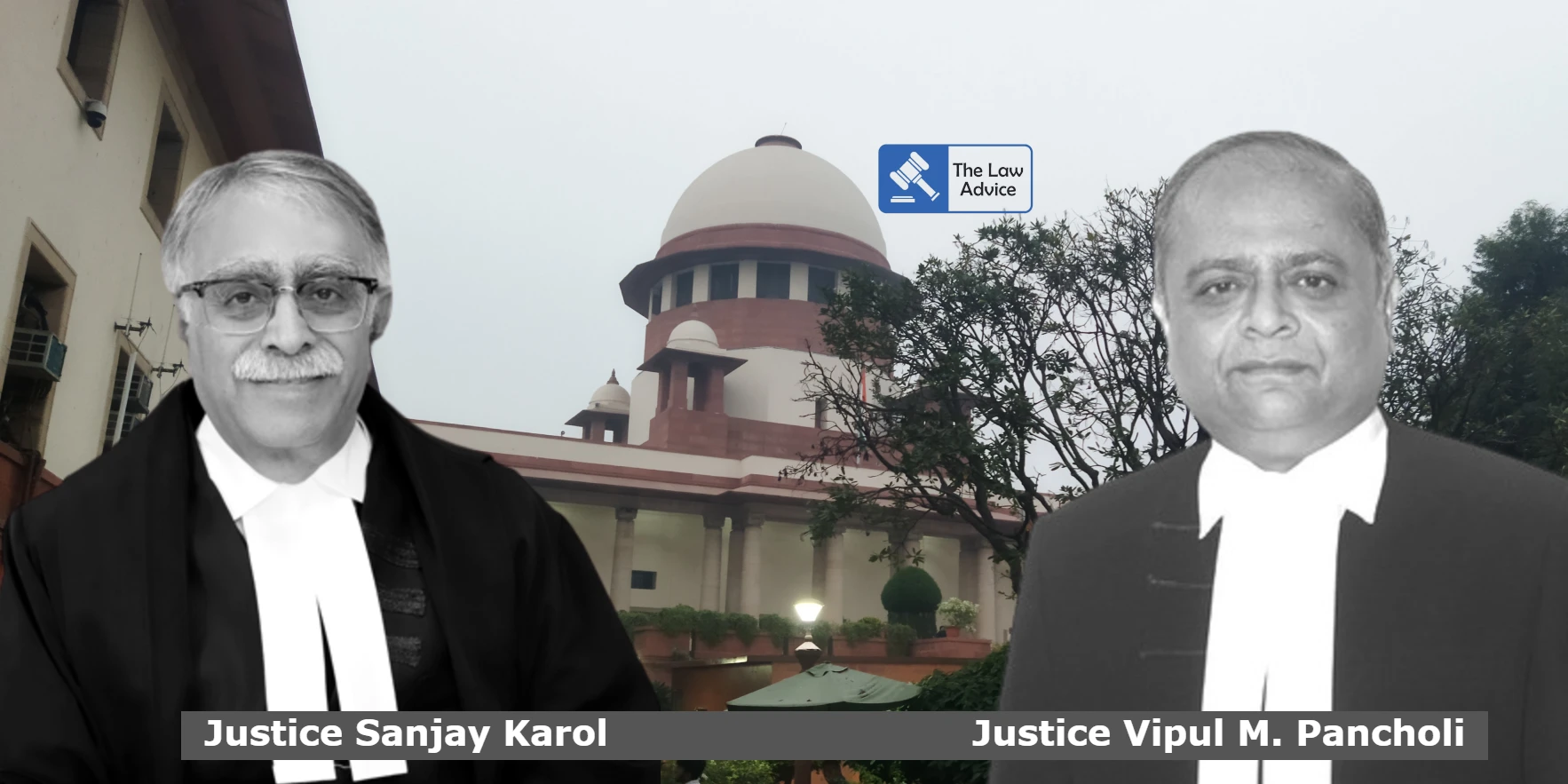
A Bench comprising Justice Sanjay Karol and Justice Vipul M. Pancholi delivered the judgment in Himanshu Chordia v. State of Rajasthan & Anr. (2026 INSC 778).
Background
The dispute arose from matrimonial proceedings between Himanshu Chordia and Arushi Jain, who married in July 2014. Following marital discord, the wife left the matrimonial home in May 2020 with their child and subsequently initiated proceedings under Section 125 CrPC seeking maintenance.
The husband opposed the claim by filing an application under Section 125(4) CrPC, alleging that the wife was living in an adulterous relationship and therefore stood disqualified from claiming maintenance under the statute. He relied upon photographs, videos and other electronic material to substantiate his allegations.
However, the Trial Court refused to examine the issue at that stage, observing that the allegations could only be determined after recording evidence during the final adjudication of the maintenance petition. The Trial Court thereafter awarded interim maintenance of ₹25,000 each to the wife and the minor son.
The Rajasthan High Court affirmed this approach, holding that adultery was a disputed question of fact which should be decided only while finally deciding the maintenance proceedings.
Aggrieved, the husband approached the Supreme Court.
Supreme Court's Analysis
The Court undertook an extensive examination of the object and scope of Section 125 CrPC, reiterating that maintenance provisions are social welfare measures intended to prevent destitution and vagrancy and must ordinarily receive a liberal interpretation.
However, the Bench emphasized that Parliament itself has carved out specific exceptions under Section 125(4), one of which is where the wife is "living in adultery."
According to the Court, once such an objection is raised, the court cannot simply defer its consideration until the final stage because doing so would render Section 125(4) largely ineffective.
The Bench held that:
Interim Maintenance Need Not Automatically Stop
The Court clarified that merely filing an application under Section 125(4) does not automatically suspend interim maintenance.
Instead, two situations may arise:
Thus, the Court balanced the beneficial object of maintenance law with the statutory exception created by Parliament.
High Court and Trial Court Erred
The Supreme Court held that both the Trial Court and the High Court committed an error by holding that the allegation of adultery could only be examined at the time of final disposal.
According to the Bench, such an interpretation would make Section 125(4) practically redundant.
Since the Trial Court had rejected the husband's application without examining its merits, the Supreme Court set aside the Rajasthan High Court's judgment and remanded the matter to the Trial Court for fresh consideration of the Section 125(4) application.
Strong Observations on Private Detectives
Apart from deciding the maintenance issue, the judgment makes extensive observations on the growing use of private investigators in matrimonial litigation.
The husband had produced nearly 237 photographs and 92 videos allegedly showing the wife's relationship with another individual.
The Court expressed concern over several unanswered questions, including:
The Bench observed that India presently lacks any regulatory framework governing private investigators despite their increasing use in civil and matrimonial disputes.
Need for Legislative Framework
The Court referred to the Private Detective Agencies (Regulation) Bill, 2007, noting that although it proposed licensing, oversight and regulation of private detective agencies, it never became law.
The Bench observed that regulation is now even more necessary because private investigators routinely collect electronic evidence affecting privacy, personal data and dignity.
It also stressed the importance of ensuring:
Electronic Evidence Must Meet Legal Standards
The Supreme Court also reiterated that electronic evidence must satisfy the mandatory requirements governing admissibility under Section 65B of the Indian Evidence Act, 1872 (and corresponding provisions under the Bharatiya Sakshya Adhiniyam, 2023), including the statutory certificate wherever required.
The Court emphasized that authenticity, source verification and reliability of electronic material assume even greater significance where allegations such as adultery are sought to be proved.
Directions Issued
Recognising the urgent need for reform, the Supreme Court directed that a copy of its judgment be forwarded to:
so that they may consider framing an appropriate regulatory framework governing private investigators in India.
The appeal was accordingly allowed, the Rajasthan High Court's judgment dated 4 February 2025 was set aside, and the matter was remanded to the Trial Court for fresh adjudication of the husband's application under Section 125(4) CrPC.

Representation:-
For Petitioner(s) : Mr. S. S. Jauhar, AOR, Mr. Prabhjit Jauhar, Adv., Ms. Tulika Bhatnagar, Adv., Ms. Chahat Raghav, Adv., Ms. Shreya Narayan, Adv. Mr. Tanay Kalia, Adv.
For Respondent(s) : Mr. Shiv Mangal Sharma, A.A.G., Ms. Shalini Singh, Adv., Mr. Aishwarya Jaiswal, Adv., Ms. Nidhi Jaswal, AOR, Ms. Preeti Singh, AOR, Mr. Sunklan Porwal, Adv., Ms. Kriti Dahiya, Adv., Ms. Sakshi Trivedi, Adv., Mr. Akshay Chhabra, Adv.
Website designed, developed and maintained by webexy