
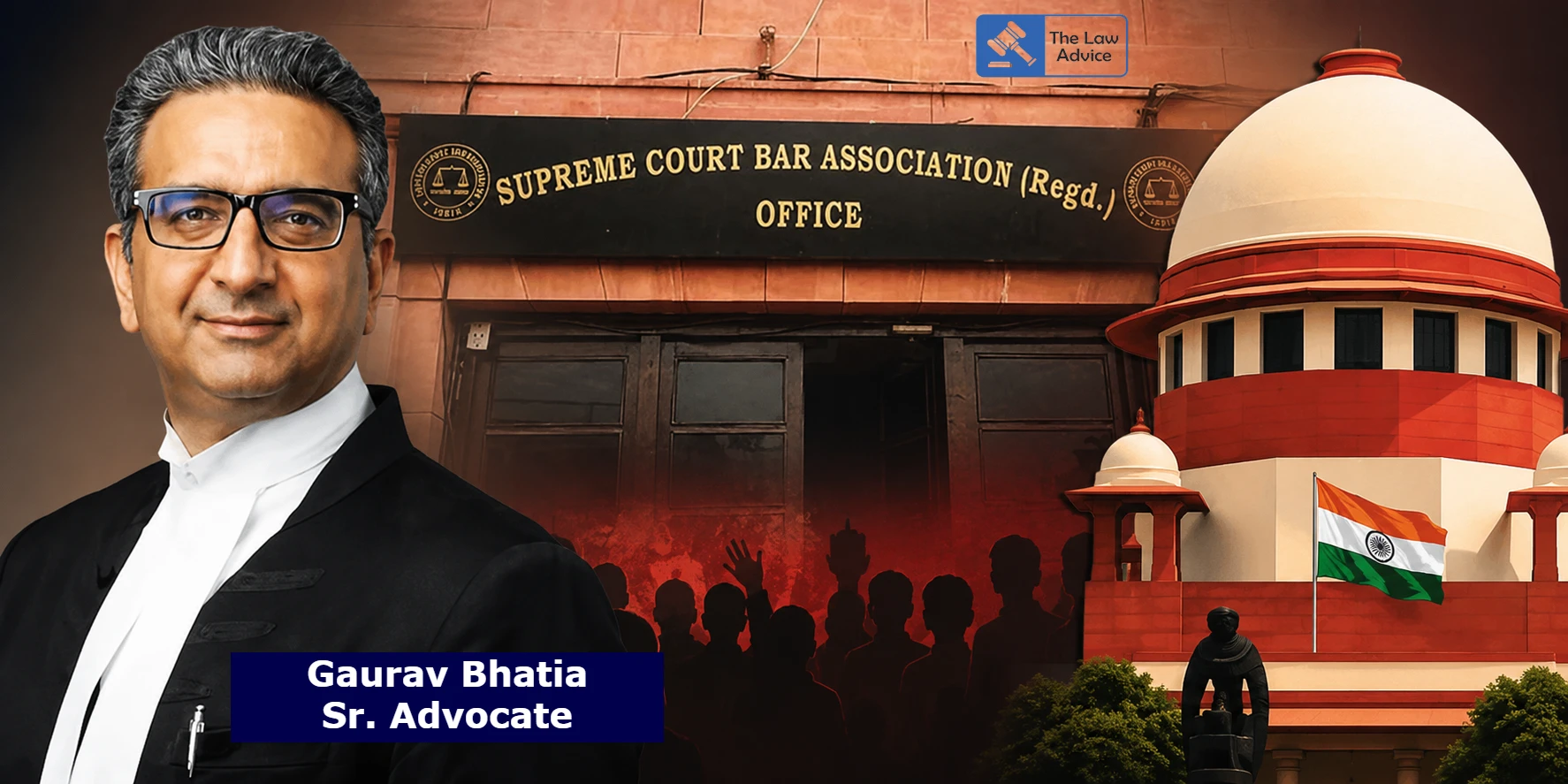
The Supreme Court Bar Association (SCBA) has witnessed several legal luminaries occupy the office of its President over the decades, including M.C. Setalvad, C.K. Daphtary, M.C. Chagla, A.K. Sen, L.M. Singhvi, M.C. Bhandare, P.P. Rao, K.K. Venugopal, R.K. Jain, Ram Jethmalani and Kapil Sibal, among others. Yet, despite their stature and eminence at the Bar, several distinguished members of the Supreme Court Bar have either chosen not to enter the electoral politics of the Association or have tried and failed to secure its top post.
The 2026 SCBA presidential election once again demonstrated that professional stature and public visibility alone do not guarantee electoral success. Senior Advocate Pradeep Rai emerged victorious with a decisive mandate, while Senior Advocate Gaurav Bhatia finished fourth with 370 votes.
What explains Bhatia's defeat?
The Law Advice spoke to members of the Supreme Court Bar to understand the factors that may have shaped the result. While no single reason can conclusively explain the outcome, three broad factors emerged from the discussions.
A fragmented field divided the vote
The first was the fragmentation of the presidential contest.
Seven candidates were in the fray, with Pradeep Rai securing 822 votes, Anupam Lal Das 451, Adish Agarwala 412, Gaurav Bhatia 370, Sukumar Pattjoshi 269, Siddharth Mridul 217 and Mahalakshmi Pavani 128.
The numbers show how widely the vote was distributed. Bhatia was only 42 votes behind Agarwala and 81 behind Das, but Rai was 371 votes ahead of the runner-up. The election, therefore, never crystallised into a direct contest between Rai and a single challenger.
Three candidates with overlapping political constituencies
According to some voters spoken to by The Law Advice, another factor was the presence of three prominent candidates—Pradeep Rai, Adish Agarwala and Gaurav Bhatia—who were perceived as broadly aligned with a similar political establishment or ideological space.
The argument is that the presence of multiple candidates appealing to overlapping sections of the electorate divided what might otherwise have become a consolidated vote. Rai eventually emerged as the principal beneficiary, polling 822 votes, while Agarwala and Bhatia secured 412 and 370 respectively.
This should, however, be understood as an assessment of the voting pattern rather than an established fact about the motivations of individual voters.
Bhatia's reduced presence at the Court
The second factor identified by voters was Bhatia's relatively reduced day-to-day presence within the Supreme Court premises in the period preceding the election.
After serving as Secretary of the SCBA, Bhatia became increasingly involved in active politics. According to some members of the Bar, this resulted in comparatively less regular interaction with advocates at the Supreme Court.
That distinction can be significant in an SCBA election. Unlike a conventional political election, the electorate is a relatively small and closely connected professional community. Regular accessibility, personal equations and day-to-day interaction with members can play an important role in building and maintaining electoral support.
Bhatia continued to enjoy considerable visibility as a senior advocate and public figure. But some voters felt that his wider public profile could not entirely substitute for regular engagement with the immediate electorate of the SCBA.
Again, this is an electoral assessment based on conversations with members of the Bar and should not be treated as a definitive explanation for individual voting decisions.
Welfare was not an uncontested space
Bhatia's campaign itself was built around a strong welfare-oriented message. He described his approach as "action-driven welfare", with an emphasis on accessibility, infrastructure and the interests of younger members of the Bar. Among his proposals were 500 dedicated lockers and 500 new chambers, along with a broader focus on making the SCBA more inclusive.
But Bhatia was not alone in making welfare a central campaign issue.
Rai also placed welfare and institutional reform at the heart of his campaign. During the presidential debate, he promised medical security cover of up to ₹50 lakh, scholarships for children of SCBA members and action on the existing sequencing system at the Supreme Court.
The contest, therefore, was not simply between a candidate focused on welfare and candidates who were not. It was also about which candidate could persuade voters that his proposals were more immediately achievable and that he had the institutional experience to implement them.
Rai's organisational advantage
Rai entered the election with considerable experience within the SCBA. He had previously served as Vice-President and had contested the presidency before. His campaign also highlighted initiatives associated with his earlier tenure in the Association.
Bhatia, too, was no outsider. He had served as Honorary Secretary of the SCBA and had a strong professional profile among Supreme Court lawyers. Yet the result suggests that Rai was more successful in converting his organisational experience and existing relationships into a broad electoral coalition.
Visibility did not translate into a winning coalition
Bhatia's campaign was visible and centred on issues that directly affect members of the Bar, including welfare, infrastructure and opportunities for younger advocates. He also received support from prominent members of the legal fraternity.
But the final numbers reveal the central problem.
Bhatia secured 370 votes—a substantial base, but one that remained considerably smaller than Rai's 822. His vote was enough to keep him within striking distance of Agarwala and Das, but not enough to emerge as the principal challenger to Rai.
The result, therefore, does not necessarily suggest a rejection of Bhatia by the Bar. Rather, it suggests that he was unable to expand his existing support into a sufficiently broad coalition.
The larger story: Rai's consolidation
The 2026 SCBA election may ultimately be as much a story about Rai's ability to consolidate support as it is about Bhatia's defeat.
With seven candidates competing for the presidency, Rai succeeded in establishing himself as the clear front-runner and finished 371 votes ahead of the runner-up. Bhatia, meanwhile, remained part of a closely contested second tier but could not break away from it.
There is no evidence to suggest that Bhatia's defeat was caused by any single controversy or voter backlash. The more measured reading of the result is that vote fragmentation, overlapping political constituencies, reduced day-to-day engagement with sections of the Bar, and competition over the welfare agenda combined to limit his ability to convert his professional and public profile into votes.
For Bhatia, the 370-vote tally represents neither an electoral collapse nor a winning mandate. It represents a substantial constituency that remained fragmented and, ultimately, insufficient to challenge Rai's much broader support base.
The 2026 election thus reinforces an enduring feature of SCBA politics: in the Supreme Court Bar, stature may open the door to the contest, but accessibility, relationships, organisational groundwork and the ability to consolidate the electorate can determine who ultimately walks into the President's office.
Website designed, developed and maintained by webexy