
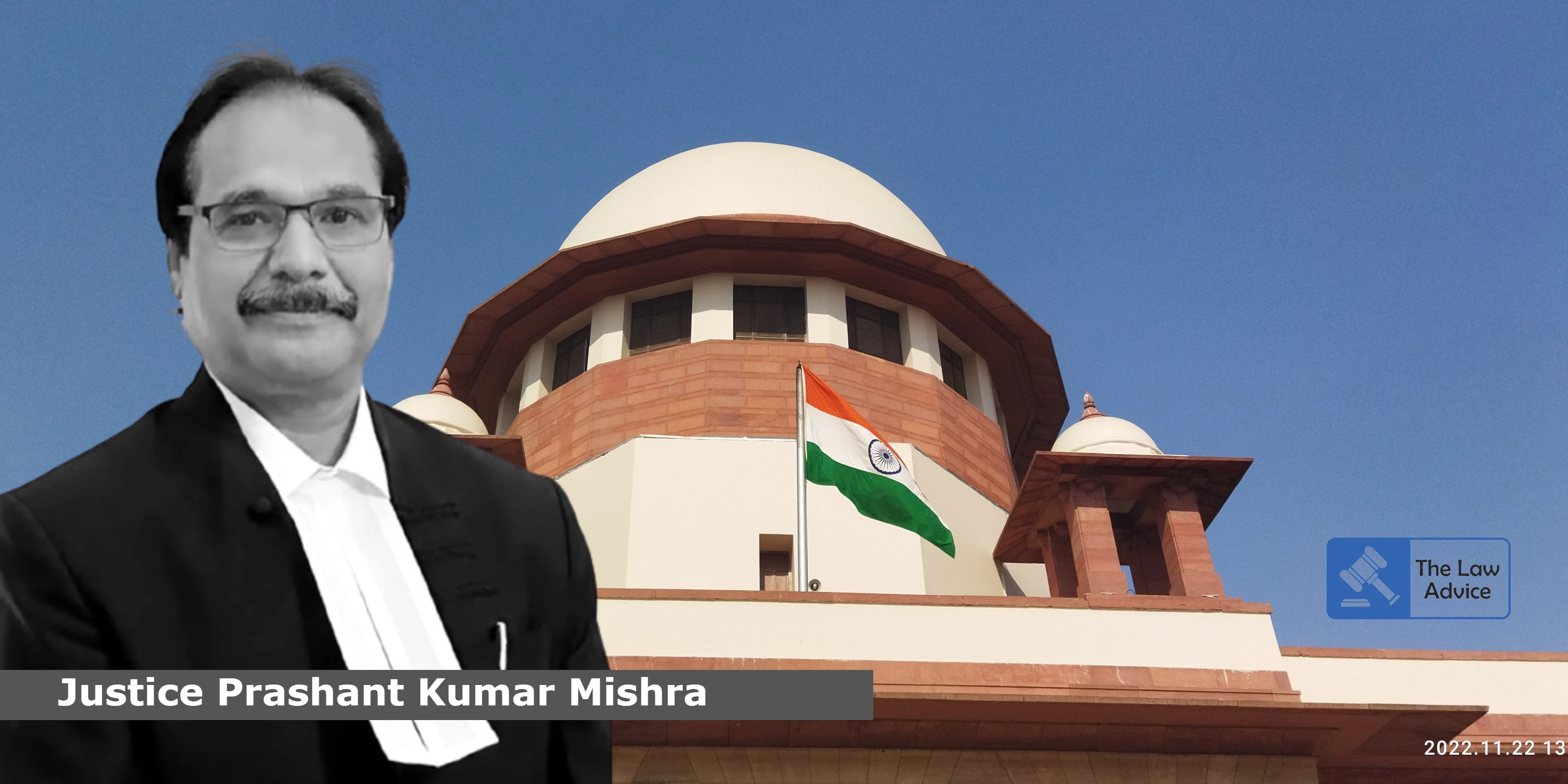
The Supreme Court on Monday dismissed a petition challenging the appointment of Padmesh Mishra, son of sitting Supreme Court Justice Prashant Kumar Mishra, as an Additional Advocate General (AAG) for Rajasthan.
A Bench comprising Justices Aravind Kumar and Vipul M Pancholi dismissed the challenge against the Rajasthan High Court judgment that had upheld Mishra’s appointment.
The petitioner had questioned the appointment on the ground that Mishra was enrolled as an advocate only in August 2019 and therefore had significantly less professional experience than the eligibility requirements ordinarily prescribed for the post.
Mishra was appointed as a panel lawyer at the Supreme Court on August 20, 2024. The appointment, according to the petition, required a minimum of five years of practice.
However, on August 23, 2024, the Rajasthan government amended its 2018 Litigation Policy by inserting a clause empowering the appropriate authority to appoint “any counsel to any post” based on the counsel's expertise, notwithstanding the other eligibility conditions.
On the same day, Mishra's appointment as a Supreme Court panel lawyer was withdrawn and he was appointed as an Additional Advocate General before the Supreme Court—a position that otherwise required 10 years of practice under the policy.
The petitioner argued that the sequence of events indicated that the amendment was specifically introduced to facilitate Mishra's appointment.
The plea also highlighted the experience of other Additional Advocate Generals appointed by the Rajasthan government.
According to the petitioner, 20 other AAGs had an average experience of more than 25 years, with the least experienced having 13 years of practice. Mishra's experience at the time of his appointment was therefore substantially lower than that of the other AAGs.
The petitioner further alleged that there had been no effective consultation with the Advocate General as required under the litigation policy and that no objective criteria had been prescribed to determine Mishra's claimed expertise.
The Rajasthan High Court had earlier dismissed a writ petition challenging the appointment, holding that the State's litigation policy was not legally enforceable and that consultation with the Advocate General was not a mandatory precondition.
In December 2025, a Division Bench of the High Court upheld that decision and additionally held that the office of an Additional Advocate General was not a “public office” and was therefore not amenable to judicial review.
The High Court had also observed that the art of advocacy and presentation of a case is not necessarily dependent upon years of experience.
The petitioner subsequently approached the Supreme Court, arguing that the litigation policy was binding because it had been framed pursuant to an earlier direction of the Supreme Court.
It was also argued that the AAG post should be treated as a public office, since the office-holder is appointed under the Governor's authority and receives remuneration from the government.
The Supreme Court, however, concurred with the Rajasthan High Court's view that the office of an Additional Advocate General is not a “public office” and dismissed the petition.
The dismissal brings the challenge to Padmesh Mishra's appointment as Rajasthan AAG to an end.
Website designed, developed and maintained by webexy