
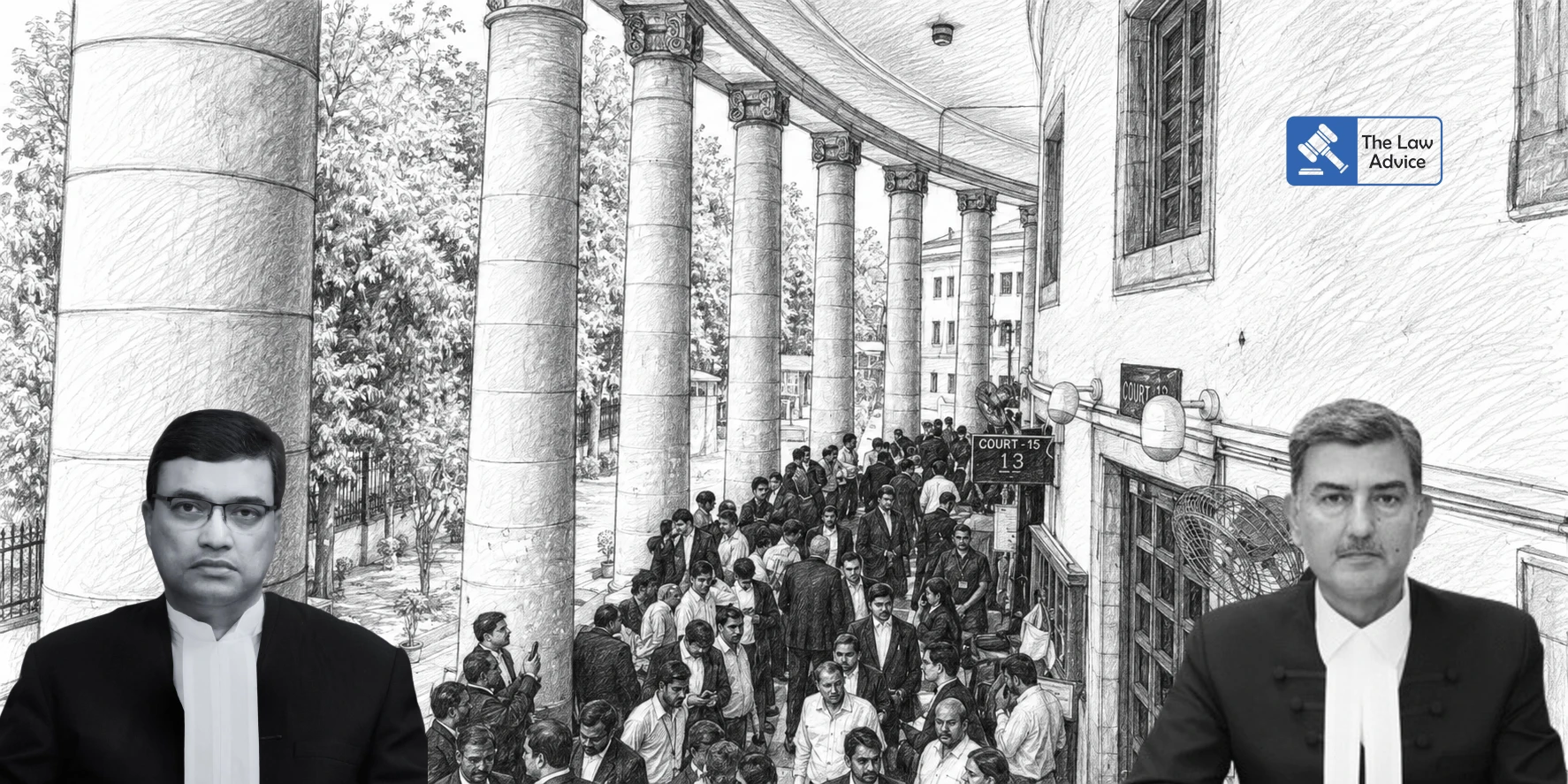
The Supreme Court has affirmed that the Enforcement Directorate (ED) cannot freeze bank accounts merely on the basis of suspicion and must satisfy the statutory requirement of having “reasons to believe” before taking such coercive action under the Prevention of Money Laundering Act, 2002 (PMLA).
A bench comprising Justice Dipankar Datta and Justice Sheel Nagu dismissed the ED’s challenge against the Delhi High Court judgment, holding that the requirement of “reasons to believe” under Section 17(1) of the PMLA equally applies to freezing of bank accounts under Section 17(1A).
The Supreme Court upheld the Delhi High Court’s interpretation that although Section 17(1A) does not expressly mention the phrase “reason to believe”, it cannot be read independently from Section 17(1), which governs search and seizure actions under the PMLA.
The High Court’s reasoning, approved by the Supreme Court, was:
“Although Section 17(1A) does not expressly use the phrase ‘reason to believe’, it cannot be read in isolation from Section 17(1). The operation of Section 17(1A) is intrinsically linked to the practicability of effecting a seizure under Section 17(1), and such seizure can only be undertaken upon the formation of a ‘reason to believe’.”
The Court observed that freezing of a bank account is merely an alternative mechanism to seizure and, therefore, cannot be subjected to a lower threshold than the requirement applicable for seizure.
The case arose from the ED’s freezing of two bank accounts belonging to Poonam Malik, wife of Ranjit Malik, who was allegedly linked with Gagan Dhawan, an accused in the alleged Sterling Biotech Limited bank fraud case involving more than ₹5,000 crore.
However, neither Poonam Malik nor her husband was named in the FIR or the ECIR.
The ED had passed a freezing order stating:
“Whereas, it is suspected that amount involved in money laundering are lying in the above mentioned bank account…”
The order prohibited debit transactions from the accounts until further directions.
The Adjudicating Authority confirmed the freezing order, but the Appellate Tribunal later set it aside. The matter eventually reached the Delhi High Court.
The Delhi High Court ruled that the freezing orders dated September 5, 2018 could not be sustained as they were passed without complying with mandatory statutory requirements and procedural safeguards.
The High Court further held that an unreasoned freezing order violates the constitutional protection under Article 300-A of the Constitution, which provides that no person shall be deprived of property except by authority of law.
The Court observed:
“The freezing of a bank account in violation of statutory requirements has far-reaching consequences. Such action directly impinges upon the constitutional right to property guaranteed under Article 300A of the Constitution of India.”
The judgment reinforces the principle that investigative agencies must follow statutory safeguards while exercising extraordinary powers under the PMLA.
The ruling places an important limitation on the ED’s power to freeze bank accounts and clarifies that:
Mere suspicion is insufficient for freezing bank accounts.
The ED must record valid reasons to believe that the account contains proceeds of crime.
Freezing of property affects the constitutional right to property under Article 300-A.
Procedural safeguards under PMLA cannot be bypassed.
Directorate of Enforcement v. Poonam Malik
Bench: Justice Dipankar Datta and Justice Sheel Nagu
Court: Supreme Court of India
Website designed, developed and maintained by webexy