
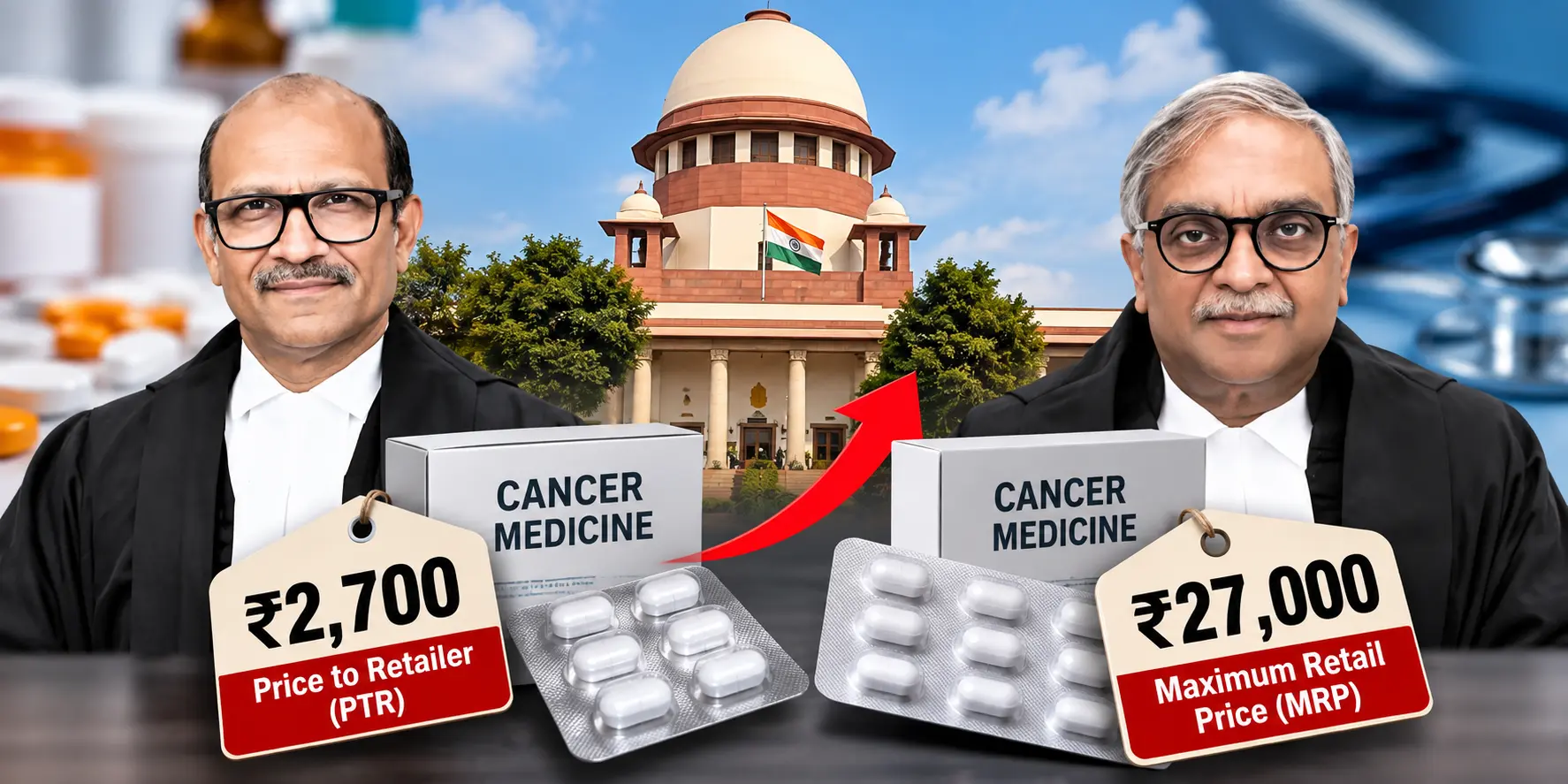
The Supreme Court on Tuesday raised serious concerns over the absence of effective price controls on several life-saving medicines, particularly cancer drugs, after being informed of a massive gap between the Price to Retailer (PTR) and Maximum Retail Price (MRP).
A Bench comprising Justice Vikram Nath and Justice Sandeep Mehta was hearing a petition in Kishan Chand Jain v. Union of India, seeking, among other measures, mandatory prescription of generic medicines, regulation of prices of non-scheduled medicines and price caps on medical devices.
During the hearing, the Court was informed that an essential cancer medicine was being sold by a manufacturer to a retailer at a PTR of approximately ₹2,700, while its printed MRP was ₹27,000.
Justice Sandeep Mehta expressed strong concern over the disparity and remarked that such pricing amounted to “broad daylight dacoity” with patients.
“There are essential medicines for cancer for which MRP is ₹27,000 and PTR is ₹2,700. That is absolute rampage and carnage and broad daylight dacoity with the patients,” the Court observed.
The Bench also highlighted the implications of inflated MRPs for government-funded healthcare schemes, including Ayushman Bharat.
The Court observed that when hospitals purchase medicines at inflated prices and subsequently claim reimbursement under government health schemes, the financial burden ultimately falls on taxpayers.
The Bench described this as raising a serious concern of fraud on the public exchequer.
Petitioner Kishan Chand Jain submitted that under the Drug Price Control Order (DPCO), 2013, the National Pharmaceutical Pricing Authority (NPPA) regulates ceiling prices for scheduled medicines, but a substantial majority of medicines remain outside the scheduled list.
According to the petitioner's submissions, approximately 82% of medicines are non-scheduled, and there is no effective upfront price-fixation mechanism for such medicines when they are introduced into the market.
The petitioner argued that this allows manufacturers to launch medicines at prices that may provide substantial margins at the retail and hospital levels.
Justice Mehta also referred to the pricing disparity involving a commonly used cholesterol-lowering medicine.
The Bench observed that a strip of Rosuvas costs around ₹214 when it falls outside the scheduled-drug framework, whereas a combination containing aspirin, which comes within the DPCO framework, could cost around ₹70.
The Court questioned the rationale behind such price differences, particularly where the combination product might ordinarily be expected to cost more.
The Bench further questioned the justification for exceptionally high margins on medicines when patients and their families are often compelled to exhaust their savings or sell property to finance medical treatment.
The Court observed:
“If that is not extortion, what else is it? A ₹100 medicine is being purchased by him for ₹2,000.”
The Bench also indicated that if a comprehensive price-fixation mechanism were introduced for medicines, the need for a separate debate over mandatory generic prescriptions could potentially be reduced.
Appearing for the Indian Pharmaceutical Alliance (IPA), Senior Advocate Kapil Sibal submitted that pharmaceutical manufacturers may not themselves retain the large margins reflected in the final MRP.
He argued that the Court should examine the prices at which medicines are supplied to stockists and retailers, stating that the actual point of concern could be further down the distribution chain.
Additional Solicitor General KM Nataraj, appearing for the Union Government, submitted that the Centre did not view the proceedings as adversarial and was committed to ensuring that medicines remain affordable and accessible.
He also referred to the Jan Aushadhi Kendra initiative.
However, the petitioner submitted that Jan Aushadhi Kendras account for only a small portion of India's overall pharmaceutical market and questioned what options remain available to patients for medicines that are not stocked through the scheme.
Justice Mehta also asked:
“The issue is, for those medicines which are not available in Jan Aushadhi Kendras, where does the patient go?”
The Supreme Court has now adjourned the matter to September 29, 2026, for further hearing.
Case: Kishan Chand Jain v. Union of India
Bench: Justice Vikram Nath and Justice Sandeep Mehta
Next Date: September 29, 2026
Website designed, developed and maintained by webexy