
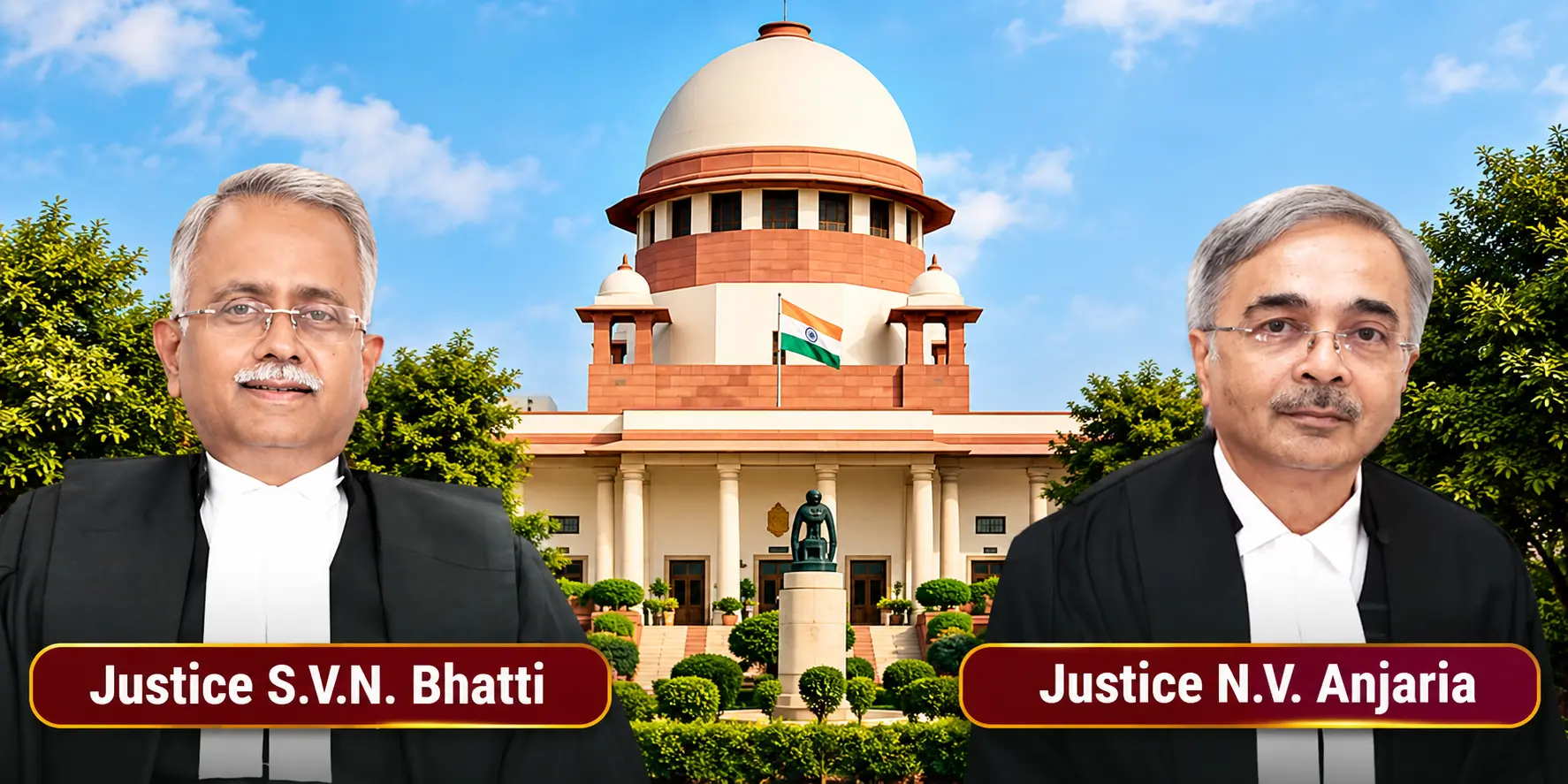
The Supreme Court has dismissed a civil appeal concerning inheritance rights in ancestral property, holding that a Hindu widow’s limited interest in property inherited under the Hindu Women’s Rights to Property Act, 1937 can enlarge into absolute ownership under Section 14(1) of the Hindu Succession Act, 1956, even in the absence of a partition.
A Bench of Justice S.V.N. Bhatti and Justice N.V. Anjaria dismissed the appeal filed by the legal representatives of Ganapati against the Karnataka High Court judgment concerning properties situated in Terdal Village, Jamkhandi Taluka, Bagalkot District.
The dispute arose from the estate of Gangaram, who died intestate in 1949. He left behind his son Ganapati from his first wife and his second wife, Kashibai, who had two daughters.
Ganapati claimed that he had exclusively inherited Gangaram's estate and had become its absolute owner. The dispute concerned two house properties bearing TMC Nos. 1074 and 1075. After Kashibai's death in 1986, one of her daughters obtained mutation of the properties in her name on the basis of a registered Will executed by Kashibai in 1984.
The daughter subsequently sold one of the properties to a third party in 1995 while the suit was pending.
The Supreme Court considered the interplay between Section 3 of the Hindu Women's Rights to Property Act, 1937 and Section 14(1) of the Hindu Succession Act, 1956.
The Court held that the consistent legal position recognises a Hindu widow's interest as developing into an absolute right under Section 14(1), except in cases falling within Section 14(2).
The Court relied upon its earlier decisions, including V. Tulasamma v. Sesha Reddy and Raghubar Singh v. Gulab Singh, which recognise a Hindu widow's pre-existing right and the broad scope of Section 14(1).
Rejecting the argument that Kashibai could not acquire absolute ownership without a partition, the Supreme Court observed that the right conferred upon a widow under the 1937 Act was not dependent upon a partition having first taken place.
The Court held that partition between the plaintiff and Kashibai was not a sine qua non for her continuing to enjoy the property as an independent or absolute owner. Even where the property remained undivided, the shares in the coparcenary could fluctuate, but the widow's right could not be denied.
The Supreme Court concluded that the Karnataka High Court had correctly applied the applicable precedents and that its exercise of jurisdiction under Section 100 of the Code of Civil Procedure, 1908 was proper.
Accordingly, the Civil Appeal was dismissed, with no order as to costs.
Case: Ganapati (Dead) by LRs v. Prabhakar & Others
Citation: 2026 INSC 1033
Coram: Justice S.V.N. Bhatti and Justice N.V. Anjaria
Date: September 22, 2026.

Representation:-
For Appellant(s) : Mr. Anil Katarki, Adv. Ms. E. R. Sumathy, AOR Mrs. Veena Katarki, Adv. Mr. Deva Vrat Anand, Adv.
For Respondent(s): Mr. Shanthkumar V. Mahale, Sr. Adv. Ms. Jahanvi Malik, Adv. Mr. Shreyas Mahale, Adv. Mr. Adviteeya, Adv. Mr. Madhvendra Singh, Adv. Mr. Harisha S.R., AOR
Website designed, developed and maintained by webexy