
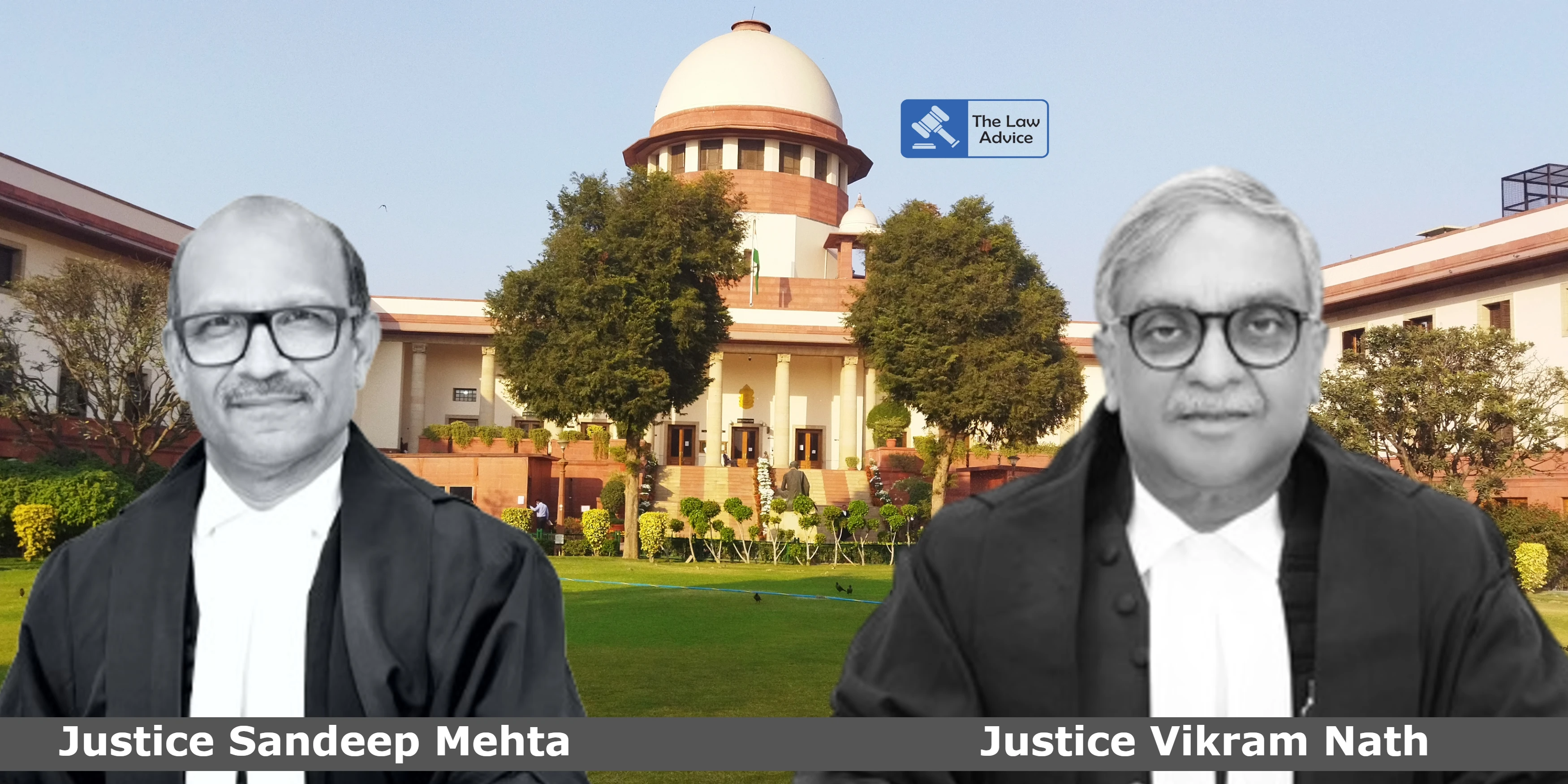
The Supreme Court has held that an aggrieved person can directly approach a Human Rights Court for prosecution of offences arising from alleged human rights violations, and that a prior inquiry or recommendation by the National or State Human Rights Commission is not a mandatory precondition.
A Bench comprising Justice Vikram Nath and Justice Sandeep Mehta delivered the ruling while setting aside a judgment of the Karnataka High Court that had struck down Rule 6 of the Karnataka State Human Rights Courts Rules, 2006 as unconstitutional and ultra vires the Protection of Human Rights Act, 1993.
The case arose from a complaint filed by Sayad Asifulla before the Human Rights Court at Vijayapura alleging violation of his human rights by police officials in connection with his custody. The Human Rights Court had referred the complaint for investigation under Section 156(3) CrPC, following which a criminal case was registered against the concerned police officials.
NHRC/SHRC Route Not Mandatory
The Supreme Court examined whether Rule 6, which permits complaints to be filed directly before a Human Rights Court, was inconsistent with the Protection of Human Rights Act, 1993.
The Court held that the Act creates two distinct and complementary mechanisms: Human Rights Commissions primarily perform an inquisitorial and recommendatory role, while Human Rights Courts exercise judicial power concerning offences arising from human rights violations.
The Bench rejected the argument that a complaint must first go through the Human Rights Commission before criminal proceedings can be initiated.
According to the Court, Sections 12 to 18 of the 1993 Act do not expressly make an inquiry or recommendation by the Commission a condition precedent for prosecution. Similarly, Section 30 does not make the jurisdiction of a Human Rights Court dependent upon completion of proceedings before the Commission.
Rule 6 Does Not Create a New Offence
The Court further held that Rule 6 of the 2006 Rules does not create any new offence, prescribe a new punishment or expand the definition of human rights.
Rather, it merely lays down the procedural mechanism through which the jurisdiction of a Human Rights Court under Section 30 of the 1993 Act can be invoked and exercised.
The Bench also rejected the argument that the State Government lacked authority to frame Rule 6. It held that Section 41(1) confers a general rule-making power to carry out the provisions of the Act, while the matters specifically mentioned in Section 41(2) are illustrative and do not exhaust that power.
Human Rights Commission and Court Provide Separate Remedies
Relying upon earlier decisions, including Paramvir Singh Saini v. Baljit Singh, the Court observed that complaints concerning human rights violations may be made to the Human Rights Commission as well as the Human Rights Courts.
The two remedies are distinct and complementary, and approaching the Commission is not a mandatory gateway before invoking the jurisdiction of a Human Rights Court.
The Court also rejected the argument that simultaneous recourse to the Commission and Human Rights Court would result in double jeopardy, holding that an inquiry or recommendation by the Commission does not amount to prior prosecution or punishment.
Karnataka High Court Judgment Set Aside
The Supreme Court concluded that Rule 6 of the Karnataka State Human Rights Courts Rules, 2006 is valid and intra vires the Protection of Human Rights Act, 1993.
It accordingly set aside the Karnataka High Court's July 17, 2025 judgment, as well as the consequential quashing of Crime No. 15 of 2024 and the proceedings arising from the complaint filed before the Human Rights Court at Vijayapura.
The Supreme Court clarified that it had not expressed any opinion on the merits of the allegations against the police officials and left all contentions and defences open for consideration by the competent court.
The appeals were accordingly allowed.
Case: Sayad Asifulla v. State of Karnataka & Ors.
Citation: 2026 INSC 964
Decision: August 25, 2026.

Representation:-
For Petitioner(s) :Mr. Aman Panwar, A.A.G. Mr. Avishkar Singhvi, A.A.G. Mr. Rajesh Gulab Inamdar, AOR Mr. B.L.N. Sanjit, Adv. Ms. Rakshita Singh, Adv. Mr. Ritik Grover, Adv. Ms. Bhawna Piplani, Adv. Mr. Abhishek Kaushik, Adv. Mr. Manav Kaushik, Adv. Ms. Aujaswi Makan, Adv. Mr. Nizam Pasha, Adv. Mr. Mushtaq Salim, Adv. Mr. Lzafeer Ahmad B. F., AOR Mr. Sidharth Kaushik, Adv. Ms. Awstika Das, Adv. Mr. Arif Ali, Adv
For Respondent(s) :Ms. Patil Rekha Chandra Gouda, AOR Dr. Vipin Gupta, AOR Mr. Krishna Kumar, Adv. Ms. Nandani Gupta, Adv.
Website designed, developed and maintained by webexy