
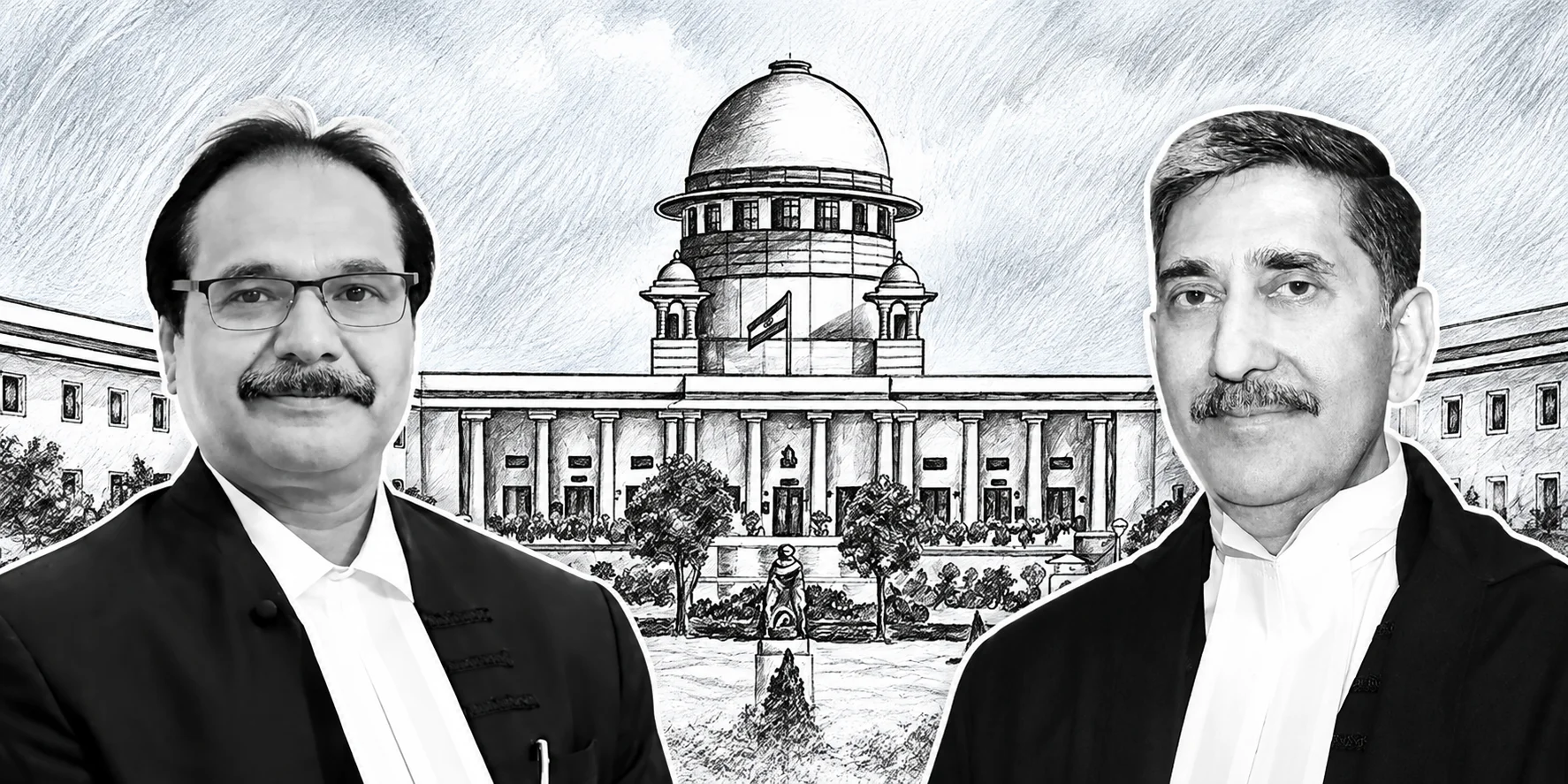
The Supreme Court has ruled that a widow cannot be denied family pension merely because she approached the authorities or the court after a considerable delay, particularly where the delay was not attributable to her.
A Bench comprising Justice Prashant Kumar Mishra and Justice Shree Chandrashekhar held that Maya Banerjee, widow of a deceased Railway employee, is entitled to family pension from the date of her husband’s death, November 12, 2000, rather than from 2014 when she first approached the Central Administrative Tribunal (CAT).
The Court directed the authorities to pay the entire arrears of family pension with interest at 6% per annum within three months.
Maya Banerjee's husband, Late K.M. Banerjee, was employed with the Railways as a Leverman and died in service on November 12, 2000. The appellant was living separately from her husband due to a dispute and, being an illiterate woman, earned her livelihood by working as a maid in the neighbourhood.
She was unaware of her husband’s service details and place of posting when he died.
The matter became complicated because, despite a Railway Board circular providing that disciplinary proceedings against an employee should be closed immediately upon his death, Banerjee's husband was dismissed from service after his death, on October 10, 2001.
Banerjee later challenged the dismissal and sought settlement of the dues. Her proceedings before the CAT were initially dismissed on the ground of limitation.
She also had to institute a civil suit to establish the correct date of her husband's death because conflicting dates had appeared in the Railway records. The civil court ultimately declared November 12, 2000 as the date of death, and that decree attained finality.
The High Court subsequently allowed her claim for family pension but restricted the payment to 2014 onwards, the year in which she first approached the CAT.
The Supreme Court held that restricting family pension to the period beginning in 2014 would be arbitrary and unjust, particularly considering the circumstances of the appellant.
The Court emphasized that pension and gratuity are no longer treated as a bounty from the Government but constitute valuable rights and property of the beneficiary.
The Bench relied particularly on its earlier decision in S.K. Mastan Bee v. General Manager, South Central Railway, which involved a similar claim by a widow who had been unaware of her legal entitlement to family pension.
In that case, the Supreme Court had held that it was the employer’s obligation to compute and offer family pension to an eligible widow without requiring her to initiate litigation.
An important legal issue before the Bench concerned the apparent conflict between S.K. Mastan Bee and Union of India v. Tarsem Singh.
While Tarsem Singh provides that arrears relating to pension claims are normally restricted to three years preceding the filing of a writ petition, the Court noted that S.K. Mastan Bee, which directly concerned a widow's family pension claim, had not been considered by the later coordinate Bench in Tarsem Singh.
The Supreme Court reiterated the settled principle that a coordinate Bench of equal strength cannot take a contrary view to an earlier coordinate Bench. If it disagrees with the earlier decision, the matter must be referred to a larger Bench.
Applying these principles, the Court held that the ratio in S.K. Mastan Bee was more directly applicable to the case.
The Bench observed that family pension is a valuable right akin to property and that denying arrears from the date they became due would cause serious injustice to the appellant, who was a poor widow and had not been responsible for the delay.
The Court also took note of the fact that the Railways had dismissed her husband after his death and that she had been compelled to approach a civil court to establish his correct date of death.
The Supreme Court accordingly allowed the appeals, modified the High Court's order and directed that Maya Banerjee shall receive family pension from November 12, 2000, the date of her husband's death.
The entire arrears are to be paid with 6% annual interest within three months.
Case: Maya Banerjee v. Union of India & Ors.
Citation: 2026 INSC 959
Decision: August 20, 2026.

Representation:-
For Petitioner(s) : Mr. P. V. Yogeswaran, Adv. Mr. Y. Lokesh, Adv. Mr. Bibek Tripathi, Adv. Mr. Arun Singh, Adv. Mr. V. Kandha Prabhu, Adv. Ms. Dhatri Singh, Adv. Ms. Hari Preethi, Adv. Mr. Surya Narayana Patro, Adv. Mr. Guneswaran Pv, Adv. Mr. Ashish Kumar Upadhyay, AOR
For Respondent(s) : Mr. Anil Kaushik, A.S.G. Mr. Rajat Nair, Adv. Mr. Pranjal Singh, Adv. Ms. Nasadiya Singh, Adv. Mr. Ishaan Sharma, Adv. Mr. Vibhu Shankar Mishra, Adv. Mr. Amrish Kumar, AOR
Website designed, developed and maintained by webexy