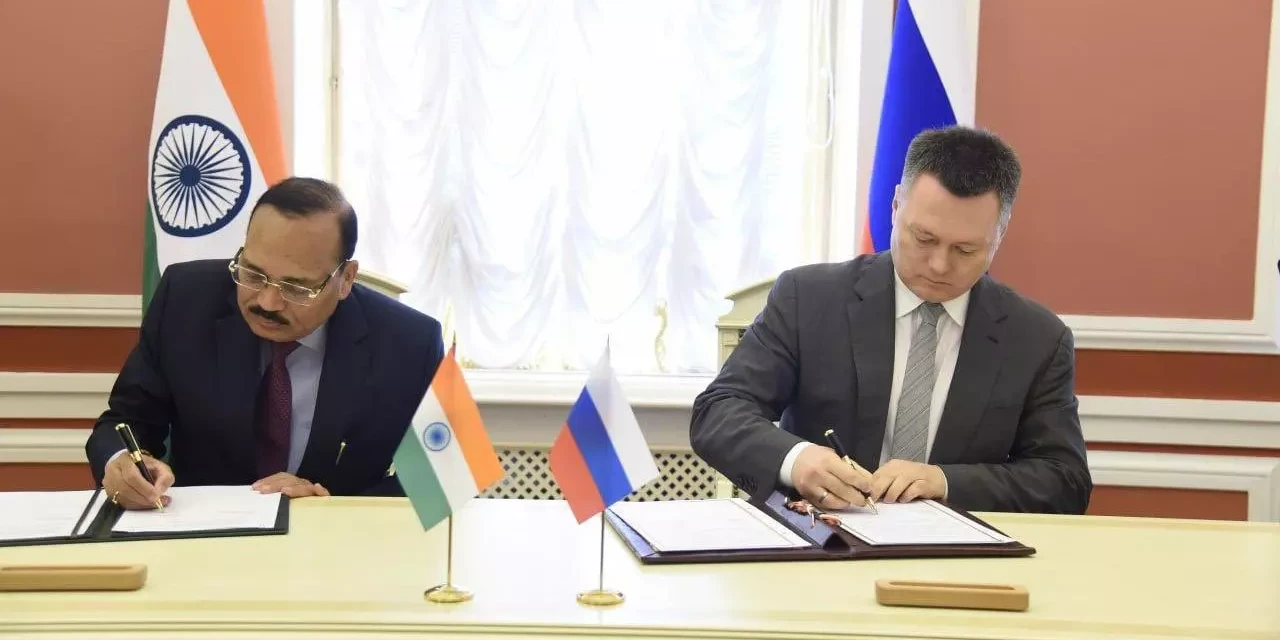
Supreme Courts of India and Russia Sign MoU on Judicial Cooperation; CJI Surya Kant Highlights Responsible Use of AI
The Supreme Court of India and the Supreme Court of the Russian Federation have signed a Memorandum of Understanding (MoU) to strengthen judicial cooperation between the two countries.
The agreement was signed in Moscow by Chief Justice of India Surya Kant and Chief Justice of the Supreme Court of the Russian Federation Igor Krasnov.
Addressing members of the Russian Supreme Court, CJI Surya Kant said that although India and Russia have developed under different legal systems, both countries face similar challenges in maintaining public trust in the justice system while adapting to rapid technological and social changes.
He emphasised that technology should be used to improve access to justice and not replace human decision-making in courts.
Highlighting India's digital transformation in the judiciary, CJI Surya Kant said the focus has been on making courts more accessible, transparent and efficient for citizens.
He also spoke about the increasing use of Artificial Intelligence in the judicial system and highlighted several initiatives undertaken by the Supreme Court.
Among them is SUVAS (Supreme Court Vidhik Anuvaad Software), an AI-powered translation tool that translates court judgments from English into 16 regional languages.
He also referred to the recently launched AI chatbot, "Su Sahay", which helps litigants, lawyers and members of the public access information related to court procedures, case status and filing requirements.
The Chief Justice further highlighted the "One Case, One Data" initiative, which aims to create a standardised digital record for every case across judicial platforms.
He added that technology is also being increasingly used to promote online arbitration and mediation, helping reduce costs, improve efficiency and ensure faster dispute resolution.
At the same time, CJI Surya Kant underlined that justice delivery must remain a fundamentally human process.
He said that while Artificial Intelligence can assist judges in areas such as translation, transcription, information management and administrative support, it cannot replace judicial functions such as evaluating evidence, assessing witness credibility or exercising judicial discretion.
Referring to the Supreme Court's recently notified draft regulations on AI, he said the framework aims to ensure responsible use of technology while safeguarding judicial independence and maintaining human oversight.
Concluding his address, CJI Surya Kant said courts around the world are facing common challenges related to technology, public confidence and institutional preparedness.
He expressed hope that the MoU would pave the way for stronger collaboration between the Indian and Russian judiciaries through judicial exchanges, training programmes, research partnerships and sharing of best practices.
“The future of justice will depend upon our ability to combine technological innovation with enduring human values,” he said.
#Supreme Court of India# Supreme Court of Russian Federation# judicial cooperation# MoU# CJI Surya Kant# Moscow# AI in judiciary# access to justice# judicial technology# SUVAS# Su Sahay chatbot# One Case One Data# digital courts# online arbitration# online
Website designed, developed and maintained by webexy