
The Supreme Court has held that a Will disinheriting a spouse in favour of non-relatives may constitute a suspicious circumstance and requires the propounder of the Will to dispel all doubts regarding its genuine execution.
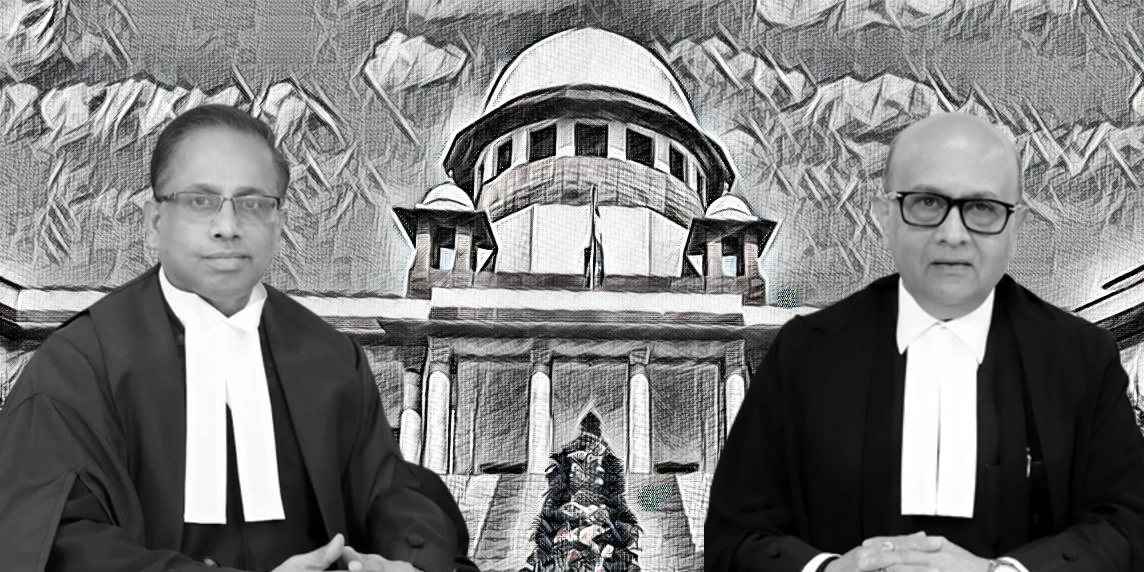
A Bench comprising Justice Manoj Misra and Justice K. V. Viswanathan allowed a civil appeal and restored the concurrent findings of the Trial Court and the First Appellate Court, which had rejected the disputed Will and upheld the possession rights of the widow.
The Court observed that while disinheritance of a wife is not always suspicious, the facts of each case are crucial. Ordinarily, a bequest in favour of a son or daughter at the expense of the spouse may not raise doubts. However, where a caring wife is excluded and the estate is bequeathed to strangers or distant relatives, such a disposition becomes unnatural and invites closer judicial scrutiny.
In the present case, the testator, an illiterate agriculturist who could only affix his thumb impression, had completely excluded his wife—the sole surviving Class I heir—from inheritance and bequeathed his property to persons who were not shown to be close relatives. The Court noted that the reasons recorded in the Will for excluding the wife were found to be factually incorrect by the First Appellate Court.
The Will stated that the beneficiaries were the testator’s nephews and that they had been providing food, clothing and care to the testator and his wife. However, the evidence on record failed to establish any close relationship between the beneficiaries and the testator. The Court also found that the testator and his wife lived separately from the beneficiaries and that the wife had been caring for the testator until his death.
Significantly, the Supreme Court held that where a Will contains reasons for a bequest, courts are entitled to examine whether those reasons are genuine or merely inserted to justify the document. If such explanations are found to be untruthful, they may cast doubt on whether the testator executed the Will with full understanding and free will.
The Court further examined irregularities in the registration process. It found unexplained cuttings and overwriting in the endorsement made by the Sub-Registrar on the reverse side of the Will. The name of the person presenting the document for registration had originally been recorded as another individual and was later replaced with the testator’s name without any initials or authentication by the registering authority. According to the Court, these alterations deprived the propounders of the benefit of the presumption that ordinarily flows from registration of a Will.
Rejecting the High Court’s approach, the Supreme Court reiterated that where suspicious circumstances surround the execution of a Will, the burden remains on the propounder to satisfactorily explain those circumstances. Merely proving execution through an attesting witness does not automatically remove such doubts.
The Bench emphasized that the “conscience of the Court” principle in testamentary matters is a rule of prudence requiring courts to exercise great caution before depriving legal heirs of their inheritance on the basis of a document executed by a person who is no longer available for examination.
Holding that the suspicious circumstances surrounding the Will remained unexplained, the Court ruled that the findings of the First Appellate Court were neither perverse nor irrational. It further held that the High Court had exceeded its jurisdiction under Section 100 of the Code of Civil Procedure by interfering with those factual findings in second appeal.
Accordingly, the Supreme Court set aside the High Court’s judgment and restored the decree passed by the Trial Court as affirmed by the First Appellate Court, thereby rejecting the Will and upholding the widow’s rights.
Case: Chhajju (Deceased) Through LRs v. Smt. Chandro (Deceased) Through LRs & Ors., Civil Appeal No. 10990 of 2016, decided on July 6, 2026.

Representation:-
For Appellant(s) :- Ms. Radhika Gautam, AOR, Ms. Anjali Dubey, Advocate
For Respondent(s) :- Mr. Rajesh Gupta, Mr. Harpreet Singh, Advocates, Mr. Sumit R. Sharma, AOR
Website designed, developed and maintained by webexy