
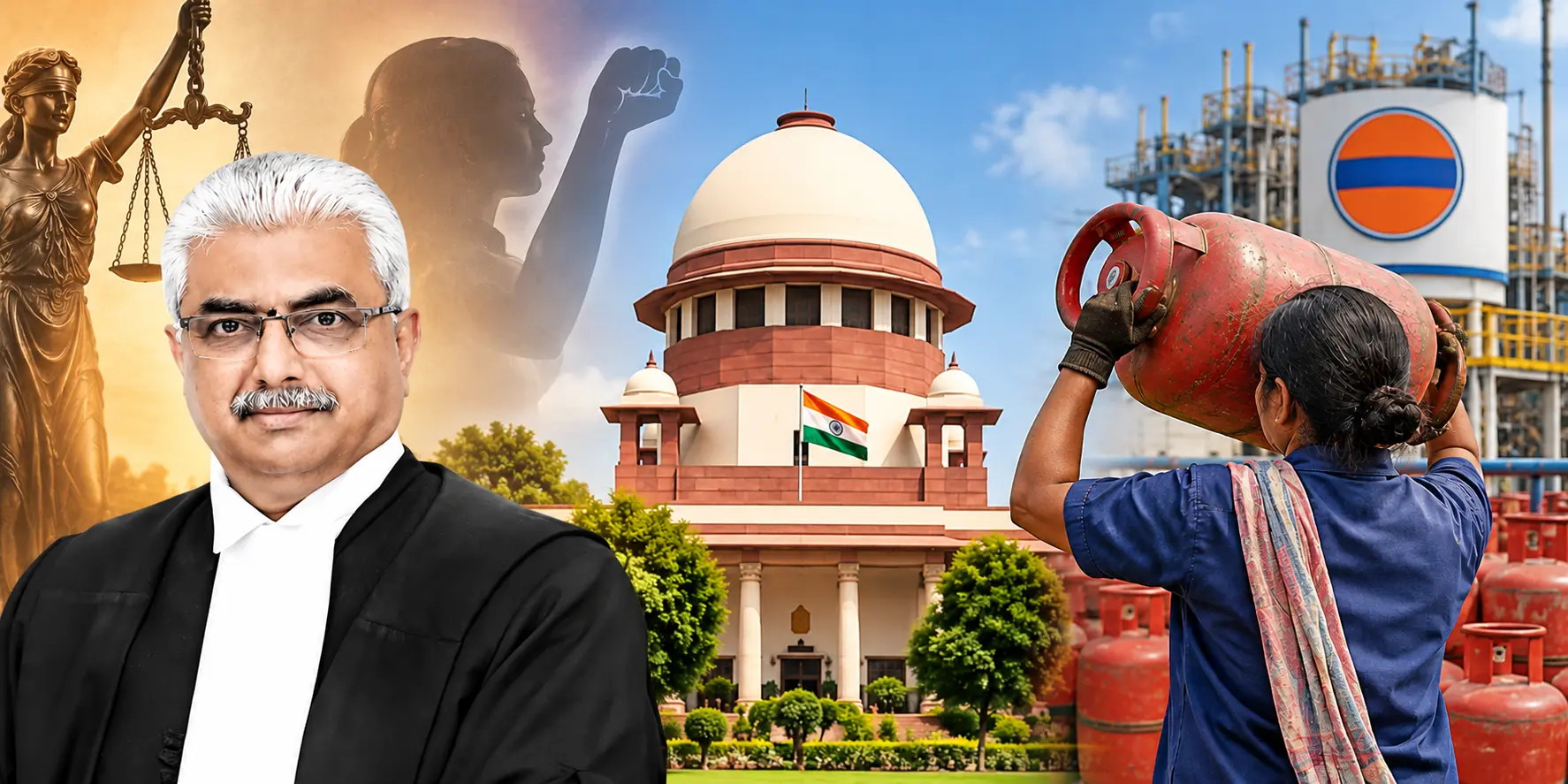
The Supreme Court has directed Indian Oil Corporation Limited (IOCL) to pay ₹12 lakh compensation to a woman who was denied appointment as a refilling helper at an LPG bottling plant amid allegations that she was considered unsuitable because she was a woman. The Bench of Justice Aravind Kumar and Justice Vipul M. Pancholi criticised the denial of equal employment opportunity and questioned the assumption that women cannot perform physically demanding work such as lifting LPG cylinders.
The case concerned Sumitra, a resident of Gudha village, who was among 49 persons recommended by a local committee headed by the Deputy Commissioner for employment at an IOCL LPG Bottling Plant.
She appeared for an interview for the post of casual khalasi/peon/refilling helper. While 43 other candidates were issued appointment letters, Sumitra was not appointed.
The corporation argued before the Supreme Court that the list prepared by the committee was only a recommendation and did not create a binding right to appointment. It was also suggested that the authorities may have found her unsuitable because the job involved manual labour, including lifting LPG cylinders, and included night shifts.
The submissions drew a strong response from Justice Aravind Kumar.
Questioning the basis of the alleged gender-based exclusion, the Court observed:
“You denied her appointment just because she is a lady? This is disrespect to womanhood.”
The Bench further noted that women routinely handle LPG cylinders in their homes and said that denying employment on such an assumption was particularly concerning when the employer was a Government of India undertaking.
Sumitra had earlier challenged the denial before the Trial Court. The Trial Court found that she fulfilled the prescribed eligibility requirements and relied upon evidence indicating that she had been denied appointment because she was a woman.
The Trial Court consequently directed her absorption as a casual employee or in an administrative/peon post other than a labourer.
The First Appellate Court subsequently reversed that decision, holding that her name had only been recommended and that she had never actually been selected. It also held that the Trial Court had granted relief in respect of a post for which she had not been interviewed.
The Punjab and Haryana High Court, by its order dated October 14, 2025, upheld the appellate decision, observing that Sumitra had no legal or vested right to appointment and that alleged gender-based rejection, by itself, could not justify mandatory appointment in the absence of such a right.
By the time the matter reached the Supreme Court, Sumitra had attained the age of superannuation. Consequently, appointment was no longer a practical remedy.
The Supreme Court therefore directed IOCL to pay her ₹12 lakh as lump-sum compensation for the discrimination and loss of employment opportunity suffered by her. The corporation's request to refer the matter to mediation was also declined.
The case was heard as Sumitra v. Indian Oil Corporation Ltd., SLP(C) No. 19874/2026.
Website designed, developed and maintained by webexy