
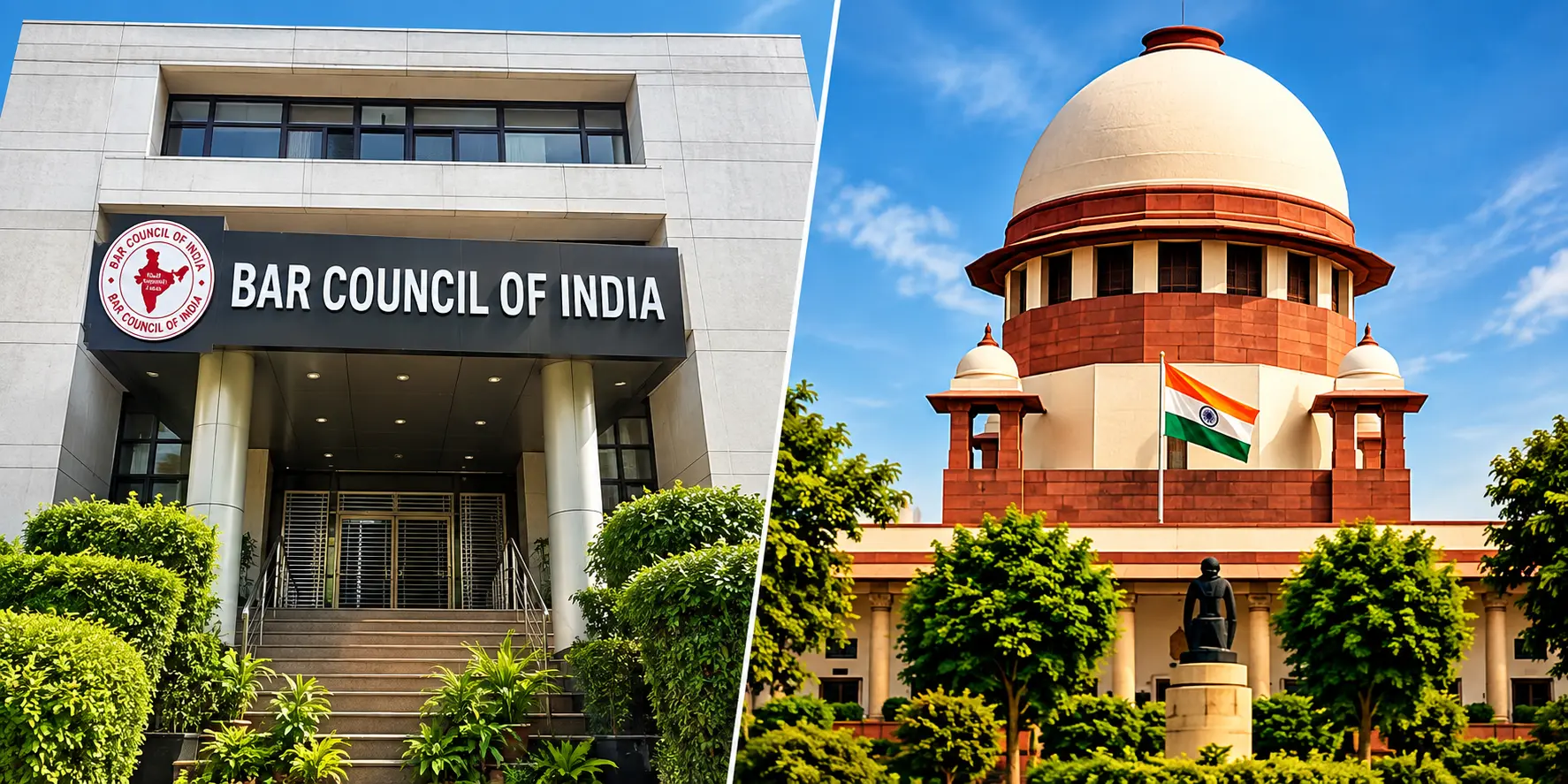
The Supreme Court on Wednesday questioned the extent of the Bar Council of India’s (BCI) powers over legal education, observing that while the BCI can prescribe standards and promote legal education, the question whether it can actually control or run law colleges requires examination.
A Bench comprising Chief Justice of India Surya Kant, Justice Joymalya Bagchi and Justice V. Mohana was hearing a petition filed by Girish Mittal concerning the functioning of two law colleges in Goa and Andhra Pradesh and the utilisation of funds transferred to the BCI Trust PEARL-First.
During the hearing, CJI Surya Kant questioned whether the BCI could exercise control over law colleges merely because it has statutory responsibilities concerning legal education.
“You can lay down the curriculum, whether it should be four years, five years. You can promote legal education and for that, you can take promotional measures. But you can't control it. What do you know about legal education? There are experts,”
the CJI remarked.
The Court indicated that it would examine the scope of Section 7(1)(h) of the Advocates Act, 1961, which assigns the BCI the responsibility to “promote legal education and to lay down standards of such education.”
CJI Surya Kant observed that the fundamental question was the extent to which the BCI could regulate legal education.
“We would like to examine this and if needed refer it also to larger bench. The very basic issue is how far the Bar Council of India is an expert body to regulate legal education…”
The Court also observed that it would first have to determine whether the BCI has the authority to regulate and control law universities.
The petition concerns the creation and functioning of two law colleges in Goa and Andhra Pradesh following arrangements entered into by the BCI Trust PEARL-First with the respective State Governments.
The petitioner has questioned the manner in which BCI funds are being transferred and utilised in relation to these institutions.
Advocate Prashant Bhushan, appearing for the petitioner, argued that the statutory framework governing the two colleges effectively gives the BCI substantial control over institutions which it is also responsible for regulating.
He submitted that 27 of the 35 members of the Executive Council of the college are nominated by the BCI, and contended that the arrangement raises concerns regarding the separation between a regulator and the institution being regulated.
Bhushan referred to the principle that a regulator should not itself run the institution it regulates.
Senior Advocate Atmaram Nadkarni, appearing for a respondent, defended the BCI's authority and submitted that the relevant legislation confers such powers upon the Council.
He referred to the regulatory framework governing medical education and submitted that there are constitutional precedents dealing with the respective roles of regulatory bodies.
Senior Advocate Shobha Gupta also raised concerns regarding the utilisation of funds transferred to the BCI PEARL-First Trust and stated that documents concerning the alleged receipt of donations would be placed before the Court.
After hearing the submissions, the Bench issued notice on Girish Mittal's petition.
The Court directed that notice be served upon the BCI and the office of Solicitor General Tushar Mehta.
The Supreme Court has, therefore, not yet finally determined the extent of BCI's authority over law colleges. The proceedings will examine the scope of the BCI's statutory role in promoting legal education and laying down educational standards, and whether that role extends to controlling or running law institutions.
Website designed, developed and maintained by webexy