
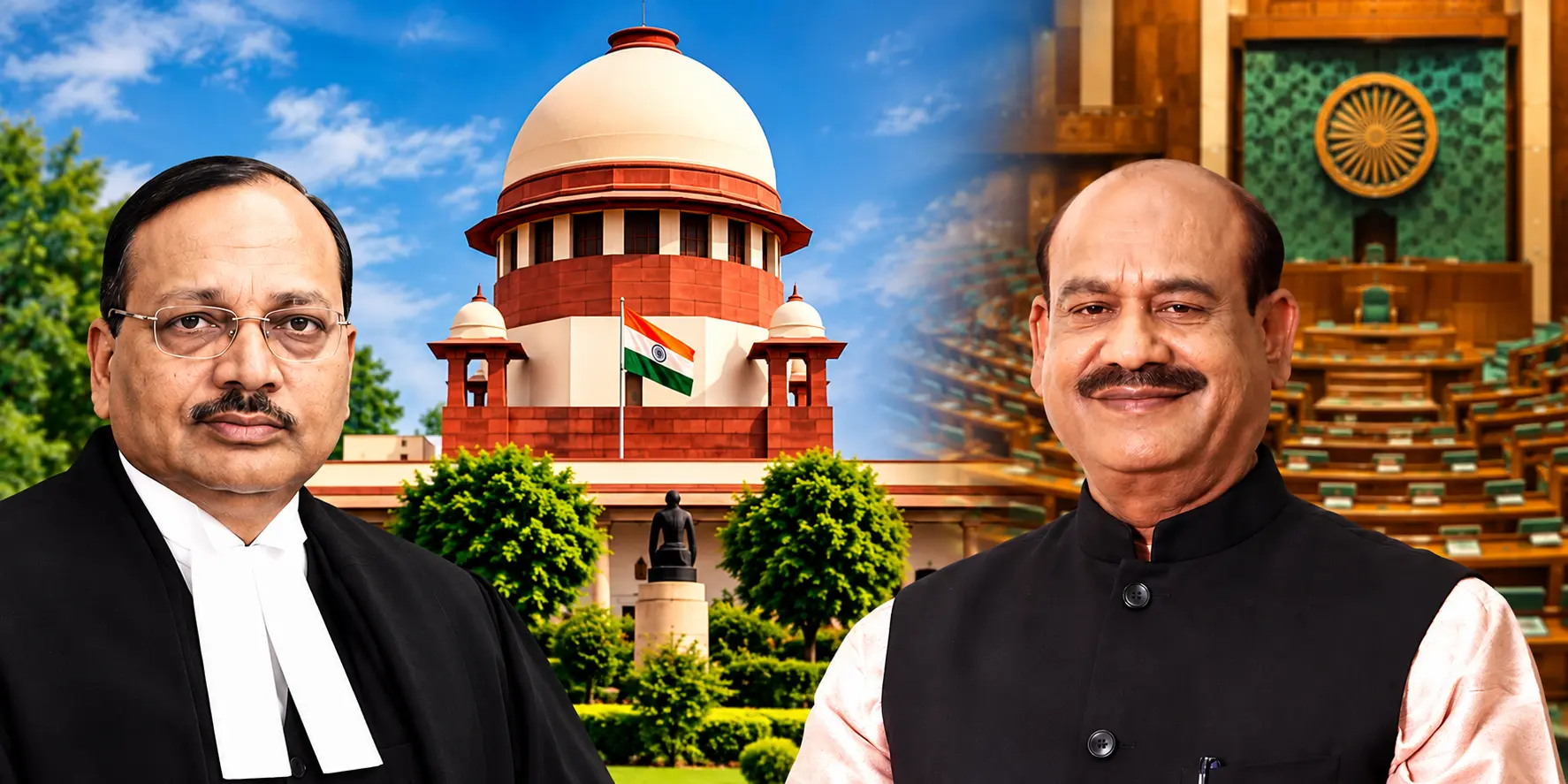
The Supreme Court on Wednesday expressed concern over the three-month delay in deciding disqualification petitions against 20 Trinamool Congress (TMC) Lok Sabha MPs, calling the lapse a “red flag” in view of the potential consequences for related proceedings and the democratic process.
A Bench comprising Chief Justice of India Surya Kant and Justices Joymalya Bagchi and V. Mohana was hearing a plea filed by TMC MP Abhishek Banerjee, seeking an expeditious decision by Lok Sabha Speaker Om Birla on the disqualification petitions.
The dispute arose after 20 TMC MPs announced their departure from the party and sought recognition as a separate group in the Lok Sabha. Abhishek Banerjee subsequently filed 20 separate disqualification petitions before the Speaker on June 18, alleging that the MPs had voluntarily given up their membership of TMC and attracted disqualification under the Tenth Schedule of the Constitution.
The Speaker issued notices to the MPs on August 5, giving them 14 days to respond. Their response period was subsequently extended up to September 22, and a further extension has been sought.
During the hearing, Justice Joymalya Bagchi questioned why the proceedings had not been concluded after three months, particularly considering their potential impact.
The Court referred to its earlier judgment in Keisham Meghachandra Singh v. Speaker, Manipur Legislative Assembly, where it had indicated that disqualification petitions should ordinarily be decided within a reasonable period, with three months indicated as the outer limit in the absence of exceptional circumstances.
Justice Bagchi observed that the three-month lapse was significant because the proceedings could have repercussions in collateral matters as well as the democratic process.
Senior Advocate Kalyan Bandopadhyay, appearing for Abhishek Banerjee, argued that the proceedings could not remain pending indefinitely and relied upon the Supreme Court's earlier ruling concerning the time taken to decide anti-defection petitions.
Solicitor General Tushar Mehta, appearing for the Speaker, opposed fixing a judicial deadline. He submitted that the Speaker is a constitutional functionary and that the concerned MPs must be given adequate opportunity to respond. He also pointed out that the proceedings may require consideration of evidence and arguments.
The Bench acknowledged the constitutional position of the Speaker and clarified that it was not seeking to impose an inflexible timeline.
Justice Bagchi observed that while the Speaker must perform the constitutional role assigned to the office, different disputes may require different amounts of time.
The Supreme Court ultimately did not prescribe a specific deadline for the Speaker to decide the disqualification petitions.
Instead, the Court decided to keep Abhishek Banerjee's petition pending and seek an update on the progress of the proceedings within a reasonable time.
The Solicitor General stated that the MPs were in the process of filing their replies and would require approximately four weeks. The matter has accordingly been posted after six weeks.
Importantly, the Supreme Court has not decided whether the 20 MPs are liable to be disqualified. The underlying disqualification proceedings remain pending before the Lok Sabha Speaker.
Case: Abhishek Banerjee v. Speaker, Lok Sabha & Ors.
Bench: CJI Surya Kant, Justice Joymalya Bagchi and Justice V. Mohana
Issue: Delay in deciding Tenth Schedule disqualification petitions.
Website designed, developed and maintained by webexy