
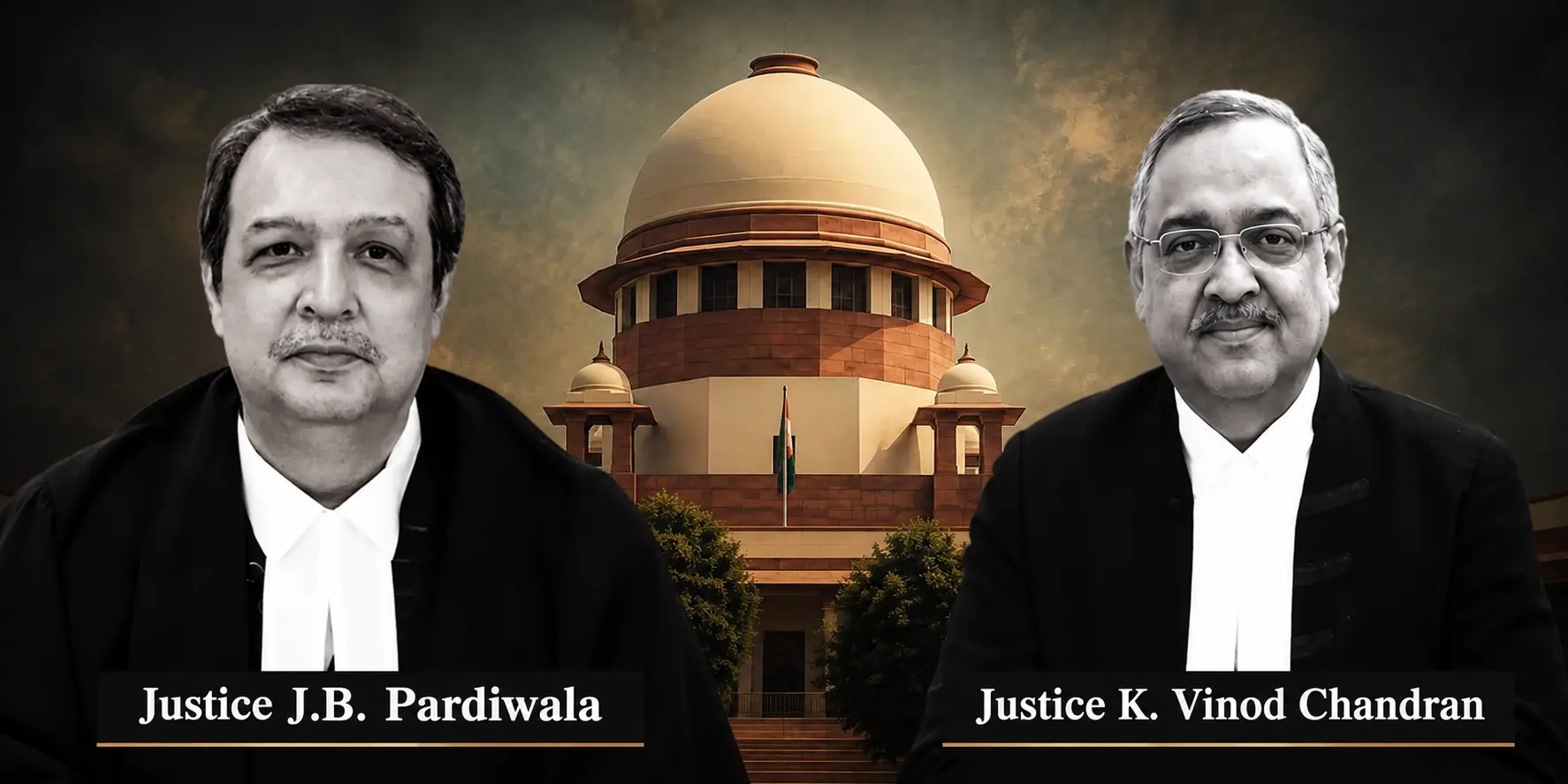
The Supreme Court has held that although a confessional statement under Section 67 of the Narcotic Drugs and Psychotropic Substances Act, 1985 (NDPS Act) has no evidentiary value at trial and cannot lead to conviction, that principle cannot mechanically be applied to quash a pending criminal prosecution without examining the other material collected during investigation.
A Bench of Justice J.B. Pardiwala and Justice K. Vinod Chandran made the observation while setting aside a Karnataka High Court order which had quashed criminal proceedings against Sadiq Pasha in an NDPS case. The Supreme Court restored the criminal proceedings pending before the Principal District and Sessions Judge and Special Court, Udupi. Pasted markdown
The case arose from the alleged transportation of 32.615 kg of ganja, which was found in 42 bundles concealed in the dashboard and trunk of a car.
According to the prosecution, police acting on information reached a parking area and found three persons near the specified vehicle. One person allegedly fled from the spot while the other two were apprehended. The respondent was alleged to be the person who escaped.
The respondent was subsequently shown as an absconder and a split charge-sheet was filed against him.
The Karnataka High Court quashed the proceedings against him on the ground that he had neither been apprehended at the spot nor was any contraband recovered from his possession and that he had been implicated on the basis of the statement of the co-accused.
The High Court had relied upon Supreme Court decisions including Tofan Singh v. State of Tamil Nadu, State (by NCB) Bengaluru v. Pallulabid Ahmad Arimutta, Balwinder Singh (Binda) v. Narcotics Control Bureau and Firdoskhan Khurshidkhan v. State of Gujarat.
The Supreme Court, however, distinguished those cases, observing that they concerned either convictions or cancellation of bail where the confessional statement constituted the sole incriminating material.
The present case, on the other hand, concerned a pending prosecution at the stage of quashing, requiring a different consideration.
The Court observed that the question was whether the principle relating to the inadmissibility of confessional statements could be applied to a pending prosecution so as to take the “extreme step of quashing the charges.”
The Supreme Court reaffirmed the legal position regarding statements under the NDPS Act, observing:
“We have no doubt that the confessional statement under Section 67 or a disclosure statement under Section 53A of the NDPS Act, can have no evidentiary value in a trial and it cannot lead to a conviction.” Pasted markdown
The Court further clarified that Section 53A does not enable the disclosure of a co-accused to be placed before the Court, particularly when the co-accused is neither examined as a witness nor made an approver.
Significantly, the Bench explained that information supplied by a co-accused regarding the identity of another accused can nevertheless serve as an investigative lead.
The Court observed that disclosure by the co-accused regarding the identity and name of the person who allegedly fled from the spot is material that the Investigating Officer can use to gather further evidence.
It is such further evidence, the Court clarified, that may ultimately form the basis of a charge-sheet or conviction after a properly instituted trial.
The Supreme Court found that the High Court had not examined the evidence produced in the case. It also noted that there was no consideration of the charge-sheet or the material regarding the alleged culpability of the respondent.
The Court held that quashing the proceedings merely because a confessional statement cannot be relied upon at trial was not a proper exercise of the High Court's inherent powers.
At the same time, the Supreme Court expressly clarified that it had made no observation on the merits of the case.
The respondent was permitted to raise the contention that no other incriminating material had been discovered during investigation either when cognizance is considered by the Special Court or, if cognizance has already been taken, through an appropriate application for discharge.
Accordingly, the Supreme Court restored Special Case No. 24 of 2022 arising out of Special Case No. 131 of 2019 to the file of the Principal District and Sessions Judge and Special Court, Udupi.
The respondent has been directed to appear before the Special Court within two weeks. If he appears within that period, the Special Court has been directed to release him on bail on such terms and conditions as it considers appropriate. In case of failure to appear, the Trial Court may take steps for his apprehension.
Case: The State of Karnataka & Anr. v. Sadiq Pasha
Citation: 2026 INSC 1083
Coram: Justice J.B. Pardiwala and Justice K. Vinod Chandran
Decision: October 1, 2026

Representation:-
For Petitioner(s) : Mr. Aman Panwar, A.A.G. Mr. Sanchit Garga, AOR Mr. Shashwat Jaiswal, Adv. Mr. Bhanu Pratap Singh, Adv. Ms. Diksha Arora, Adv. Mr. Manav Kaushik, Adv. Ms. Aranya Sahay, Adv. Mr. Rishi Yadav, Adv. Mr. Nakul Shrivastava, Adv.
Website designed, developed and maintained by webexy