
The Supreme Court has dismissed the State of Himachal Pradesh's appeal against the acquittal of Anchla @ Chanchla, who was accused of murdering her stepmother and minor stepbrother, holding that the prosecution failed to establish the chain of circumstantial evidence beyond reasonable doubt.
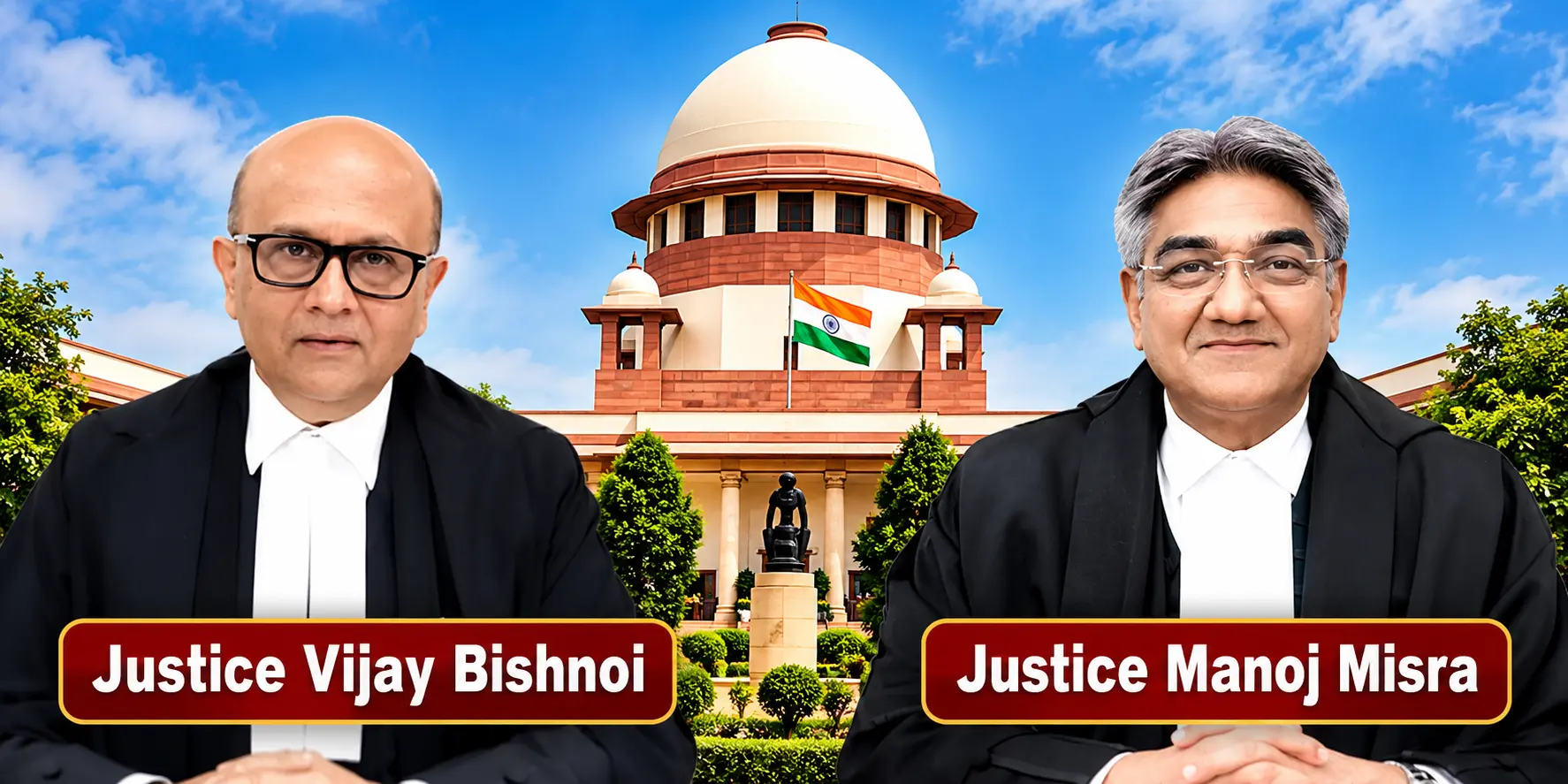
A Bench of Justice Manoj Misra and Justice Vijay Bishnoi held that the circumstances relied upon by the prosecution did not conclusively establish that the accused had committed the murders. The Court consequently declined to interfere with the High Court's decision acquitting her.
The prosecution case primarily relied upon the allegation that the accused was last seen with the deceased on 31 August 2011. However, the Supreme Court found that the testimony of PW-1, who was the principal witness to the last-seen circumstance, contained an improvement over his earlier statement.
The Court noted that PW-1 had not mentioned in his earlier statement that he had seen the accused talking to the minor deceased. His explanation for remaining silent for 6–7 days after finding the house locked also did not inspire confidence.
The Court therefore held that the prosecution failed to prove beyond reasonable doubt that the accused was present in the house of the deceased on the relevant date.
The Supreme Court also rejected the evidence of the taxi driver and the hotel employee who were relied upon to establish the accused's presence at Diur and her subsequent stay at Chamba.
The Court particularly took note of the investigating officer's failure to explain what prompted him to record the statements of these witnesses and when their statements were recorded.
The Bench observed that the role of an investigating officer is to collect evidence and not create evidence, and unexplained circumstances surrounding the recording of witness statements may raise doubts as to whether a witness was set up to create evidence.
The Court also highlighted the failure of the investigating agency to obtain the tower locations corresponding to the Call Detail Records (CDRs) of the deceased and the accused.
The Bench observed that tower locations could have established whether the two mobile phones were in close proximity at the relevant time and could also have assisted in determining the location of the deceased's mobile after the alleged date of occurrence.
The Court termed the non-collection of tower location information a serious investigational lapse in the facts of the case.
The prosecution had relied upon the alleged recovery of the deceased's mobile phone and a bunch of keys from the accused.
However, the Supreme Court found that it was not established beyond reasonable doubt that the lock produced in Court was the same lock that had secured the deceased's house. Consequently, the alleged recovery of keys lost its incriminating value.
The Court also found the recovery of the deceased's mobile doubtful, particularly because the complete CDR and tower location of the mobile had not been produced.
"42. It is well settled that the role of the investigating officer is to collect evidence and not to create one. Where there is no occasion for the investigating officer to record statement of a person, or for that person to impart information to the police, yet, the police proceeds to record his statement without narrating the circumstance in which it was considered necessary to record his statement, a serious doubt arises as to whether that witness has been set up to create evidence. Pasted markdown
51. During investigation, the investigating officer was apprised of mobile numbers of the deceased Mithilesh Kumari (D-1) and the accused respondent. PW-19 was produced to prove the CDR of one of the mobiles, though both CDRs were part of police papers collected during investigation. However, interestingly, the CDRs do not disclose tower location of the concerned mobiles which could have helped in pin-pointing as to whether the two mobiles at the relevant time were in close proximity of each other, and whether D-1’s mobile had moved to the place of residence of the accused from where it was allegedly recovered. Non-collection of tower location of the two mobiles is a serious investigational lapse in the facts of the case."
The prosecution had also relied upon a DNA match between the accused's blood sample and blood found on a trunk/cabinet at the crime scene.
The Supreme Court held that, even if the DNA evidence was accepted, it only established that the accused's blood was present at the house at some point in time. It did not establish that she was present there on 31 August 2011 or that she was the perpetrator of the murders.
The Court noted that the accused had been a regular visitor to the deceased's house and, importantly, her blood was not found on the clothes of the deceased or on the material allegedly used for strangulation.
The prosecution alleged that the accused had murdered her stepmother and stepbrother because her father had bequeathed property to the minor deceased.
However, the Court found that there was no evidence establishing such a bequest. It also observed that even if the stepbrother had been removed, the accused would not alone have benefited from the property.
The Court therefore found that no strong motive had been established.
Summing up its analysis, the Supreme Court held that the prosecution failed to establish:
The Court accordingly concluded that the prosecution had failed to bring home the charge against the accused and dismissed the State's appeal, thereby maintaining the High Court's acquittal.
Case: State of Himachal Pradesh v. Anchla @ Chanchla
Criminal Appeal No. 166 of 2019
2026 INSC 1074
Coram: Justice Manoj Misra and Justice Vijay Bishnoi
Decision: October 1, 2026.

Representation:-
For Appellant(s) : Mr. Vikrant Narayan Vasudeva, AOR Mr. Rohit Lochav, Adv. Mr. Arindam Gupta, Adv.
For Respondent(s) :Ms. Sangeeta Kumar, AOR Ms. Vidushi Garg, Adv.
Website designed, developed and maintained by webexy