
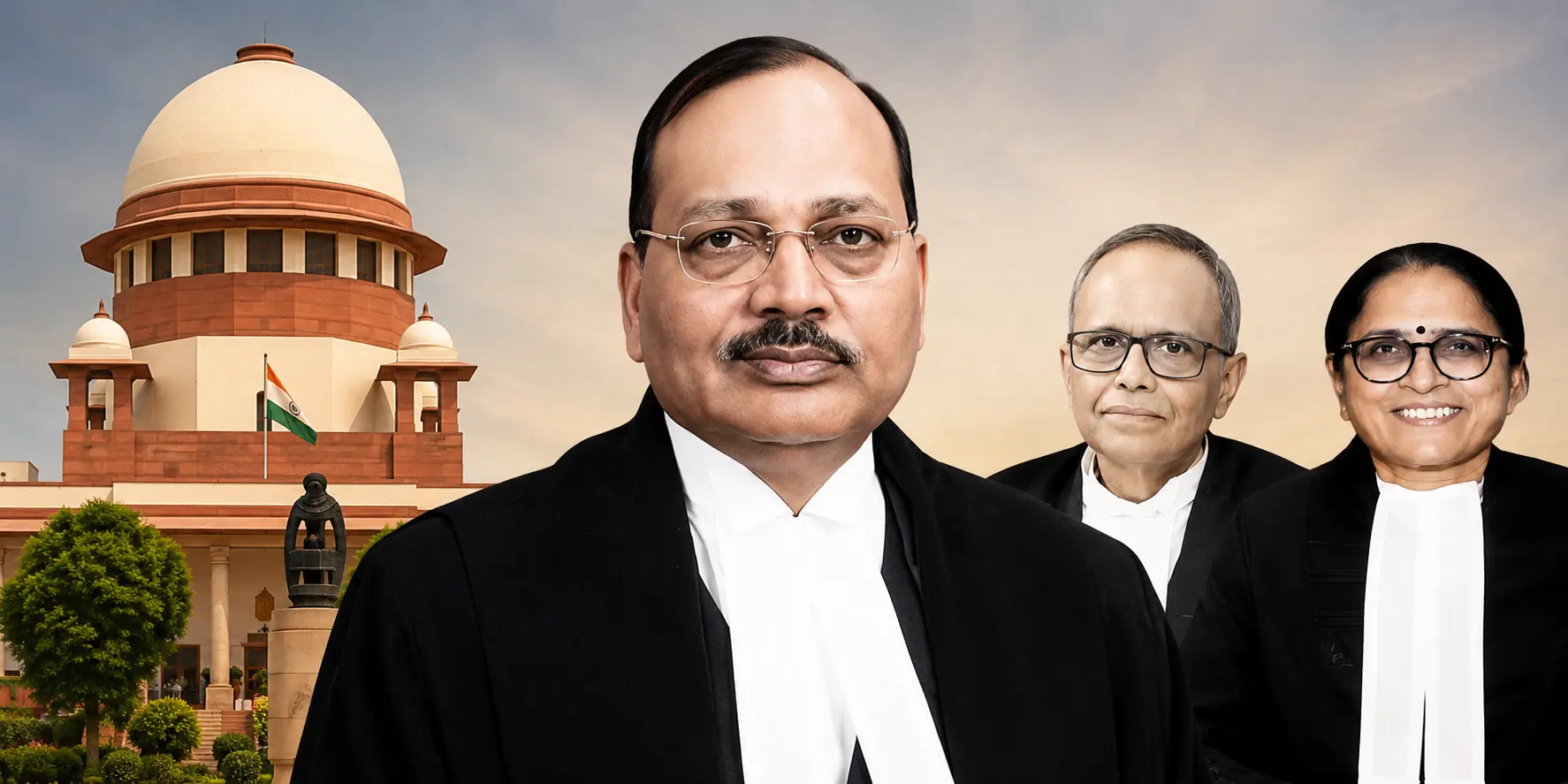
The Supreme Court has declined to entertain a writ petition filed by seven Family Court judges from Maharashtra seeking a declaration that they hold “judicial office” for the purpose of determining their eligibility for appointment as High Court judges under Article 217(2)(a) of the Constitution.
A Bench comprising Chief Justice of India Surya Kant, Justice Joymalya Bagchi and Justice V. Mohana held that the issue had already been conclusively decided by the Supreme Court in S.D. Joshi and Others v. High Court of Judicature at Bombay and Another, reported in (2011) 1 SCC 252. In that judgment, the Court had held that judges appointed to a separate Family Court cadre could not be treated as holding “judicial office” for the purposes of Article 217(2)(a).
The petition was filed in Indrakala Joginder Nanda v. High Court of Judicature at Bombay, D. No. 38854/2026.
The petitioners were represented by Senior Advocate R. Basant, who urged the Bench to reconsider the earlier ruling in view of what he described as significant changes in the factual circumstances in Maharashtra.
Basant submitted that all seven petitioners had been appointed under the applicable Family Courts Recruitment Rules and had completed more than seven years of service. Four of them had completed at least ten years as Family Court judges, while some had spent as many as 26 years in judicial service, initially as subordinate judges and subsequently as Family Court judges.
The senior counsel argued that the petitioners had entered the Family Court system through a judicial recruitment process and had always been members of the judicial service.
According to the submissions, for the past 36 years, Maharashtra had not appointed any person from outside the judicial service as a Family Court judge. Basant therefore argued that the factual basis underlying S.D. Joshi had materially changed.
At the outset, Justice Joymalya Bagchi pointed out that the earlier judgment “clearly answers the issue against your clients.”
Basant accepted that S.D. Joshi was against the petitioners but argued that the judgment deserved reconsideration because of the changed factual circumstances.
He submitted that the petitioners' plea was confined to a specific question under Article 217(2)(a) and did not seek reopening of the entire issue concerning the separate Family Court cadre.
Basant also relied upon the Supreme Court's judgment in Rajnish v. Neha, but CJI Surya Kant clarified that the decision did not deal with the interpretation of Article 217.
During the hearing, the Bench also questioned the very structure of a separate Family Court cadre in Maharashtra.
CJI Surya Kant observed that in several States, Family Court judges are drawn from the regular judicial service and posted to Family Courts on deputation. Such judges retain their status as judicial officers and can subsequently return to the mainstream judicial cadre.
The Chief Justice observed that the difficulty in Maharashtra appeared to arise from the creation of an exclusive and separate cadre for Family Courts.
The Bench noted that Family Court judges in the separate cadre do not deal with the entire range of civil and criminal matters handled by judges in the regular judicial service.
Basant argued that Article 217(2)(a) permits eligibility for appointment as a High Court judge through the requisite experience in practice at the Bar or through holding judicial office.
He submitted that the expression “judicial office” had been interpreted too narrowly in S.D. Joshi, where the Supreme Court had compared the functions of Family Court judges with those of judges belonging to the regular District Judge cadre.
According to Basant, the earlier judgment had been influenced by the fact that the Family Courts Act permits persons other than members of the judicial service to be appointed as Family Court judges.
However, he contended that the actual position in Maharashtra had evolved substantially because no such appointments had been made from that source for approximately 36 years.
Justice Bagchi questioned counsel as to what legal or factual development justified reconsideration of S.D. Joshi.
He observed that if the petitioners wanted the Court to doubt the ratio of S.D. Joshi with a view to overruling it, they would have to demonstrate a contrary judgment or an alternative interpretation of Article 217 that had not been considered earlier.
The Bench also noted that S.D. Joshi had undertaken a detailed comparison between the functions of regular District Judges and Family Court judges and had concluded that the two were not equivalent for the purpose in question.
Ultimately, the Supreme Court declined to entertain the writ petition.
The Bench held that the issue raised by the petitioners had already been decided against them in S.D. Joshi and that the present petition essentially sought a review or recall of that earlier judgment.
The Court observed:
“The writ petition essentially seeks review/recall of that judgment.”
It further held that a writ petition under Article 32 is not an appropriate remedy for seeking review of a judgment of the Supreme Court.
The Supreme Court, however, indicated that the underlying structural issue could be addressed through the administrative and policy route.
The Bench suggested that the petitioners could approach the concerned High Court and the Maharashtra Government for reconsideration of the rules governing appointments to Family Courts.
The Court observed that in States where separate Family Court cadres exist, the authorities could consider whether the separate cadre should be abolished and Family Court postings made transferable among members of the higher judicial service.
The Bench indicated that such restructuring would essentially be a policy matter, which the High Court and State Government could consider in consultation with each other.
The Supreme Court ultimately refused to entertain the Article 32 petition, holding that the petitioners had not established a legal basis for interfering with the position settled in S.D. Joshi.
The Court left it open to the High Court and State Government to consider appropriate changes to the Family Court recruitment and cadre structure through the administrative and policy process.
Case: Indrakala Joginder Nanda v. High Court of Judicature at Bombay
Diary No.: 38854/2026
Bench: CJI Surya Kant, Justice Joymalya Bagchi and Justice V. Mohana
Website designed, developed and maintained by webexy