
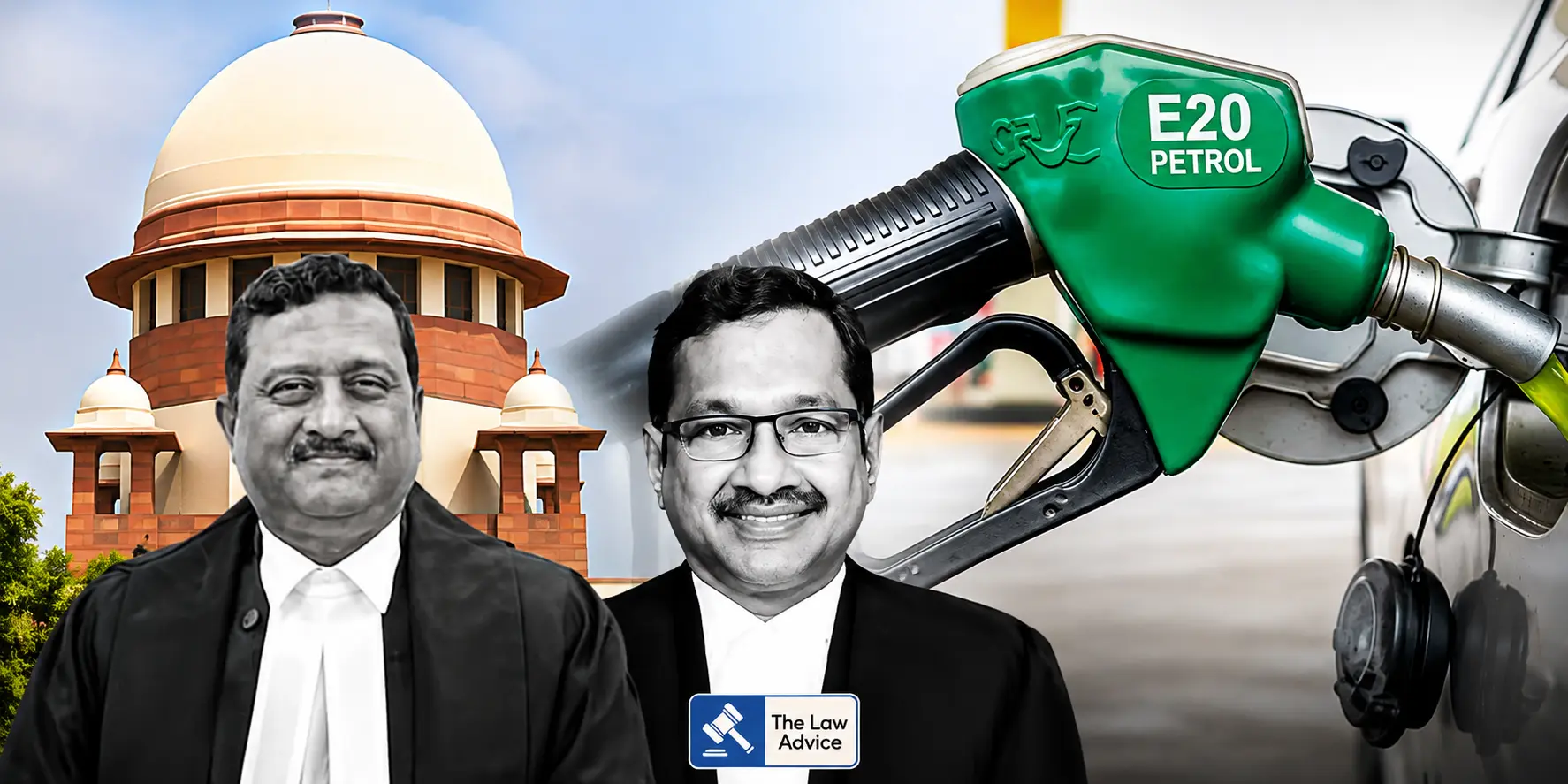
The Supreme Court on Monday declined to entertain a petition seeking directions to petrol pumps to prominently display the percentage of ethanol blended in petrol and to mandate disclosure of ethanol content on fuel bills, invoices and receipts.
A Bench comprising Justice M.M. Sundresh and Justice Prasanna B. Varale granted liberty to the petitioner, advocate N.K. Goswami, to approach the concerned High Court for appropriate relief.
During the hearing, Goswami argued that consumers have a right to know the composition of the fuel being purchased by them.
Pointing to petrol receipts, he submitted that there was no disclosure of the ethanol content in the fuel and argued that consumers should be informed about what they are purchasing.
He also referred to an earlier statement attributed to the Attorney General regarding the ethanol-blending programme and sought an assurance from the Central Government on the issue.
The Attorney General objected to the manner in which the petition was being pursued, questioning why the Government should be made answerable to the petitioner personally.
Goswami responded that the issue was not about his individual interest but concerned the right to know of citizens.
The Attorney General described the petition as a “proxy petition” and also pointed out that the Supreme Court had dismissed a similar plea in the previous year.
The Bench ultimately declined to entertain the petition but granted the petitioner liberty to approach the appropriate High Court.
The petition sought several directions concerning the country's ethanol-blending programme.
One of the principal prayers was for a direction requiring prominent and uniform disclosure of the exact ethanol percentage on every petrol dispensing nozzle.
It also sought mandatory disclosure of the ethanol percentage on every fuel invoice, bill and receipt issued to consumers.
The petitioner further sought creation of an official, publicly accessible vehicle-wise compatibility database, searchable by manufacturer, model, engine type and year of manufacture.
The database was proposed to indicate the suitability of different ethanol blends for individual vehicles.
The petition also sought a transparent transition framework for older or ethanol-incompatible vehicles, including consideration of making lower-ethanol petrol available wherever technically, economically and logistically feasible.
Another prayer sought constitution of an independent expert committee comprising representatives from the Petroleum Ministry, Ministry of Road Transport and Highways, Bureau of Indian Standards, ARAI/ICAT, consumer organisations, automobile engineers, fuel technologists, environmental and public-health experts and water-resource specialists.
The proposed committee was to examine various aspects of the ethanol-blending programme, including:
Real-world compatibility of E20 petrol with India's existing vehicle fleet;
Impact on fuel efficiency, engine life and maintenance costs;
Warranty and insurance implications;
Environmental impact, including tail-pipe emissions and water consumption associated with ethanol production; and
Food-security and feed-diversion concerns arising from ethanol production.
The petitioner also sought directions requiring the Government to place before the Supreme Court relevant policy files, technical studies, vehicle compatibility reports, safety standards, consumer advisories and records of public consultation underlying the compulsory rollout of E20 petrol.
A further prayer sought formulation of a nationwide Consumer Disclosure Protocol for ethanol-blended petrol in consultation with the Central Consumer Protection Authority and the Bureau of Indian Standards.
The Supreme Court, however, declined to entertain the writ petition and left the petitioner free to pursue the grievances before the concerned High Court.
Case: Narendra Kumar Goswami v. Union of India
**W.P. (C) No. 887/2026
Bench: Justice M.M. Sundresh and Justice Prasanna B. Varale
Issue: Disclosure of ethanol content in petrol and consumer concerns relating to E20 fuel.
Website designed, developed and maintained by webexy