
Supreme Court sets aside consecutive life sentences imposed on a rape and murder convict, reiterating that multiple life sentences must be superimposed upon each other, while remission in one sentence does not automatically extend to another.
New Delhi: The Supreme Court has reiterated that when a person is convicted of multiple offences carrying life imprisonment in a single trial, the sentences cannot be directed to run consecutively. Instead, such sentences must run concurrently, with each life sentence remaining independently operative for the purpose of remission or commutation.
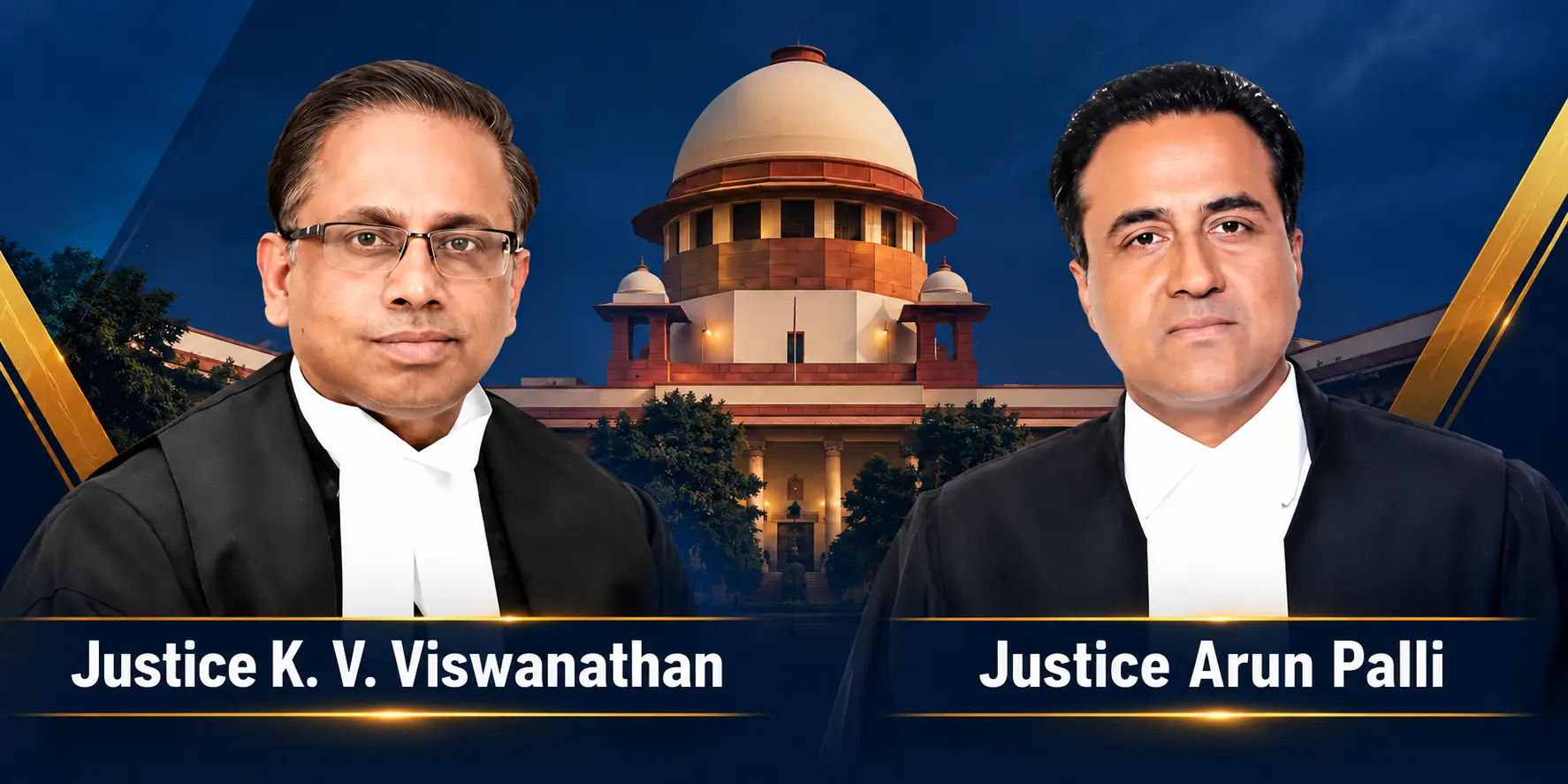
A Bench comprising Justice K.V. Viswanathan and Justice Arun Palli, in Raju Shantaram Koli v. State of Maharashtra, set aside the direction of the Trial Court, subsequently affirmed by the Bombay High Court, requiring the convict to undergo two life sentences consecutively.
The judgment, delivered on October 27, 2026, clarified that although courts are empowered to award multiple life sentences for separate offences, directing a prisoner to serve one life sentence after completing another is legally impermissible.
Background of the Case
The case arose from the rape and murder of a 12-year-old child in Maharashtra on April 29, 2010. The accused, Raju Shantaram Koli, was arrested on April 30, 2010, and subsequently tried before the Additional Sessions Judge, Thane.
On September 27, 2013, the Trial Court convicted him under Section 302 of the Indian Penal Code (IPC) and sentenced him to life imprisonment with a fine of ₹5,000.
He was also convicted under Sections 376 and 342 IPC and awarded life imprisonment along with fines.
Significantly, the Trial Court directed that the substantive sentences would run consecutively rather than concurrently, meaning that one life sentence would follow the other.
The convict challenged the judgment before the Bombay High Court. However, on June 10, 2016, the High Court upheld both the conviction and the sentence, expressly declining to interfere with the direction imposing consecutive life sentences.
The appellant subsequently approached the High Court through a criminal writ petition seeking concurrent sentences. On January 13, 2025, the High Court declined to modify the earlier judgment, observing that a writ court could not review the decision of a coordinate Bench.
The matter eventually reached the Supreme Court.
Supreme Court Examines Legality of Consecutive Life Sentences
The principal question before the Supreme Court was whether the Trial Court and the Bombay High Court were justified in imposing consecutive life sentences for offences under Sections 302 and 376 read with Section 342 IPC in a single trial.
The Bench examined the Constitution Bench judgment in Muthuramalingam and Others v. State Represented by Inspector of Police, (2016) 8 SCC 313.
In that judgment, the Supreme Court had categorically held that although multiple life sentences can be imposed for multiple offences, such sentences cannot be made consecutive.
The Constitution Bench explained that life imprisonment ordinarily means imprisonment for the remainder of the convict's natural life, unless the sentence is lawfully remitted or commuted by the competent authority.
Consequently, directing a person to undergo two life sentences one after another would create a legal impossibility.
The Court reiterated the principle that a person has only one natural life and cannot be required to complete one life sentence before beginning another.
Multiple Life Sentences Must Be Superimposed
Referring to the Constitution Bench ruling, the Supreme Court observed that multiple life sentences must be superimposed upon each other.
However, the Court clarified that concurrent operation of life sentences does not mean that remission or commutation granted in respect of one sentence automatically applies to the others.
The Bench observed:
"Life sentences awarded for multiple offences in a single Trial, cannot be directed to run consecutively."
The Court further explained that where several life sentences are imposed, each retains its independent legal effect.
Therefore, even if the competent authority grants remission or commutation in respect of one sentence, the convict cannot automatically claim the same benefit for another life sentence.
This distinction ensures that the punishment imposed for each separate offence remains legally effective.
Supreme Court Sets Aside Consecutive Sentencing Direction
Applying the principles laid down in Muthuramalingam, the Supreme Court partly allowed the criminal appeal and set aside the direction requiring the appellant to undergo consecutive life sentences.
The Court held that the Trial Court's direction, as affirmed by the Bombay High Court, requiring the substantive sentences to run one after another could not be sustained.
However, the Supreme Court did not interfere with the conviction or the individual sentences of life imprisonment awarded for the offences.
The Bench maintained the conviction under Section 302 IPC and the life sentences imposed for the offences under Sections 376 and 342 IPC, along with the fines.
It directed that the life sentences would be superimposed upon each other, ensuring that remission or commutation in respect of one would not automatically affect the other.
The connected appeal arising from the earlier writ proceedings was disposed of as infructuous.
Significance of the Judgment
The ruling reinforces the settled legal position governing multiple life sentences under Indian criminal law.
It clarifies that the power to impose separate life sentences for multiple offences must be distinguished from the power to direct their consecutive execution.
The judgment is particularly significant in cases involving multiple serious offences where courts impose more than one life sentence in a single trial.
While reaffirming that consecutive life imprisonment is impermissible, the Supreme Court has also preserved the independent operation of each sentence for remission and commutation purposes.
The decision makes clear that concurrent life sentences do not automatically entitle a convict to early release, as each sentence continues to carry its own legal consequences.
Case Details

Website designed, developed and maintained by webexy