
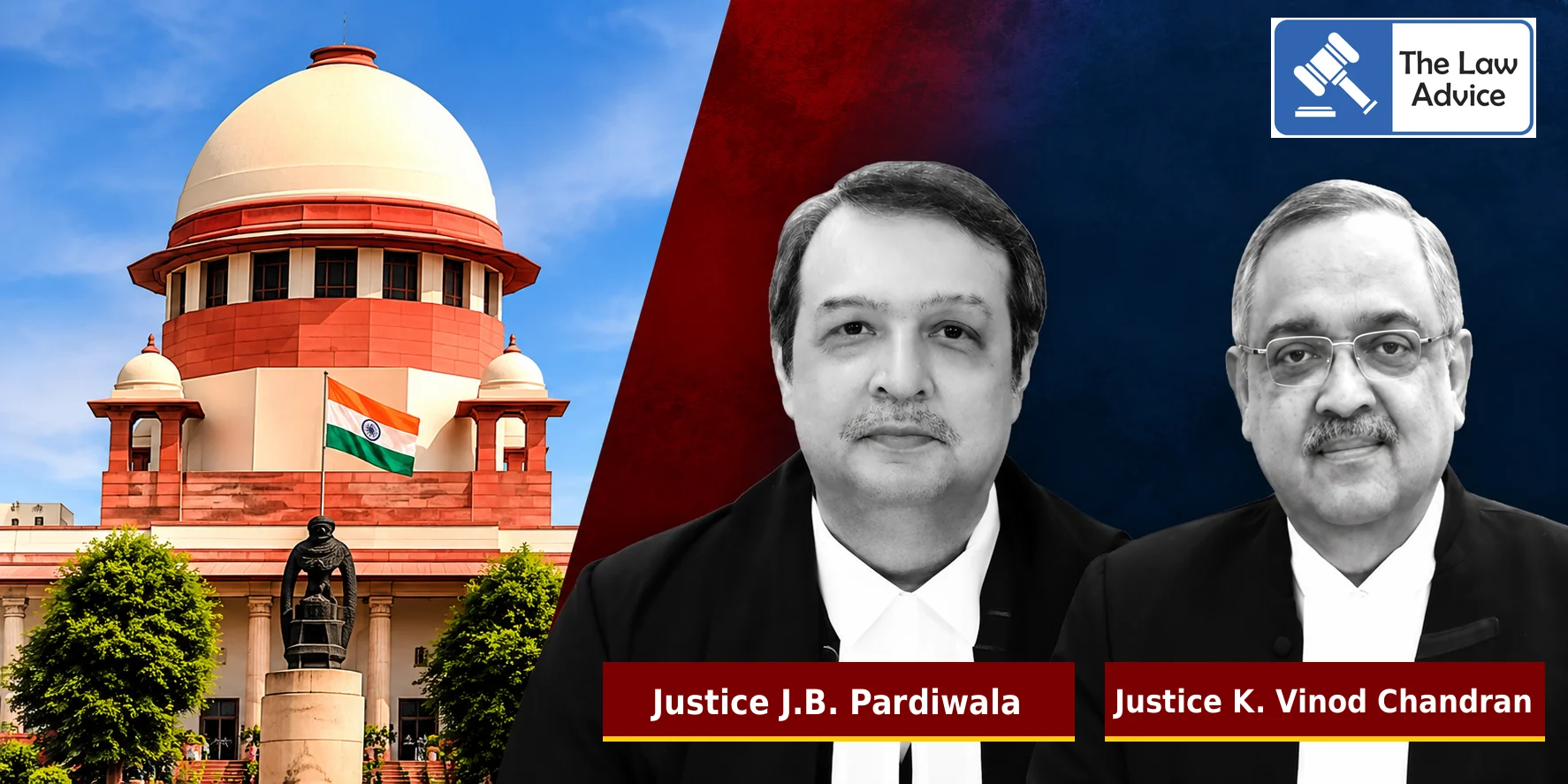
The Supreme Court has reiterated that criminal proceedings involving serious offences such as rape cannot be quashed merely because the parties have entered into a compromise. The Court set aside an order of the Madhya Pradesh High Court that had quashed a rape complaint on the basis of a settlement, directing that the trial proceed.
A Bench of Justice J. B. Pardiwala and Justice K. Vinod Chandran, in Gopal Lodhi v. State of Madhya Pradesh & Anr., observed that courts must exercise caution while invoking their inherent powers to quash criminal proceedings involving heinous offences, particularly where a settlement may have been obtained through coercion or financial inducement.
The judgment was delivered on October 26, 2026, in Special Leave Petition (Crl.) No. 7332 of 2026, reported as 2026 INSC 1164.
Supreme Court Expresses Concern Over Quashing of Rape Complaint
The matter initially came before the Supreme Court in a petition seeking anticipatory bail in a case registered under Sections 64(1), 331(2) and 351(3) of the Bharatiya Nyaya Sanhita, 2023, along with provisions of the Scheduled Castes and Scheduled Tribes (Prevention of Atrocities) Act, 1989.
During the proceedings, the Court was informed that the parties had reached a compromise and that the Madhya Pradesh High Court had quashed the complaint by exercising its inherent jurisdiction under Section 528 of the Bharatiya Nagarik Suraksha Sanhita, 2023.
The Supreme Court expressed concern over the quashing of a rape case solely on the basis of a compromise. It examined several earlier decisions, including Gian Singh v. State of Punjab, Narinder Singh v. State of Punjab and Madan Mohan Abbot v. State of Punjab, which dealt with the exercise of inherent powers to quash criminal proceedings following a settlement.
The Court distinguished cases involving private disputes, commercial transactions or offences arising from personal disagreements from cases involving serious and heinous offences such as rape.
Victim Tells Supreme Court She Was Coerced Into Settlement
To ascertain the circumstances surrounding the compromise, the Supreme Court directed that the victim be facilitated to interact with the Bench through video conferencing.
The interaction took place from the office of the District Legal Services Authority at Rajgarh, Pachore, in the presence of its Secretary.
During the interaction, the victim stated that she had been coerced into the settlement. She further stated that she was not willing to settle the matter and that she required money for the settlement. She categorically maintained that she had lodged the complaint and had stated the truth in it.
The Bench observed that the victim's statements would have to be examined during the trial and clarified that it was not expressing any opinion on the merits of the allegations.
The Court also cautioned against situations in which false accusations might be raised with the expectation of a future financial settlement, as well as settlements secured through coercion.
Serious Offences Cannot Be Quashed Merely Because of a Compromise
The Supreme Court reiterated that the inherent power to quash criminal proceedings is distinct from the statutory power to compound offences.
Referring to its earlier decisions, the Court observed that the power to quash proceedings must be exercised to secure the ends of justice and prevent abuse of the process of law. However, such power cannot ordinarily be invoked merely because the parties have settled a dispute involving a heinous offence.
The Bench noted that the decisions relied upon by the High Court did not, prima facie, justify quashing a rape complaint solely on the basis of a compromise.
It reiterated that the seriousness of the offence and its impact on society must be considered while deciding whether criminal proceedings should be terminated following a settlement.
High Court Order Set Aside; Trial Directed to Continue
In view of the circumstances, the Supreme Court set aside the Madhya Pradesh High Court's order in Miscellaneous Criminal Case No. 15763 of 2026, which had quashed the complaint on the basis of the compromise.
The Court directed that the trial proceed, clarifying that its observations should not influence the trial court's independent assessment of the evidence.
Separately, while dealing with the petition for anticipatory bail, the Supreme Court set aside the impugned order in Criminal Appeal No. 2110 of 2026 and directed that the petitioner be released on anticipatory bail, subject to the conditions imposed by the Trial Court.
The petitioner was directed to cooperate with the investigation and appear before the Trial Court whenever summoned.
The Special Leave Petition was accordingly disposed of.
Significance of the Judgment
The decision underscores the distinction between disputes that are predominantly private in nature and criminal cases involving serious offences that have broader societal implications.
It also highlights the need for courts to examine whether a compromise is voluntary before relying on it to terminate criminal proceedings.
By setting aside the High Court's order and directing the trial to continue, the Supreme Court reaffirmed that a settlement between the parties cannot, by itself, justify quashing a prosecution involving an alleged heinous offence such as rape.
The Court's observations also highlight two concerns that require careful judicial scrutiny: the possibility of coercion being used to secure settlements and the possibility of criminal allegations being raised with an expectation of financial settlement.
The Bench clarified that the truth of the allegations in the present case must be determined during the trial.
Case Details

Website designed, developed and maintained by webexy