
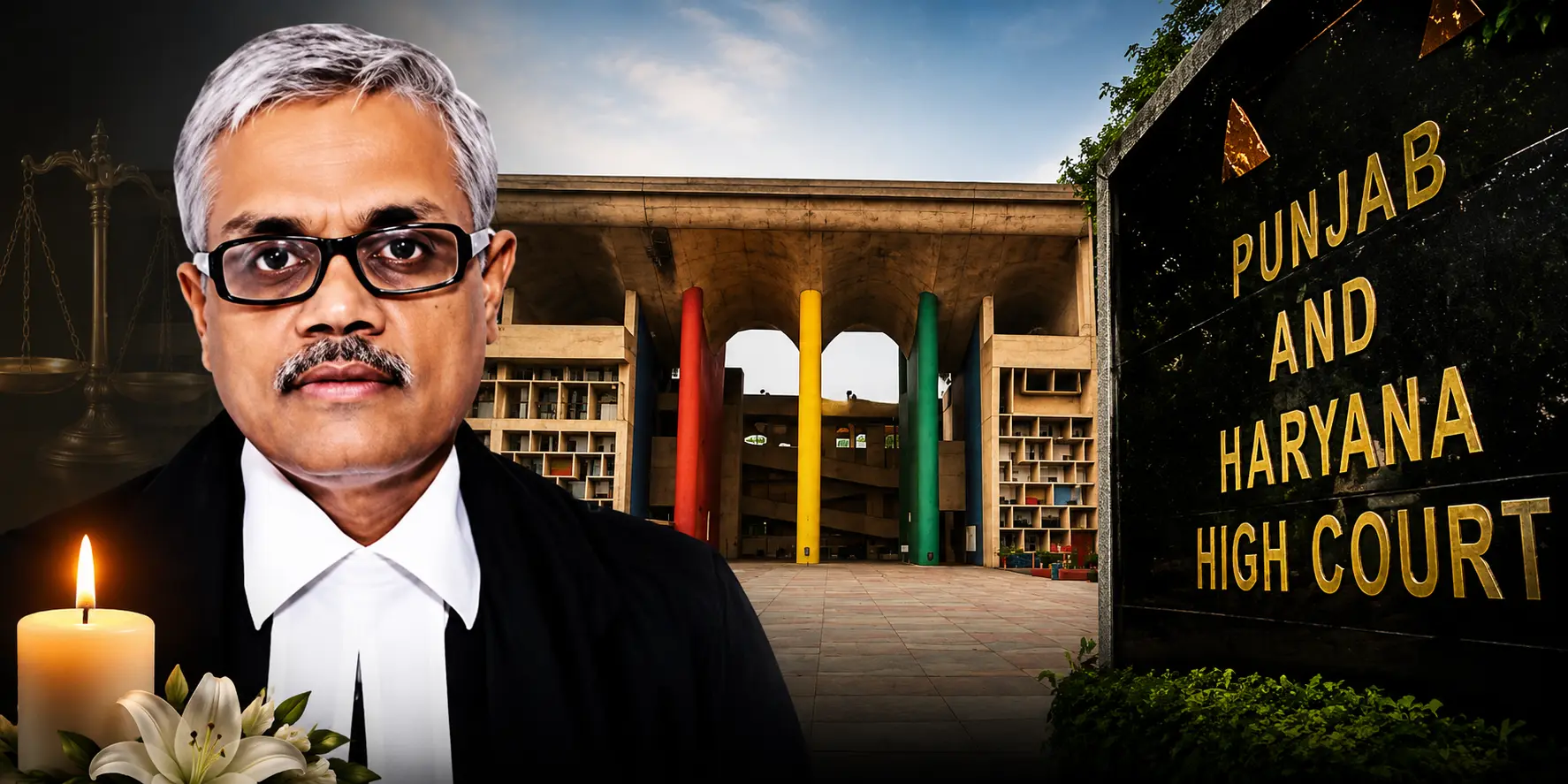
The legal fraternity is mourning the untimely demise of Justice Mahabir Singh Sindhu, a sitting Judge of the Punjab and Haryana High Court, who passed away on June 28, 2026. His sudden demise has left a deep void in the judiciary, where he was widely respected for his integrity, judicial acumen, and unwavering commitment to justice.
At the time of his passing, Justice Sindhu was the third senior-most judge of the High Court and was scheduled to retire in April 2029. Throughout his judicial career, he earned a reputation for balancing firmness in enforcing the rule of law with sensitivity towards individual rights and human dignity.
Justice Sindhu authored several landmark decisions aimed at protecting constitutional rights and ensuring accountability of public authorities.
In a significant ruling concerning investigations under the Prevention of Money Laundering Act, he directed the Enforcement Directorate to adopt remedial measures and sensitise its officers regarding reasonable limits on interrogation. Criticising prolonged questioning sessions extending up to fifteen hours, he observed that such practices were inconsistent with human dignity and constitutional values.
In Balwant Singh v. Directorate of Enforcement, Justice Sindhu cautioned judicial officers presiding over Special PMLA Courts against acting as an "extended arm" of investigating agencies by routinely granting remand requests. Setting aside a remand order, he stressed that courts must independently scrutinise requests for custody and protect individual liberty.
Justice Sindhu was equally known for holding government authorities accountable for arbitrary actions.
In one notable case, he imposed exemplary costs of ₹10 lakh on the Haryana Public Service Commission for denying reservation benefits to a candidate under the "Dependent of Ex-serviceman (disability beyond 50%)" category while recruiting Sub-Inspectors. The Court observed that a deserving candidate had been unfairly deprived of his lawful claim.
Similarly, he imposed costs of ₹3 lakh on the Haryana Staff Selection Commission after finding that a woman candidate had been unjustly denied appointment as a Constable and forced into prolonged litigation spanning six years.
In another matter, he directed the Punjab Public Works Department to compensate an employee who had been unlawfully denied promotion, imposing costs of ₹1 lakh on the concerned departmental authorities.
Justice Sindhu consistently emphasised procedural fairness and constitutional protections.
In the Ashok Kumar Sharma case, he declared an arrest under narcotics laws illegal after finding that authorities had failed to record reasons for the search and had not supplied the grounds of arrest to the accused. He held that such omissions violated statutory requirements as well as safeguards guaranteed under Article 22 of the Constitution.
He also criticised authorities for rejecting parole applications on speculative grounds. In one case involving a convict under the NDPS Act, he observed that decisions affecting liberty must be based on concrete material and legal principles rather than assumptions.
Justice Sindhu's judgments reflected an unwavering commitment to judicial independence and fairness.
He took stern action against a District Judge for adopting what he described as a "pick-and-choose" approach while denying service benefits to a court employee, holding such conduct to be arbitrary and legally unsustainable.
In another high-profile matter, he quashed two FIRs registered against former Punjab Minister Bharat Bhushan Ashu and others in a corruption case relating to alleged foodgrain transportation irregularities. The Court found that the criminal proceedings appeared to have been initiated merely to harass the accused and amounted to misuse of power by investigating authorities.
Justice Mahabir Singh Sindhu will be remembered as a judge who consistently upheld constitutional values, protected civil liberties, and ensured that public authorities remained accountable to the law. His judgments reflected courage, compassion, and a deep commitment to justice.
His untimely demise is a significant loss not only to the Punjab and Haryana High Court but also to the Indian judicial system as a whole. His contributions to the law and his unwavering dedication to fairness will continue to inspire generations of judges, lawyers, and law students.
Website designed, developed and maintained by webexy