
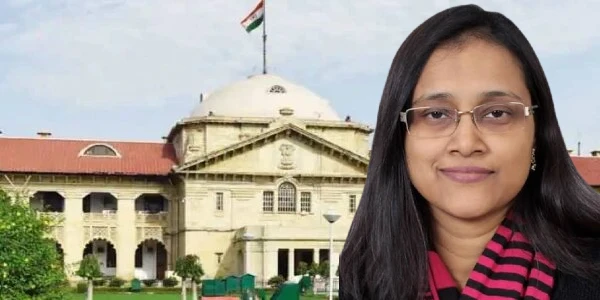
In a significant ruling reinforcing the protective object of maintenance laws, the Allahabad High Court has held that a wife cannot be denied maintenance under Section 125 CrPC merely because her parents are financially supporting her during difficult times. The Court clarified that parental assistance cannot substitute the husband's legal obligation to maintain his wife.
Justice Garima Prashad observed that the income of a wife's parents cannot be treated as the wife's own income and that an able-bodied husband cannot escape his statutory duty by relying on the support extended by her family.
The judgment came while allowing a criminal revision petition filed by a wife and her two minor children challenging a December 2023 order passed by the Family Court, Bulandshahr. The Family Court had denied maintenance to the wife altogether while granting only ₹3,000 per month each to the two children.
The wife had approached the Family Court under Section 125 CrPC alleging that after marriage she was subjected to harassment, cruelty and humiliation by her husband and his family members. She further claimed that her husband, a retired Army personnel, stopped maintaining marital relations and later informed her that he had married another woman.
According to her, in January 2020 she was assaulted and forcibly driven out of the matrimonial home along with her children. Since then, she has been residing at her parental home and has no independent source of income.
The husband denied the allegations and contended that the wife had left the matrimonial home without sufficient reason. He also accused her of maintaining illicit relationships with other persons. He stated that during his Army service, a sum of ₹11,303 per month was deducted from his salary and paid to his wife and children until his retirement in November 2020. After retirement, he claimed to be surviving solely on a pension of approximately ₹21,025 per month.
The Family Court rejected the wife's claim for maintenance after concluding that she had failed to prove allegations of dowry demand, assault, cruelty or the husband's alleged second marriage. It held that both sides had made unsubstantiated allegations and that the wife had failed to establish sufficient grounds for living separately from her husband.
Consequently, the Family Court denied maintenance to the wife while awarding ₹3,000 per month to each child.
Setting aside the Family Court's reasoning, the High Court emphasized that proceedings under Section 125 CrPC are summary in nature and are intended to prevent destitution rather than conduct a detailed matrimonial trial.
The Court observed that the inquiry under Section 125 CrPC is limited to determining whether the wife has a reasonable ground to live separately and whether the husband, despite having sufficient means, has neglected or refused to maintain her.
Justice Prashad noted that the admitted facts clearly demonstrated serious matrimonial discord between the parties. The husband had also admitted during cross-examination that he had not paid any maintenance after November 2020. These circumstances, according to the Court, were sufficient to establish neglect.
The Court further held that when divorce proceedings are pending, the spouses are living separately due to serious marital disputes, and the wife has custody of two minor children, it cannot be casually presumed that she is residing separately without sufficient cause.
Rejecting the husband's allegations of adultery, the Court found that no independent witness, documentary evidence or reliable material had been produced to support such claims.
The bench reiterated that the disqualification under Section 125(4) CrPC applies only when adultery is actually proved. Mere suspicion, allegations or attempts at character assassination cannot deprive a wife of her right to maintenance.
The Court strongly emphasized that support received from parents during periods of hardship cannot be treated as an alternative source of income for the wife.
It held that once there was no evidence showing that the wife had sufficient independent earnings, there was no legal basis to deny her maintenance. The Court observed that a husband cannot avoid his legal responsibility by claiming that his wife's parents are taking care of her expenses.
The High Court also found the maintenance granted to the children to be "wholly inadequate and unrealistic," observing that ₹3,000 per month was insufficient to meet the expenses of school-going children, including food, clothing, education, books, transportation and medical needs.
The Court further drew an adverse inference against the husband for failing to disclose complete details regarding his financial assets, agricultural holdings and dairy activities.
Accordingly, the Court modified the Family Court's order and directed the husband to pay:
₹5,000 per month to the wife.
₹4,000 per month each to the two minor children.
The Court additionally held that in the event of default, the wife and children would be entitled to seek direct recovery of the maintenance amount from the husband's military pension and other lawful receivables.
The ruling reiterates that Section 125 CrPC is a social welfare provision aimed at preventing destitution and ensuring financial security for neglected spouses and children. The judgment also sends a clear message that temporary support from parents cannot absolve a husband of his legal duty to maintain his wife.
Case: Vikas Sharma vs. State of U.P. and Another
Citation: 2026 LiveLaw (AB) 337
Website designed, developed and maintained by webexy