
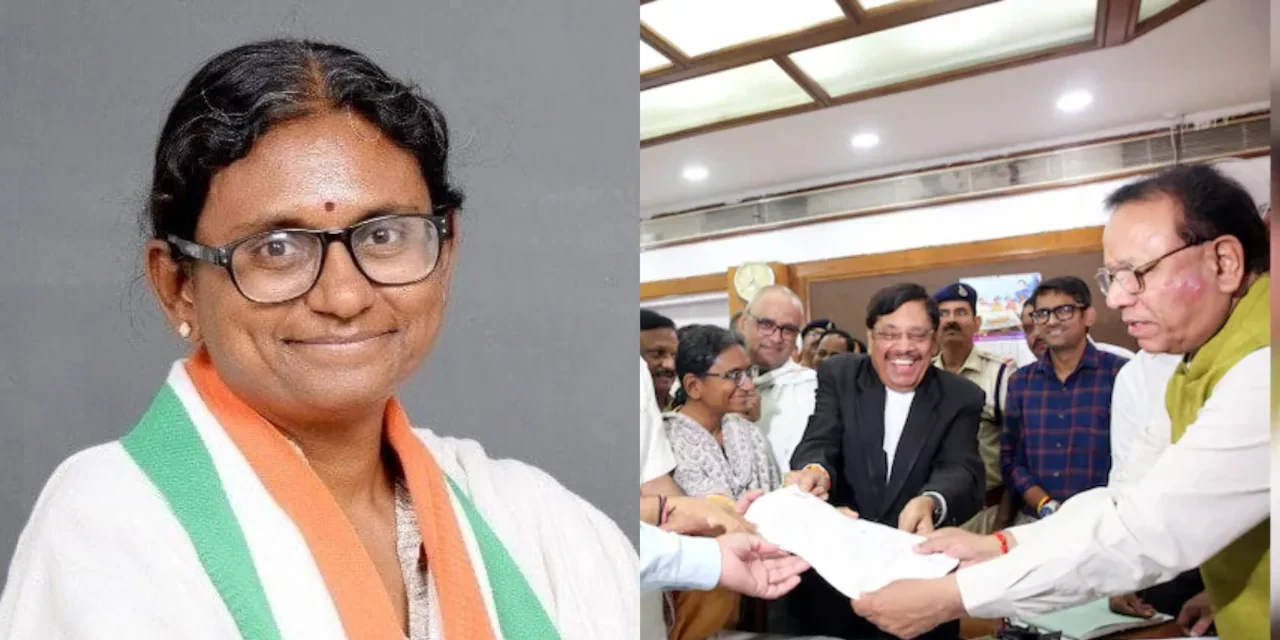
The Supreme Court on Friday dismissed a petition filed by Congress leader Meenakshi Natarajan challenging the rejection of her nomination papers for the Rajya Sabha elections.
A Bench of Justice Prashant Kumar Mishra and Justice AS Chandurkar held that courts cannot ordinarily interfere in election-related disputes once the electoral process has commenced, reiterating the constitutional bar contained in Article 329(b) of the Constitution.
"Whenever an attempt has been made to invoke the jurisdiction of this Court under Article 32, or that of the High Courts under Article 226, during the process of elections, this Court has repeatedly declined interference, having regard to the constitutional mandate contained in Article 329(b) of the Constitution," the Bench observed.
The Court rejected Natarajan's argument that judicial intervention should be permitted where the rejection of a nomination is ex facie illegal, arbitrary, or manifestly erroneous.
According to the Bench, accepting such a proposition would require courts to classify election disputes into categories based on the apparent severity of the alleged error, a distinction not contemplated by the Constitution.
"If such a distinction were to be recognised, courts would be required to classify election disputes into two categories—first, those involving allegedly glaring or manifest errors warranting immediate intervention under Articles 32 or 226; and second, those where the aggrieved party must await the remedy of an election petition," the Court said.
It added that creating such an exception would be inconsistent with the constitutional framework and the settled legal position governing election disputes.
Natarajan's nomination for the Rajya Sabha election from Madhya Pradesh was rejected on June 9 by Returning Officer and Madhya Pradesh Assembly Principal Secretary Arvind Sharma.
The rejection followed objections raised by BJP leaders, including Rajya Sabha candidate Mahesh Kewat and State General Secretary Rahul Kothari. They contended that Natarajan had failed to disclose details of a case pending before a Hyderabad court in the affidavit accompanying her nomination papers.
According to the Returning Officer's order, Natarajan had responded to a notice issued by a Hyderabad court in October 2025 but did not disclose the matter in Form 26 submitted with her nomination. The officer concluded that the affidavit was incomplete and rejected her candidature.
The Congress leader challenged the decision before the Supreme Court, arguing that no criminal case was pending against her in the legal sense because no court had taken cognisance of the private complaint. She maintained that a pre-cognisance notice did not amount to a pending criminal case requiring disclosure.
Appearing for Natarajan, Senior Advocate Abhishek Manu Singhvi argued that the Returning Officer had acted arbitrarily. He submitted that even if cognisance had been taken in the Hyderabad matter, charges had not been framed and the allegations remained untested.
"The allegations remain to be tested and the matter is still at a preliminary stage. Therefore, there is no violation of the requirements contained in Section 33A of the Representation of the People Act, 1951," Singhvi argued.
He further contended that judicial review should facilitate the democratic process and preserve electoral choice rather than restrict it.
However, the Court remained unconvinced, noting that settled law requires a candidate aggrieved by rejection of a nomination to challenge the decision through an election petition after the election process concludes.
"Is there any judgment of this Court where we have interfered at that stage?" Justice Mishra asked during the hearing.
Senior Advocates Mukul Rohatgi and Dama Seshadri Naidu, appearing for the respondents, argued that the petition under Article 32 was not maintainable since the right to contest an election is a statutory right and not a fundamental right. They submitted that neither the Supreme Court nor High Courts can entertain challenges to nomination rejections during the pendency of the election process.
The respondents also argued that candidates are obligated to disclose all pending criminal proceedings, regardless of the stage of the case, and that disclosure requirements are not limited to cases where charges have been framed.
Solicitor General Tushar Mehta appeared on behalf of the State of Madhya Pradesh. However, the Court declined to permit the State's intervention, observing that it had no role in the conduct of the election.
Senior Advocate Dama Seshadri Naidu represented the Election Commission of India, while Senior Advocate Mukul Rohatgi and Advocate Kanu Agrawal appeared for BJP candidates Rajneesh Kumar Agrawal and Mahesh Kewat.
Website designed, developed and maintained by webexy