
The Supreme Court has held that while a suit for specific performance can be based on an oral agreement to sell, the plaintiff carries a heavy burden to establish that a concluded contract was actually reached between the parties.
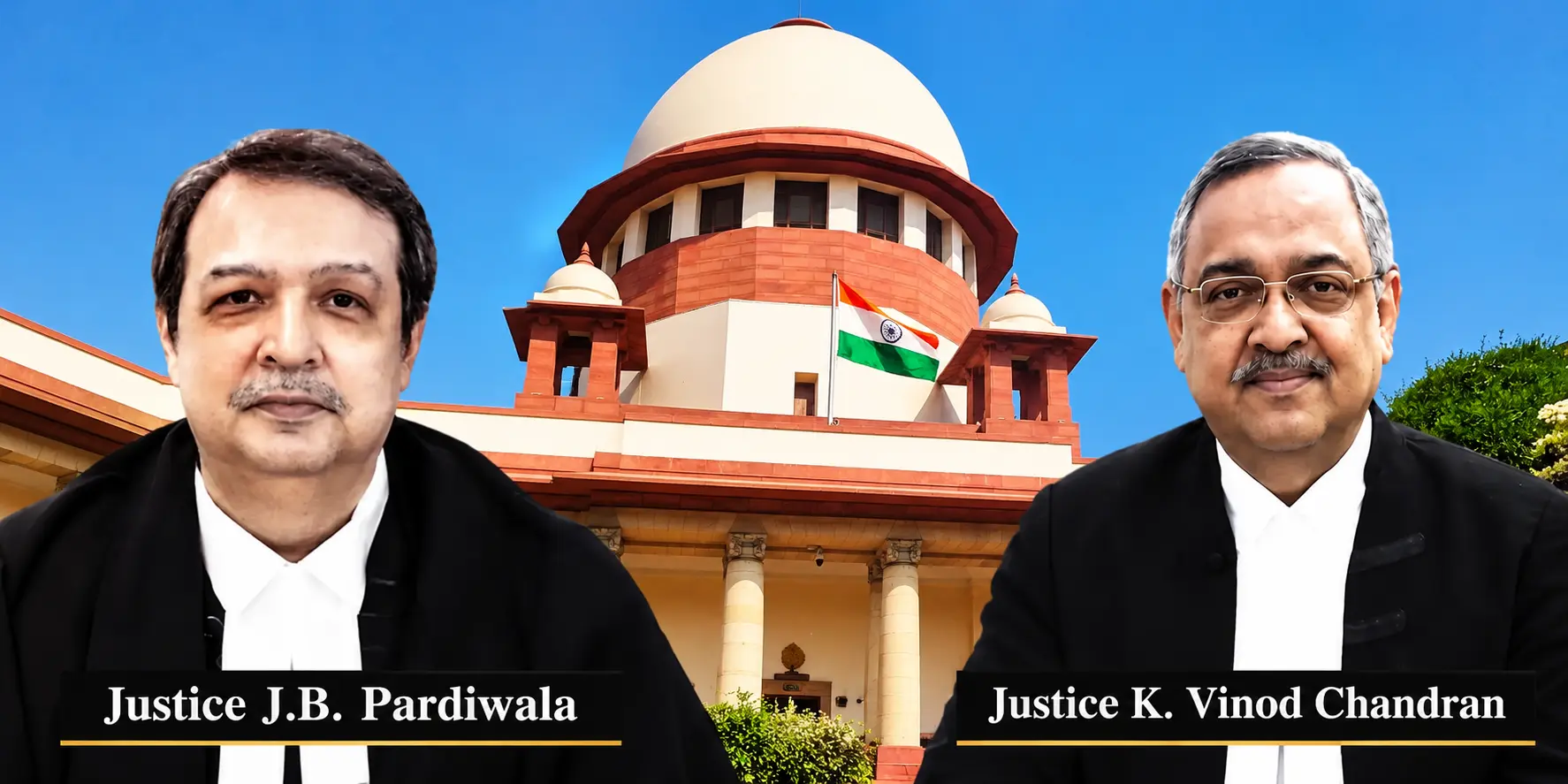
A Bench comprising Justice J.B. Pardiwala and Justice K. Vinod Chandran made the observations while allowing an appeal in Bombay Garage Ahmedabad Limited & Ors. v. J P Iscon Private Ltd. & Anr. and dismissing the suit for specific performance.
The Supreme Court reiterated that there is no legal requirement that an agreement for sale of immovable property must necessarily be in writing.
However, where a plaintiff seeks specific performance solely on the basis of an oral agreement, the burden of proof is heavy.
The plaintiff must establish that there was a consensus ad idem and that the vital and fundamental terms of the proposed sale had been conclusively settled orally. A mere inference is not sufficient.
The Court noted that strict proof is the norm in such cases.
The dispute also involved the applicability of Order II Rule 2 of the Code of Civil Procedure.
The plaintiff had earlier filed a suit seeking only permanent injunction concerning the property. The plaintiff subsequently withdrew that suit and instituted a fresh suit seeking specific performance.
The Supreme Court held that the relief of specific performance was already available to the plaintiff when the first suit was instituted. The plaintiff had neither sought that relief in the first suit nor obtained the necessary leave of the Court to reserve it.
Consequently, the subsequent suit attracted the bar under Order II Rule 2 CPC.
The Court clarified that permission sought at the time of withdrawal of the earlier suit could not cure the failure to obtain leave when the first suit was instituted.
The Supreme Court also examined the evidence relied upon to establish the alleged oral agreement.
The plaintiff claimed that the sale consideration was ultimately agreed at ₹20.50 crore and that an advance of ₹5.11 lakh was paid in cash, besides a ₹5 crore cheque.
However, the Court noted that the alleged ₹5 crore cheque had never been presented for encashment.
According to the Court, this circumstance itself contradicted the claim that there was a concluded contract, particularly when the cheque was alleged to have been given as an advance.
The Court also found several inconsistencies in the pleadings regarding the meetings at which the alleged agreement was said to have been concluded.
The plaintiff relied upon oral testimony of three witnesses. However, the Court found that the evidence did not unequivocally establish the alleged contract.
The Court also noted that one of the persons said to have negotiated the transaction had no official capacity in the company and that his matrimonial relationship with another person associated with the company did not, by itself, give him authority to contract concerning the company's assets.
The Court emphasized that even evasive or inconsistent answers by defence witnesses cannot, by themselves, establish the plaintiff's case. The burden remained on the plaintiff to prove the concluded contract.
The Supreme Court concluded that the plaintiff had failed to establish a concluded contract and that the Trial Court and First Appellate Court had erred in granting specific performance.
The Court also held that the suit was not maintainable in view of the bar under Order II Rule 2 CPC.
Accordingly, the Supreme Court allowed the appeal, set aside the orders of the Trial Court and High Court, and dismissed the suit for specific performance.
The parties were directed to bear their own costs.
Case: Bombay Garage Ahmedabad Limited & Ors. v. J P Iscon Private Ltd. & Anr.
Citation:- 2026 INSC 1066
Judgment Date: September 29, 2026
Bench: Justice J.B. Pardiwala and Justice K. Vinod Chandran
Website designed, developed and maintained by webexy