
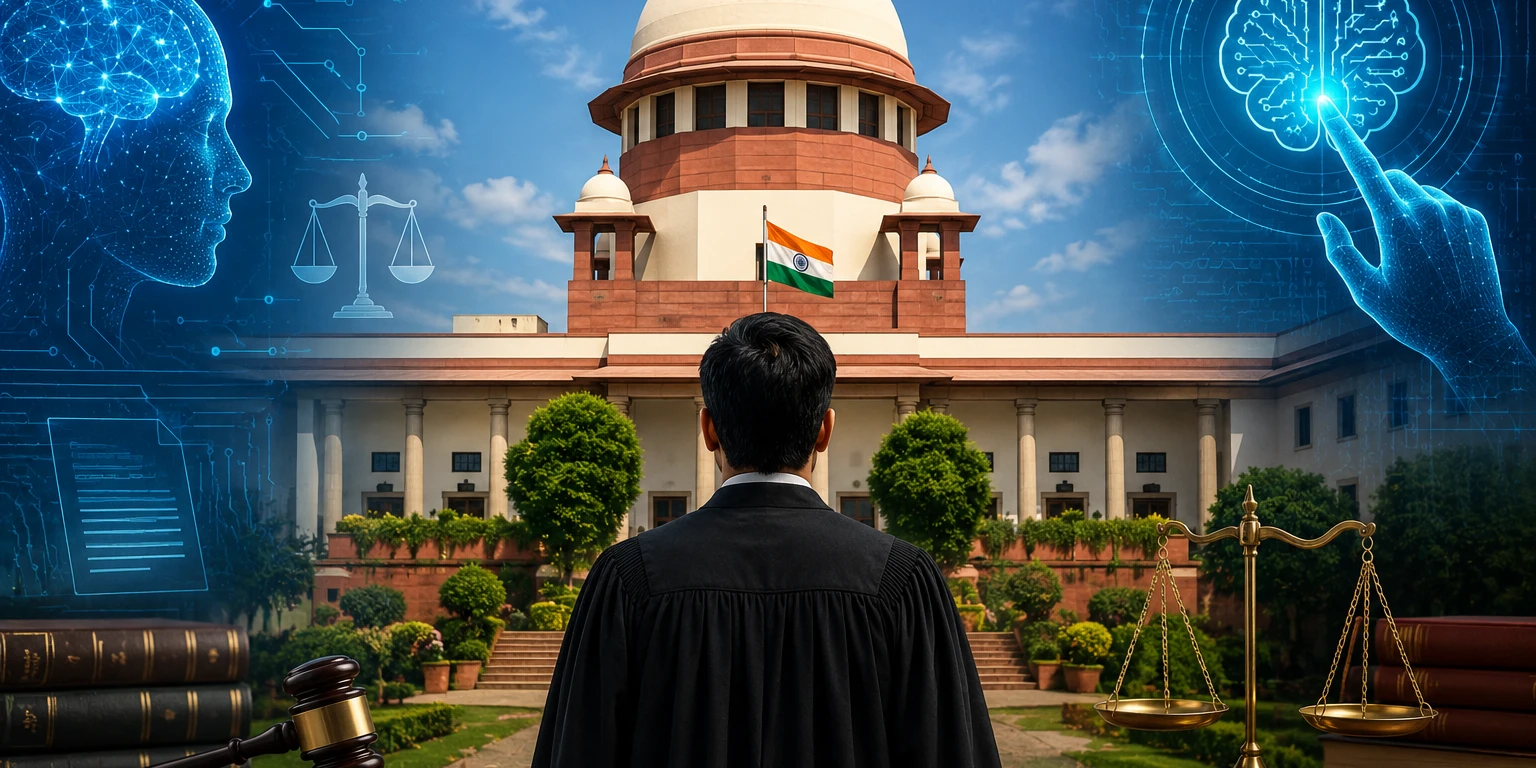
The Supreme Court of India has released a draft framework titled “Regulations for Use of Artificial Intelligence (AI) in Courts, 2026” and invited comments and suggestions from stakeholders and the general public. The proposed regulations seek to establish a comprehensive legal and institutional framework governing the adoption, deployment, and use of Artificial Intelligence across the Indian judiciary.
According to the notice issued on June 3, 2026, the draft regulations have been prepared under the aegis of the Supreme Court's AI Committee after extensive deliberations and consultations. Interested persons may submit their suggestions to the AI Committee by June 20, 2026.
The draft places human primacy and judicial independence at the center of AI governance. It expressly states that AI systems can only function in an assistive role and cannot replace judges in deciding questions of law, fact, or justice. Judicial officers will continue to bear full responsibility for decisions made with AI assistance.
One of the most significant features of the draft is the clear distinction between permissible and prohibited uses of AI. Courts may use AI for case management, legal research, document summarization, transcription, translation, accessibility services, cause-list preparation, and administrative functions. However, the regulations categorically prohibit AI from independently determining judicial outcomes, sentencing, bail decisions, risk assessment, witness credibility analysis, or predicting future behavior of litigants and accused persons.
The proposed framework also introduces strict safeguards against AI hallucinations, bias, discrimination, and privacy violations. Every AI system used by courts would be subject to regular technical, legal, ethical, and cybersecurity audits. The regulations further require transparency whenever AI-generated content is used in court proceedings, and parties would be obligated to disclose AI-assisted pleadings, documents, or evidence.
To oversee AI governance, the draft proposes the creation of a permanent Apex Body at the Supreme Court level, supported by specialized committees on technology, cybersecurity, judicial administration, infrastructure, and data management. Every High Court would also establish its own AI Committee and AI Secretariat to supervise AI deployment within its jurisdiction.
Another notable provision prohibits the use of sensitive judicial data for training AI systems without approval and mandates strict compliance with the Digital Personal Data Protection Act, 2023 and cybersecurity standards. The draft further requires courts to maintain an AI Register documenting all approved AI tools, audits, incidents, and compliance measures.
The regulations reflect a policy approach that encourages responsible innovation while safeguarding constitutional values, judicial independence, privacy rights, and access to justice. If finalized, they would constitute one of the most detailed judicial AI governance frameworks in the world.
Website designed, developed and maintained by webexy