
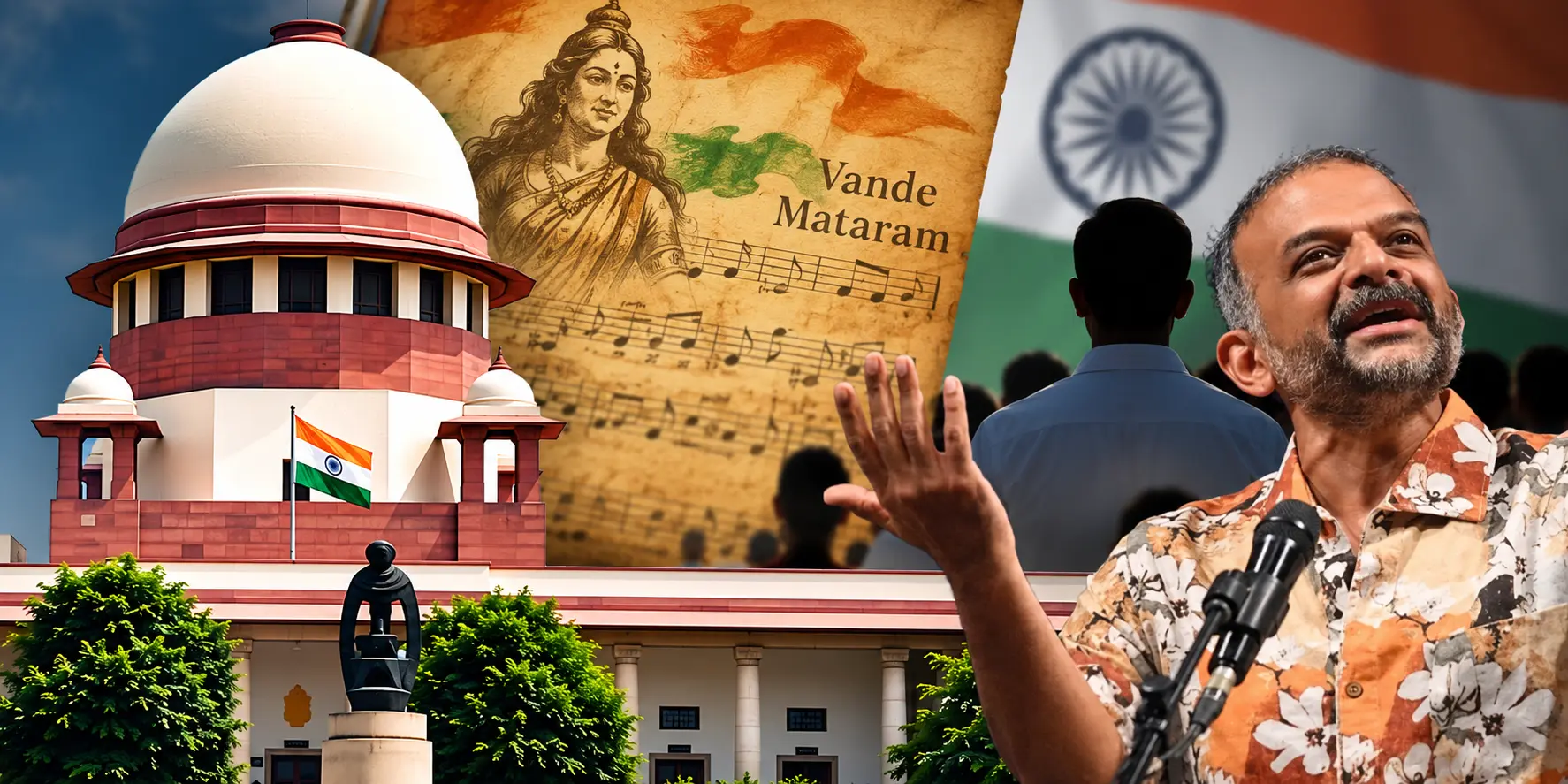
The Supreme Court on Tuesday indicated that a person who does not sing ‘Vande Mataram’ on religious or conscientious grounds should not face criminal consequences, while seeking the response of the Union Government on a challenge to the 2026 amendment extending penal protection to the National Song.
A Bench comprising Chief Justice of India Surya Kant, Justice Joymalya Bagchi and Justice V. Mohana was hearing a writ petition filed by Carnatic musician T.M. Krishna, challenging the constitutional validity of the Prevention of Insults to National Honour (Amendment) Act, 2026, along with the Ministry of Home Affairs' directions requiring the singing of all six stanzas of Vande Mataram at specified official functions.
During the hearing, the Bench referred to the Supreme Court's landmark 1986 judgment in Bijoe Emmanuel v. State of Kerala, which recognised the rights of students who declined to sing the National Anthem because of their religious beliefs while continuing to stand respectfully.
Justice Joymalya Bagchi observed that the declaration of law in Bijoe Emmanuel had not been questioned and indicated that the same principle should govern the amended law concerning Vande Mataram.
The Court made it clear that it would examine whether the rights of a conscientious objector to refrain from singing the National Song are protected, particularly in the context of fundamental rights under Articles 25 and 26 of the Constitution.
The Bench also observed that determining what constitutes the National Song, including whether it comprises two or all six stanzas, was not for the Court to decide.
The Court indicated that the State is entitled to determine the national song and the manner in which it is officially observed, but a person exercising constitutionally protected freedom of conscience or religion should not be subjected to criminal consequences merely for refusing to sing it.
T.M. Krishna's petition challenges the requirement to sing all six stanzas of Vande Mataram. According to the petition, the last four stanzas contain references to Hindu deities including Durga, Lakshmi and Saraswati, and compelling individuals to sing them could amount to compelled religious or ideological expression.
The petition argues that the amended law, when read with the MHA directions, effectively imposes criminal consequences in relation to the singing of the complete six-stanza composition and raises questions under Articles 14, 15, 19, 21 and 25 of the Constitution.
The petition challenges Section 3 of the Prevention of Insults to National Honour Act, 1971, as amended in 2026. The amended provision provides penal consequences for intentionally preventing the singing of the National Anthem or National Song, or causing disturbance to an assembly engaged in such singing.
The amended provision carries a punishment of imprisonment up to three years, fine, or both.
The Supreme Court has sought the Union Government's response on the challenge. The Court's observations were made during the hearing and are not, by themselves, a final determination on the constitutional validity of the amended law.
Website designed, developed and maintained by webexy