
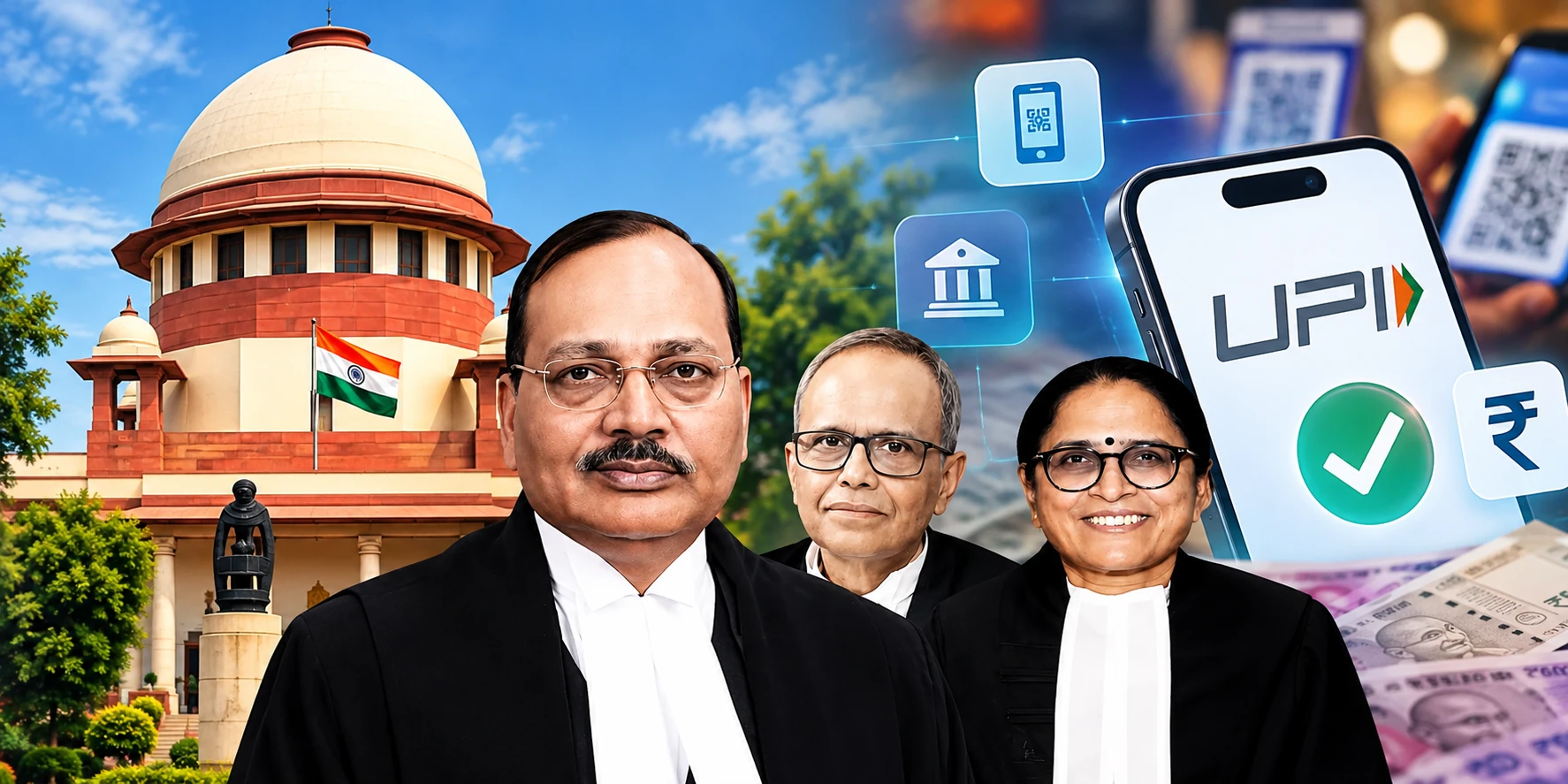
The Supreme Court on September 28, 2026 sought an affidavit from the Central Government explaining the legal and policy basis for the new framework permitting Merchant Discount Rate (MDR) charges on specified UPI transactions above ₹2,000, while refusing to stay its implementation.
A Bench comprising Chief Justice of India Surya Kant, Justice Joymalya Bagchi and Justice V. Mohana was hearing a writ petition filed by Advocate Anjan Datta, challenging the Union Finance Ministry's Gazette notifications dated September 14 and 15 concerning charges on specified commercial UPI transactions.
During the hearing, Additional Solicitor General N. Venkataraman, appearing for the Centre, submitted that the new charges would come into effect from October 15, 2026.
The Centre told the Court that approximately 96% of merchant transactions would remain unaffected. It also submitted that person-to-person UPI transfers would remain free and that specified essential services would attract a capped charge of ₹5.
The ASG submitted that the charge is neither a tax nor a fee, and that the Government of India would not receive any part of the amount. According to the Centre, the MDR would operate as a settlement fee within the payment ecosystem between banks and payment aggregators.
Justice Joymalya Bagchi questioned the legal character and basis of the proposed charges.
The Bench sought clarity on whether the levy was a tax or a fee and, if it was neither, what was the executive basis for imposing it and what service was being provided in return.
The Court also referred to Section 269SU of the Income Tax Act, which requires certain businesses to provide electronic payment facilities, and questioned the legal incidence of the proposed charge in the UPI ecosystem.
The Bench observed that the issue required the relevant facts to be placed on affidavit and described it as being more technical in nature.
The Supreme Court issued notice to the Union Government, Reserve Bank of India (RBI) and National Payments Corporation of India (NPCI) and called for their responses.
The petitioner had sought a stay on the new framework, arguing that the charges could have wider consequences, including potentially encouraging cash transactions. The Supreme Court, however, declined to grant an interim stay.
Under the announced framework, the MDR would apply to specified person-to-merchant (P2M) UPI transactions above ₹2,000.
For general P2M transactions, the MDR has been set at 0.4%, with a maximum charge of ₹300 for transactions of ₹75,000 or more. Certain sectors, including railways, telecommunications, insurance, fuel and agricultural inputs, would attract a flat MDR of ₹5 for transactions above ₹2,000. Capital market transactions would attract an MDR of 0.02%, capped at ₹300.
The framework also provides for zero MDR for small merchants receiving up to ₹1 lakh per month through UPI QR codes under the specified category. (Business Standard)
The Finance Ministry's September 14 notification protects UPI transactions up to ₹2,000 and specified RuPay debit-card payments from direct or indirect charges on persons making or receiving the payments.
Anjan Datta v. Union of India
WP(C) Diary No. 57387/2026
Website designed, developed and maintained by webexy