
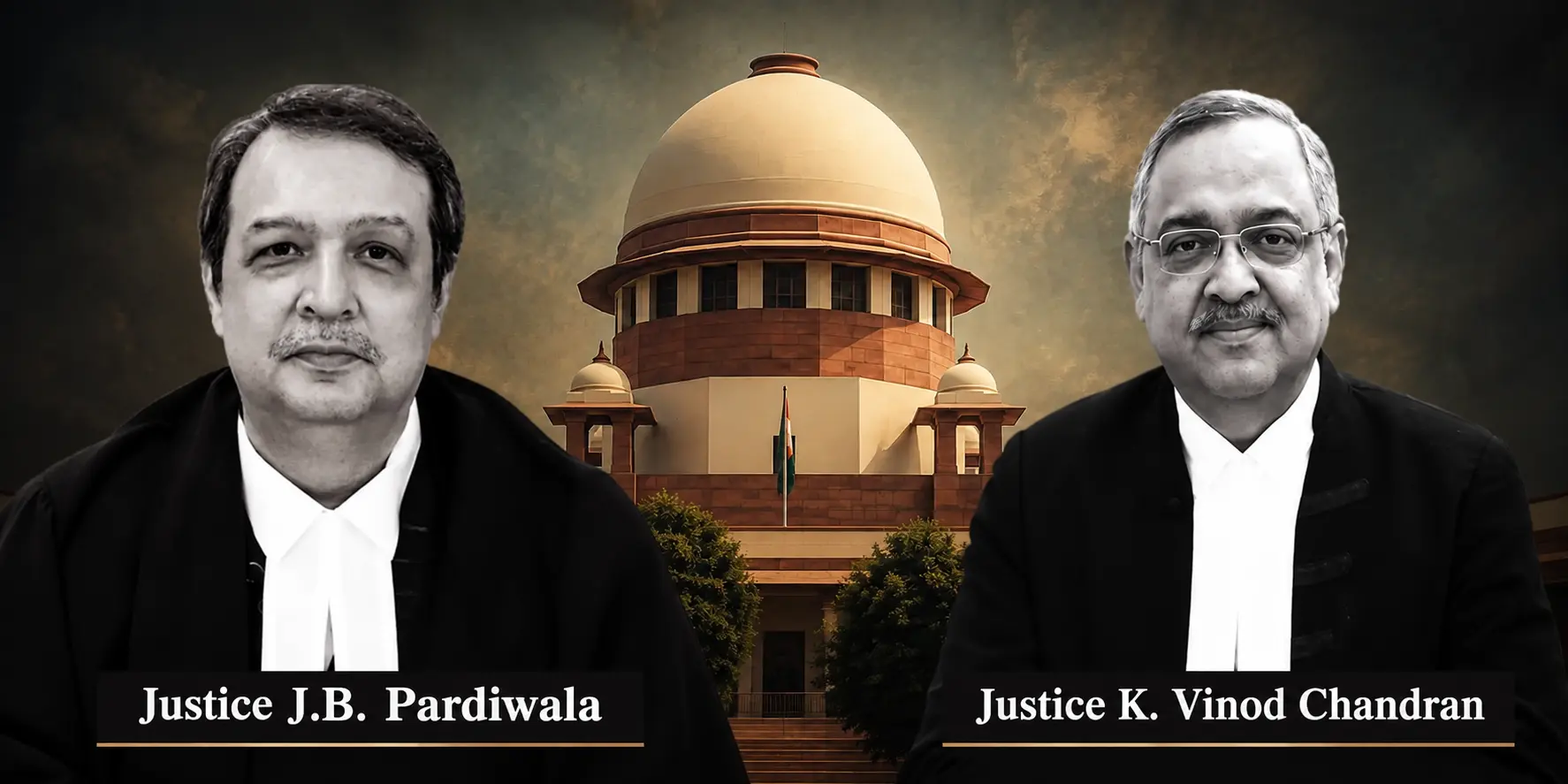
The Supreme Court of India has taken suo motu cognizance of a series of reported sexual offences against women and minor girls in the Delhi-NCR region, raising serious concerns over the safety of public spaces.
A Bench comprising Justice J.B. Pardiwala and Justice K. Vinod Chandran passed the order on 28 September 2026 in In Re: Recent Rape Incidents in Delhi NCR, Suo Moto Writ Petition (Criminal) No. 6/2026.
The Court referred to several recent incidents, including the alleged gang rape of a 17-year-old girl at Aastha Kunj Park in Delhi, an alleged gang rape and murder of a teenage girl in Swaroop Nagar, and an alleged sexual assault of a minor girl inside a moving sleeper bus travelling from Greater Noida to Delhi.
The Bench observed that these incidents, considered alongside other reports of sexual offences in Delhi-NCR, raise concerns regarding the functioning of law-enforcement and civil administrative authorities in ensuring public safety.
The Court emphasised that the right to live with dignity and free from fear of violence is part of the fundamental guarantee of life and personal liberty under Article 21. It noted that public spaces such as parks, roads, buses, metro stations, subways and footbridges cannot become high-risk zones because of inadequate lighting, surveillance or patrolling.
The Supreme Court directed the concerned authorities to place a comprehensive status report before it covering the actual functioning of various safety mechanisms in Delhi-NCR.
The Court specifically sought information regarding:
Safety arrangements in parks, roads, public transport, markets and educational institutions.
Utilisation of the National Database on Sexual Offenders (NDSO) by the Delhi Police.
Use of the Investigation Tracking System for Sexual Offences (ITSSO).
Implementation of the Mission Shakti programme in Delhi.
Functioning of Emergency Response Support System 112 and Women Helpline 181.
Status of the Safe City Project, including CCTV coverage, smart lighting and command-and-control infrastructure.
Functioning of Women Help Desks in police stations.
Availability of One Stop Centres and other support mechanisms for women and children affected by sexual violence.
The Court further directed that the reports should disclose whether these mechanisms are operational, the geographical area and population covered, the responsible officer or authority, the number of complaints or interventions handled during the preceding three years and the average response time wherever measurable.
As an immediate interim measure, the Court directed the Commissioner of Police, Delhi to constitute dedicated police teams for every police district.
These teams, headed by an officer not below the rank of Deputy Superintendent of Police, will conduct surveys of vulnerable areas, including:
isolated stretches;
parks;
transport hubs;
markets;
educational-institution zones;
outskirts; and
other public places.
The assessment is to consider NCRB data, local intelligence, complaints and previous incidents to identify locations vulnerable to crime.
The Court has also directed the preparation of district-wise vulnerability maps, which are to be shared among adjoining police stations so that information regarding recurring crime patterns and habitual offenders does not remain confined to individual police-station jurisdictions.
Police patrolling and security arrangements are to be deployed at identified vulnerable locations, particularly during evening and early-morning hours.
The Supreme Court ordered an immediate lighting and CCTV audit of public parks and vulnerable zones to eliminate blind spots.
Non-functional CCTV cameras and lighting infrastructure are to be repaired or restored, while additional infrastructure is to be installed wherever deficiencies are identified. Similar audits have been directed for metro stations, bus stops, bus terminals, railway stations and other major public transport facilities.
The Court also directed authorities to use citizen grievance mechanisms, including the CM Jan Sunwai Portal, to identify deficiencies in public-safety infrastructure. Complaints concerning inadequate lighting, CCTV coverage or unsafe stretches are to be forwarded to competent authorities and acted upon within prescribed timeframes.
The Court directed intensified police patrolling, including mobile check-posts and vehicular inspections.
It also directed strict enforcement of its earlier directions in Avishek Goenka v. Union of India, concerning the prohibition on black, tinted or solar-control films on vehicle windows. The police have been directed to ensure compliance, including impounding non-compliant vehicles and taking action against violations.
The Registrar General of the Delhi High Court has been directed to provide comprehensive information regarding the functioning of Fast Track Special Courts (FTSCs) and Exclusive POCSO Courts in Delhi.
The information must include the number of functioning courts, pending cases, annual disposal rates for the preceding three years and the average time taken for final disposal.
The Delhi High Court's administrative side has also been directed to assign the cases to a designated Fast Track Special Court and ensure that trials are concluded expeditiously, preferably within one year from commencement of trial.
The Bench also issued important observations concerning media coverage of sexual offences.
It reminded print, electronic and digital media organisations of their obligation to ensure responsible, empathetic and restrained journalism, cautioning against sensational headlines and graphic descriptions of sexual violence.
The Court specifically referred to Section 72 of the Bharatiya Nyaya Sanhita, 2023 and Section 23 of the POCSO Act, which prohibit disclosure, directly or indirectly, of the identity of victims of sexual assault or minor children.
The District Administration has been directed to immediately engage with media houses and provide dedicated space or airtime for information regarding protective mechanisms and telephone numbers that people can use when facing a perceived threat.
The Supreme Court appointed Senior Advocate Liz Mathew as Amicus Curiae to assist the Court in the proceedings.
The matter has been directed to be listed on 5 October 2026 for further directions and compliance.
Website designed, developed and maintained by webexy