
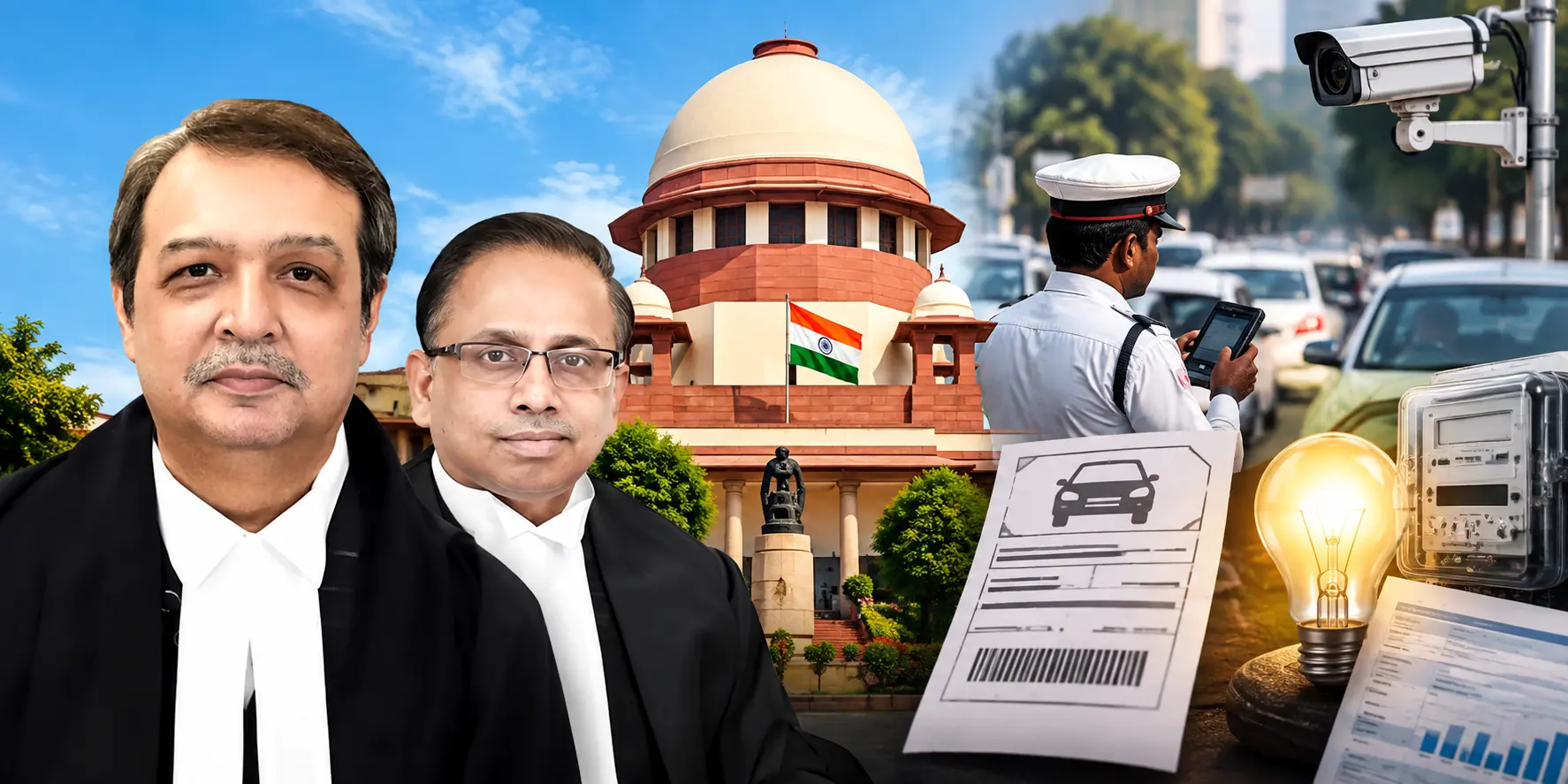
The Supreme Court on Monday suggested a series of measures to ensure recovery of unpaid traffic e-challans, including exploring whether outstanding traffic fines could be linked with electricity bills and restricting vehicle-related services until pending challans are cleared.
A Bench comprising Justice J.B. Pardiwala and Justice K.V. Viswanathan was hearing the long-running road safety matter, S. Rajaseekaran v. Union of India & Ors., concerning, among other issues, electronic enforcement of traffic violations and recovery of unpaid e-challan fines.
During the hearing, Justice Pardiwala stressed that merely generating large numbers of e-challans would not serve the purpose unless authorities develop effective mechanisms for recovering the fines.
The Court observed:
“It is not just sufficient to keep issuing e-challans... Question is recovery of fines as sought to be imposed by way of the e-challans.”
The Bench was informed that approximately ₹45,000 crore is recoverable by States and Union Territories towards e-challans, of which around ₹25,000 crore has so far been recovered.
One of the significant suggestions made by the Court was to explore whether outstanding traffic challans could be added to the defaulter's electricity dues.
The Court remarked that authorities need to devise practical solutions to ensure that people actually pay traffic fines.
“If people are not paying traffic challans, add it to their electricity dues bill... Work it out. In this country, you have to find a way out.”
The observation was a suggestion made during the hearing, rather than a declaration that unpaid challans have already been linked to electricity bills.
The Bench also discussed several other possible mechanisms for recovering outstanding e-challans.
These included preventing renewal of Registration Certificates (RCs), issuance of duplicate certificates and changes in ownership details until all outstanding traffic challans relating to the vehicle are cleared.
The Court also discussed blacklisting vehicles with unpaid challans on the Parivahan portal and preventing their ownership from being transferred until outstanding fines are paid.
Other measures discussed before the Court included withholding fitness certificates and Pollution Under Control (PUC) certificates for vehicles with unpaid challans.
The Court also considered whether authorities could prevent the renewal of driving licences and take appropriate steps regarding existing licences in cases involving unpaid challans.
Justice Pardiwala emphasised that authorities would have to formulate measures keeping practical realities in mind, observing:
“The authorities need to work at the ground level having regard to ground realities.”
The Supreme Court further suggested random checking of vehicles to identify those against which e-challans remain unpaid.
The Court indicated that where a vehicle is found during such checking to have unpaid e-challans, authorities could consider taking necessary action, including impounding the vehicle in accordance with the applicable legal framework.
The suggestions arose while the Court was considering an application seeking implementation of electronic enforcement mechanisms under Section 136A of the Motor Vehicles Act, 1988 read with Rule 167A of the Central Motor Vehicles Rules, 1989.
The application forms part of the road-safety PIL instituted in 2012 by Coimbatore-based orthopaedic surgeon S. Rajaseekaran.
The proceedings have over the years resulted in several directions concerning road safety, enforcement of motor vehicle laws, pedestrian safety and measures aimed at reducing road accidents.
The Bench also expressed concern over whether directions issued by the Supreme Court over nearly 14 years have actually been implemented on the ground.
The Court cautioned that merely continuing to issue directions would have little purpose if they remained only on paper and indicated that failure by authorities to implement them could eventually invite stronger action.
The Court consequently asked Senior Advocate Gaurav Agarwal, the Amicus Curiae, to prepare a comprehensive chart detailing the directions issued by the Supreme Court, the time granted for their implementation, their present status and the Amicus' remarks on compliance.
The exercise is intended to enable the Court to assess how far its previous road-safety directions have translated into actual implementation.
Website designed, developed and maintained by webexy