
The Supreme Court has held that a candidate possessing a Secondary School Certificate from the National Institute of Open Schooling (NIOS) cannot automatically be treated as fulfilling a recruitment condition requiring a candidate to have “passed 10th standard under 10+2 system of education.”
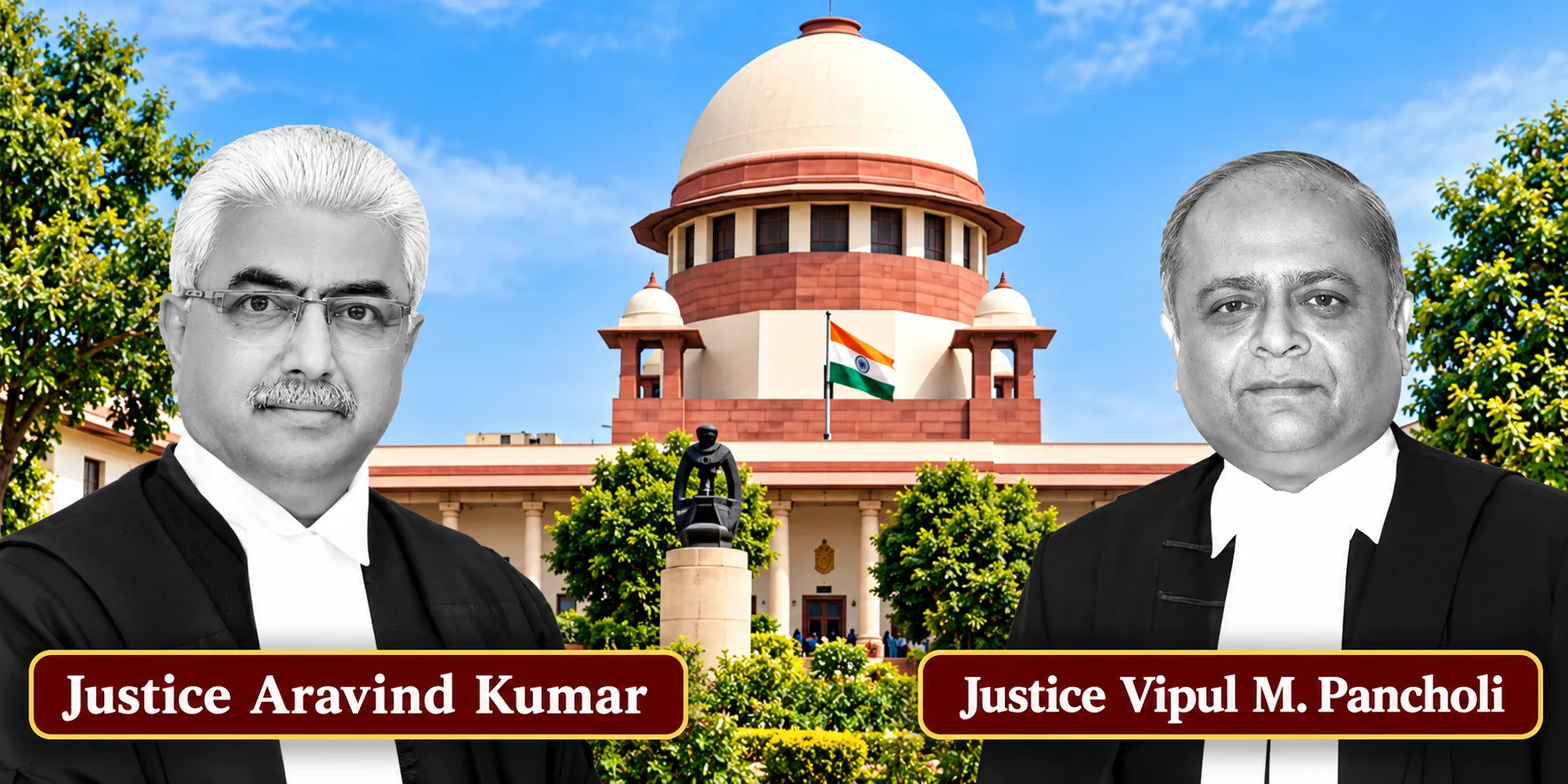
A Bench comprising Justice Aravind Kumar and Justice Vipul M. Pancholi held that the specific words used in the Recruitment Rules must be given effect and that courts cannot expand or alter an essential qualification prescribed by the recruiting authority.
The judgment was delivered in Santosh B. Naik v. State of Goa & Ors., 2026 INSC 1089, arising from a recruitment dispute concerning the post of Vocational Instructor (Practical) in the trade of Plumber under the Directorate of Skills Development and Entrepreneurship, Government of Goa.
The recruitment advertisement dated November 5, 2021 prescribed the following qualifications for the post:
The appellant and Respondent No. 3 participated in the written examination held on November 9, 2022.
Respondent No. 3 secured 96 marks, while the appellant secured 94 marks.
However, during document verification, the Departmental Selection Committee found that Respondent No. 3 did not possess the prescribed academic qualification of having passed 10th standard under the 10+2 system of education.
The appellant was accordingly declared eligible and selected for the post.
Respondent No. 3 relied upon his Secondary School Certificate obtained through NIOS and argued that the qualification was recognised and equivalent to the Class 10 examination conducted by recognised boards.
The Bombay High Court at Goa accepted his contention and directed the authorities to consider him for appointment based on the marks obtained in the written examination.
The appellant challenged that decision before the Supreme Court.
The Supreme Court drew a distinction between the general recognition of an NIOS qualification and whether that qualification satisfied the specific eligibility condition prescribed for the particular post.
The Bench observed that the relevant requirement was not merely passing the 10th standard but passing the 10th standard “under 10+2 system of education.”
“The words ‘under 10+2 system of education’ cannot be ignored. They form part of the qualification prescribed for the post and have to be given their due meaning.”
The Court held that the Recruitment Rules contained no provision treating a qualification recognised as equivalent to the 10th standard as automatically satisfying the requirement of having passed 10th standard under the 10+2 system.
The Supreme Court reiterated that qualifications prescribed by the recruiting authority must ordinarily be satisfied in the manner in which they have been prescribed.
It relied upon earlier decisions including Zahoor Ahmad Rather v. Sheikh Imtiyaz Ahmad, Unnikrishnan C.V. v. Union of India, Shifana P.S. v. State of Kerala, and Maharashtra Public Service Commission v. Sandeep Shriram Warade.
The Bench held that the question of whether a particular qualification is equivalent to the prescribed qualification ordinarily falls within the domain of the employer or competent expert body.
Judicial review cannot be used to add to, alter or enlarge the essential eligibility conditions prescribed under the Recruitment Rules.
The Court also considered the nature of the post.
The position of Vocational Instructor (Practical) in the trade of Plumber required not only an academic qualification but also a National Trade Certificate/National Apprenticeship Certificate and practical experience in the industry.
The Court therefore held that the qualifications had to be considered within the context of the technical teaching post for which recruitment was being made.
An additional factor considered by the Supreme Court was the Department's earlier recruitment process for the same post in 2015.
During that recruitment, the appellant himself had been found ineligible because he had passed the Secondary School examination of the National Open School and did not possess the qualification of having passed 10th standard under the 10+2 system.
The Supreme Court said this demonstrated that the Department had consistently interpreted and applied the Recruitment Rules in the same manner.
However, the Court clarified that the earlier decision was not being treated as a binding precedent, but was relevant to demonstrate the employer's consistent interpretation.
The Court rejected the argument that Respondent No. 3's higher marks in the written examination should entitle him to appointment.
It held that comparative merit can only be considered among candidates who satisfy the prescribed eligibility conditions.
“The marks secured in the written examination cannot cure the absence of an essential qualification prescribed under the Recruitment Rules.”
The Supreme Court concluded that the Departmental Selection Committee had correctly found Respondent No. 3 ineligible because he did not fulfil the prescribed academic qualification.
The Court accordingly:
The Court specifically clarified that its ruling was confined to the Recruitment Rules applicable to the post in question and the advertisement dated November 5, 2021. It expressed no opinion on the validity, recognition or equivalence of NIOS qualifications for any other purpose or under any other Recruitment Rules.
Case: Santosh B. Naik v. State of Goa & Ors.
Citation: 2026 INSC 1089
Civil Appeal: No. 13460 of 2026
Bench: Justice Aravind Kumar and Justice Vipul M. Pancholi
Date: October 6, 2026
Website designed, developed and maintained by webexy