
The Supreme Court has set aside an Allahabad High Court order that had directed the Uttar Pradesh Subordinate Service Selection Commission (UPSSSC) to award an additional mark to a candidate in the Village Development Officer recruitment examination.
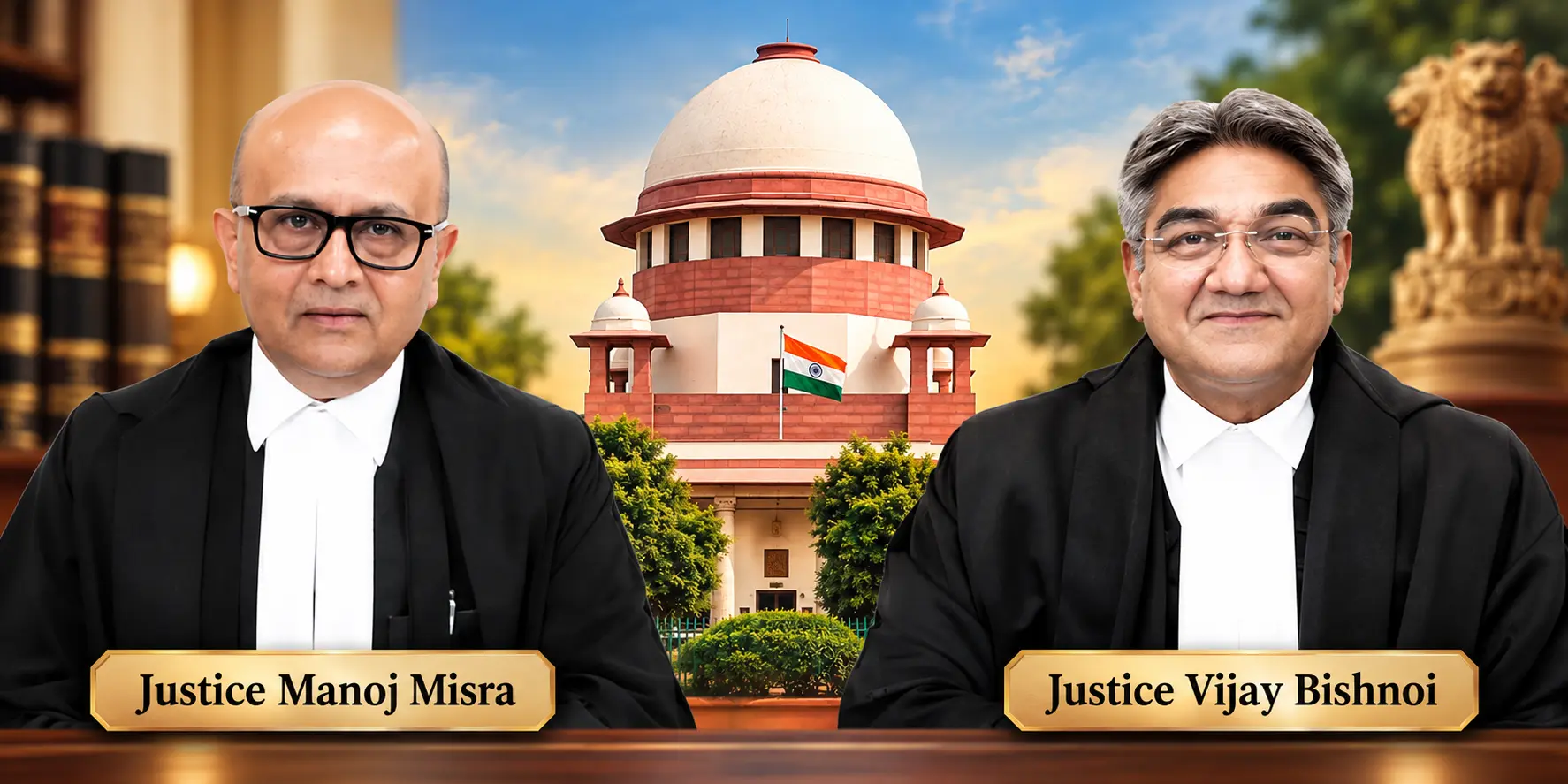
A Bench comprising Justice Manoj Misra and Justice Vijay Bishnoi held that courts should exercise considerable restraint while examining challenges to answer keys and should interfere only when an error is glaring, apparent and requires no inferential reasoning.
The case arose from the recruitment process for 3,133 posts of Village Development Officer, for which the written examination was conducted on June 5, 2016. The dispute concerned Question No. 68, which asked candidates to identify the incorrectly matched pair among historical books and their associated names.
The Commission had treated Option B — “Shahjahannama – Mohammad Tahir” as the correct answer, while the respondent candidate had selected Option C — “Humayunnama – Humayun”, arguing that Humayunnama was authored by Gulbadan Begum and not Humayun.
An expert report subsequently considered by the High Court stated that Option C would be correct if the question were approached on the basis of authorship, whereas Option B would be correct if the books were matched according to the person about whom they were written.
The Supreme Court held that the question did not specify that authorship was to be the basis for matching the pairs. In such circumstances, the Commission's subject-wise approach in selecting Option B could not be regarded as arbitrary or irrational.
The Court reiterated the principles governing judicial review of examination answer keys, observing that there is a presumption in favour of the correctness of the answer key. The burden lies on the candidate to establish that the answer is wrong, and where there is merely a doubt, the benefit should ordinarily go to the examining authority.
The Bench further noted that courts may interfere where a question is demonstrably incorrect or where two answers are clearly correct despite only one being provided for selection. However, judicial review cannot be used to reinterpret a question based on what the court believes the question ought to have asked.
Rejecting the respondent's contention, the Court observed that the candidate had read an authorship criterion into the question, even though no such criterion was specified. The Court held that this amounted to an assumptive mistake that could not be attributed to either the question or the examining authority.
The Supreme Court concluded that neither the question nor Option B suffered from a glaring or apparent error warranting judicial interference. It therefore held that the Allahabad High Court had overstepped its jurisdiction, particularly while exercising review jurisdiction.
Accordingly, the Supreme Court allowed the appeal, set aside the High Court's impugned order and dismissed the writ petition filed by the candidate.
Case: Uttar Pradesh Subordinate Service Selection Commission v. Ashok Yadav & Ors.
Case No.: Civil Appeal arising out of SLP (C) No. 12895/2026
Judgment: September 9, 2026- 2026 INSC 991
Bench: Justice Manoj Misra and Justice Vijay Bishnoi.

Representation:-
For Petitioner(s):- Mr. P S Patwalia, Sr. Adv. Mr. Talha Abdul Rahman, AOR Mr. Sudhanshu Tewari, Adv. Ms. Deveshi Chand, Adv. Mr. Faizan Ahmed, Adv. Ms. Vibha Swaminathan, Adv.
For Respondent(s):- Mr. Sudhir Kumar Saxena, Sr. Adv. Mr. Himanshu Raghave, Adv. Mr. Aviral Saxena, Adv. Mr. Harsh Srivastava, Adv. Mr. Amyra Rizavi, Adv. Mr. Umesh Dubey, AOR Mr. Abhinav Sharma, Adv. Mr. Vikas Rai, Adv. Mr. Apoorva Agarwal, A.A.G. Mr. Namit Saxena, AOR
Website designed, developed and maintained by webexy